For years, debates, satire and online ridicule have surrounded the figure of Dewanbaghi—formally known as Maulana Mahbub-e-Khoda—largely due to the religious practices, spiritual interpretations and intense devotion of his followers. Yet, behind the internet jokes and memes lies a historical account that paints a far more complex and remarkable portrait. Beneath the layers of mockery, archival documents reveal Dewanbaghi as a trained platoon commander and a courageous freedom fighter who fought on the frontline during the 1971 Liberation War.
At a time when certain religious figures such as the Pir of Sharsina issued fatwas branding Bengali women as “spoils of war”, and when leaders of Jamaat-e-Islami were allegedly involved in planning the extermination of intellectuals, a different set of devout men chose another path. Dewanbaghi and several others rejected both distortion and silence. By taking up arms, they demonstrated that patriotism was inseparable from faith, and that defending the oppressed was a religious obligation, not an optional gesture of sympathy.
A line from a recently circulated song on social media has brought Dewanbaghi back into public conversation: “In the Liberation War of ’71, Sufi Emperor Dewanbaghi Baba… He held weapons, he fought the war, he freed the soul of Mother Bengal.” The song has become a popular subject of humour online. Yet when stripped of exaggeration and sentimentality, historical records show that Dewanbaghi did, in fact, stand on the battlefield—and not as a symbolic figure, but as an active, trained and disciplined commander.
Table of Contents
An Early Awakening to Politics and Resistance
Dewanbaghi’s participation in the Liberation War was not a sudden emotional decision. His political consciousness had been shaped over several years. During the anti-Ayub uprising of 1969, he served as the president of the All-Party Students’ Struggle Council in western Brahmanbaria. After the 1970 election, when the conspiracy of the Pakistani regime became increasingly visible, he began preparing students under his leadership for the possibility of war.
By the time the catastrophic crackdown of 25 March unfolded, he was already mentally prepared for armed resistance. Initially, he formed a volunteer group to assist refugees, helping them relocate and rebuild their lives. However, he soon recognised that local weapons and goodwill alone could not withstand the advanced military machinery of the occupying forces. The transition to armed struggle quickly became unavoidable.
A Platoon Commander of Sector 3
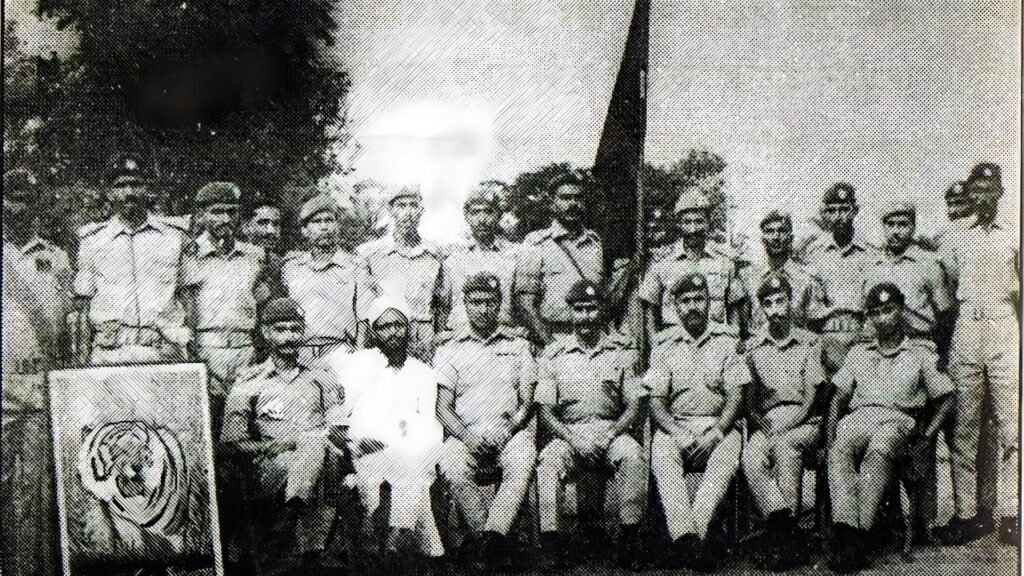
On 11 April 1971—before the formation of the Mujibnagar Government—Dewanbaghi, accompanied by 72 young fighters, joined the freedom fighters’ camp in Medda, Brahmanbaria. His arrival was both deliberate and timely. He later moved to Teliapara, the headquarters of Sector 3, and was appointed to command a platoon of 60 carefully selected freedom fighters.
His contribution is supported by formal records. Indian documentation lists his identification number in MF Volume 7, page 11, while the Bangladesh Muktijoddha Welfare Trust records him under number 34066. Accounts from contemporary military officers and wartime logs further confirm his active combat role under the S-Force of Sector 3, operating under the direct supervision of Major General K M Shafiullah.
On the Battlefield
Dewanbaghi saw his first direct combat on 26 April 1971, when he led a successful attack against Pakistani forces in Shahbazpur, Brahmanbaria. Between late April and mid-June, he participated in, and often commanded, several critical operations:
– The 11 May ambush on the Sylhet-Brahmanbaria highway
– The 12 May ambush at Baghair village of Madhabpur
– The 16 May joint ambush on the Teliapara–Chunarughat road
– The fierce battles of Madhabpur (28 April) and Mantala–Harashpur (15 June)
His tactical abilities were noted by senior commanders. Eventually, he was temporarily transferred to Tripura’s Dharmanagar under Sector 1, commanded by Major Ziaur Rahman, where he assisted in the formation of the 8th East Bengal Regiment.
Refusal of a Commission
Impressed by his leadership, General M A G Osmani and other commanders recommended Dewanbaghi for a commissioned officer’s position in the post-war army. Yet he declined the offer, stating firmly that he was fundamentally an Islamic scholar whose primary duty lay in religious teaching, not in pursuing a military career. His refusal highlighted that his involvement in the war stemmed from pure patriotism rather than personal ambition.
Spiritual Strength and a Remarkable Prophecy
Beyond the battlefield, Dewanbaghi inspired fighters with spiritual strength. At the Hejamara refugee camp on 19 November 1971—during Eid-ul-Fitr—he led the Eid congregation in an atmosphere heavy with grief and uncertainty. During his khutbah, overwhelmed by emotion, he declared: “By the grace of Almighty Allah, Bangladesh will be independent before the next Eid-ul-Azha. We shall offer the Eid prayer together at the Racecourse Maidan in Dhaka.”
Though seemingly impossible at the time, his prophecy came true. Bangladesh became independent on 16 December 1971, and he indeed led the first Eid-ul-Azha prayer of independent Bangladesh on 26 January 1972 at the Racecourse Maidan.
Legacy Beyond Controversy
Dewanbaghi’s spiritual philosophy, religious influence and his followers’ devotion may continue to be debated in modern Bangladesh. Criticism is natural in a democratic society. But his identity as a freedom fighter stands beyond controversy. In 1971, he was not a Sufi master or a spiritual guide; he was a Bengali patriot carrying a Sten gun on his shoulder.
His life forces us to reconsider the narrow assumptions about Sufism as merely ritual and tranquillity. Dewanbaghi demonstrated that resisting injustice—and, when necessary, doing so with arms—is also an expression of faith. Recognising this chapter of his story is not about endorsing or rejecting any ideology, but about honouring the historical truth beyond jokes and internet memes.