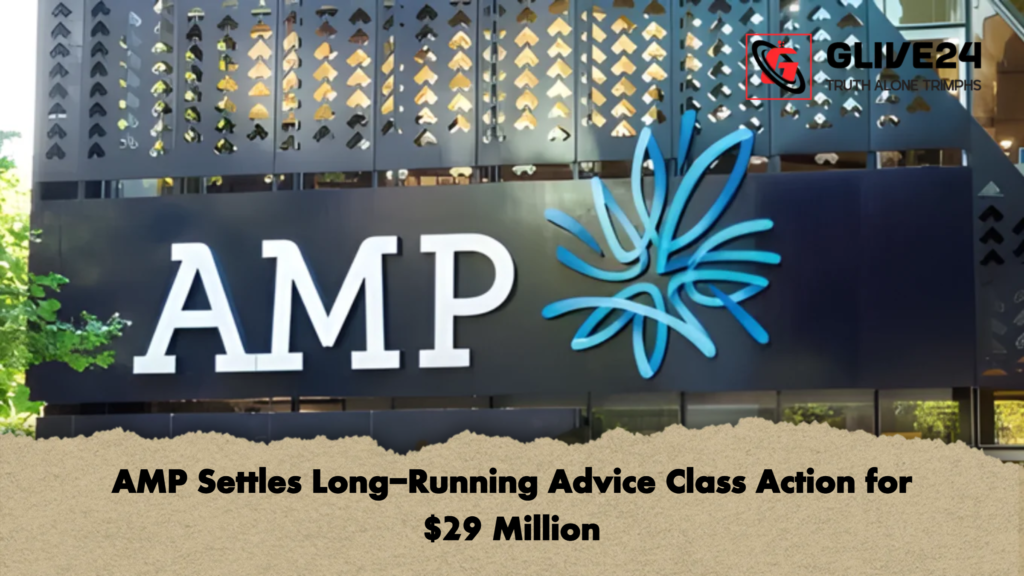
AMP has agreed to pay $29 million to settle a long-running class action concerning the conduct of its aligned financial advisers in the promotion of in-house life insurance products. The settlement represents another step in the company’s efforts to resolve legacy issues linked to its former advice and insurance businesses. The agreement, reached on an in-principle basis, is still subject to the execution of a formal deed of settlement and approval from the Federal Court of Australia. AMP has maintained that the settlement does not amount to an admission of liability.
The class action was initiated in 2020 in the Federal Court of Victoria. It alleged that advisers operating under AMP Financial Planning, Charter Financial Planning and Hillross Financial Services breached fiduciary and statutory duties owed to tens of thousands of clients. According to the claim, advisers directed customers towards AMP-linked life insurance policies on terms that were less favourable than comparable alternatives. Resolution Life Australasia, previously known as AMP Life, was also named in the proceedings. The allegations focused on the pricing of life insurance cover and the payment of commissions between July 2014 and February 2021.
It was asserted that authorised representatives failed to act in the best interests of their clients by promoting AMP-branded insurance products instead of seeking cheaper or equivalent options available elsewhere in the market. The claim further alleged that AMP did not establish adequate systems, oversight structures or supervisory mechanisms to prevent such conduct. Compensation was sought for excess premiums, embedded commissions and ongoing service fees that many clients were said to have paid without receiving corresponding advice services.
The class action reflected broader scrutiny of vertically integrated advice models, remuneration structures and potential in-house product bias during the relevant period. Many of the issues raised aligned with the findings of the Royal Commission into Misconduct in the Banking, Superannuation and Financial Services Industry, which identified systemic conflicts of interest in product distribution and advice practices across the Australian financial sector.
Law firm Shine alleged that AMP advisers prioritised the sale of AMP-linked life insurance over achieving optimal outcomes for clients, sometimes resulting in inflated premium costs. The claim further contended that clients were not informed that substantially equivalent or more cost-effective insurance products could be obtained from alternative providers. The group of affected clients was estimated at around 100,000, encompassing customers of AMP Financial Planning, Charter and Hillross licensees, along with policyholders of life insurance products issued by the former AMP Life business.
The $29 million settlement is intended to address alleged financial losses incurred by group members between July 2014 and February 2021. These losses were said to include higher-than-necessary premiums, commissions embedded within AMP-linked life insurance products and ongoing service fees charged in cases where no such service was provided. The distribution of settlement funds will depend on the methodology approved by the Federal Court, which will determine how individual losses are assessed and how much of the settlement is allocated towards legal and administrative expenses. Members of the claim group will not be required to prove misconduct in individual advice files, as the settlement will be assessed on a class-wide basis.
For the wider financial advice industry, the case underscores the legal, financial and reputational consequences that can arise when systemic advice failures remain unaddressed. The proceedings highlighted the importance of strong supervisory frameworks, effective conflict-management systems and transparent remuneration arrangements. The inclusion of ongoing service fees in the claim also echoes regulatory concerns surrounding fees-for-no-service and the need for documented evidence of services delivered.
The settlement comes after a larger class action earlier in the year concerning alleged excessive fees in AMP’s superannuation business. In that matter, AMP agreed to pay $120 million following claims that trustees systematically overcharged members of certain AMP superannuation funds between 2008 and 2020. As with the present settlement, AMP did not admit liability and indicated that insurance would cover part of the cost.
AMP has undergone substantial restructuring since the period covered by the class action, including selling its life insurance operations and its employed financial advice business. The company has repositioned itself as a more streamlined organisation centred on wealth management, banking and superannuation. Chief executive Alexis George said that resolving another legacy legal issue would allow the company to focus on its priorities and on delivering for customers and members.
For the broader industry, the AMP settlement stands as a further reminder that historic advice models, commission structures and vertically integrated product frameworks can continue to generate significant legal and financial consequences long after such practices have been altered or abandoned.