
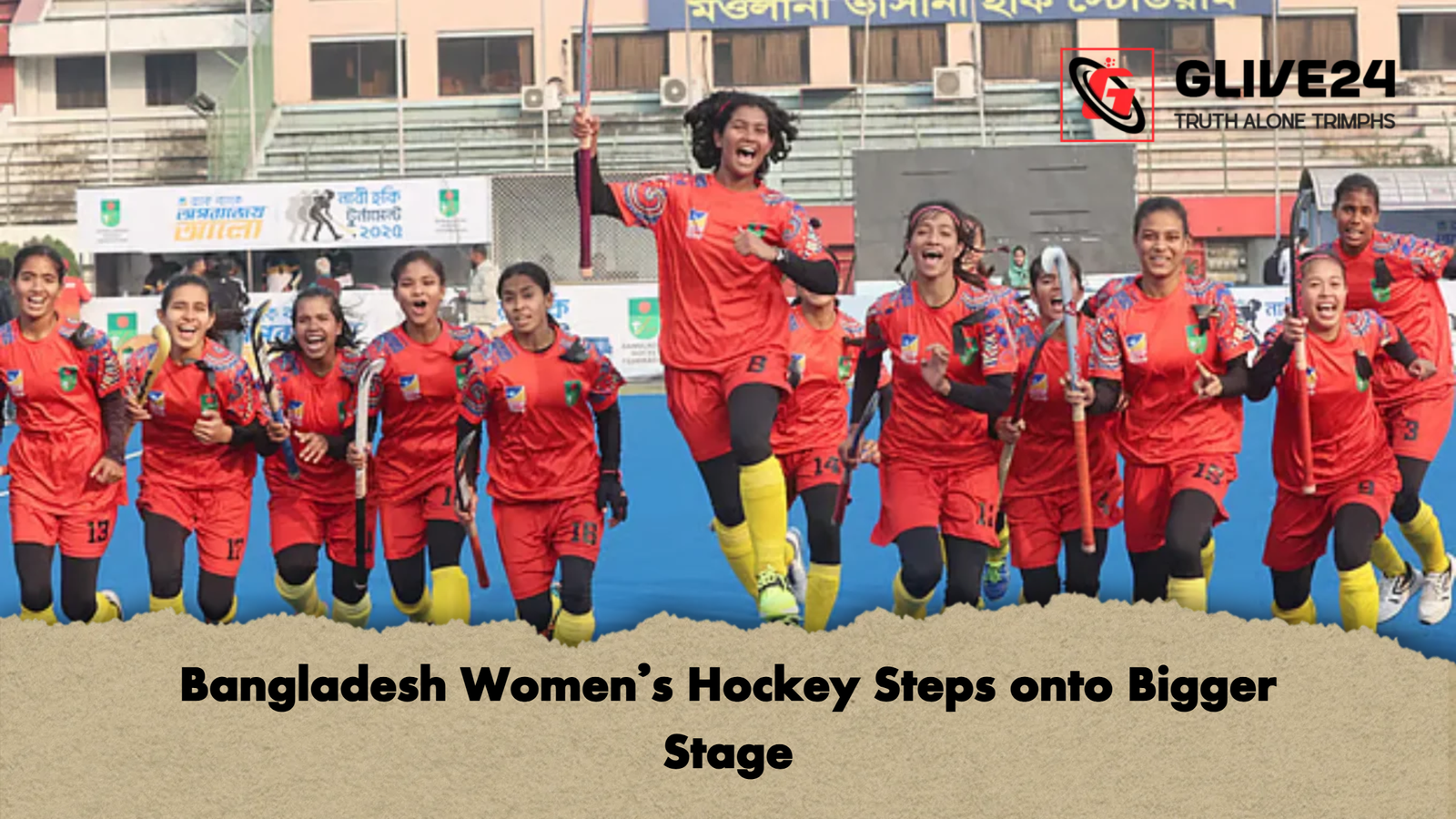
For several days, the Maulana Bhasani Hockey Stadium echoed with the rhythmic tap of stick against ball, transforming the venue into a lively theatre of hope and ambition. Teenage girls and young women sprinted across the turf, chasing the ball with determination and bright-eyed enthusiasm. Long dominated by cricket and football, Bangladesh’s sporting landscape is now witnessing the confident rise of women’s hockey—a discipline steadily breaking free from its once-limited domestic confines and stepping onto a broader national stage.
That progress was vividly showcased at the recently concluded BRAC Bank “Aparajeyo Alo” Women’s Hockey Tournament, the largest domestic women’s hockey competition ever held in the country. Organised by dividing 18 districts into four regional zones, the tournament brought together 352 players, many of whom had never held a hockey stick or played on artificial turf before this event. For several participants, it was also their first visit to Dhaka and their first opportunity to perform at the historic Maulana Bhasani Stadium.
Tournament at a Glance :
| Category | Details |
|---|---|
| Tournament Name | BRAC Bank “Aparajeyo Alo” Women’s Hockey |
| Participating Districts | 18 |
| Total Players | 352 |
| Champion | Zone–5 (BKSP) |
| Runners-up | Zone–4 (Mymensingh region) |
| Final Score | BKSP 8–0 Zone–4 |
| Top Scorer | Arpita Pal (22 goals) |
| Player of the Tournament | Irene Akter |
The final saw Zone–5, represented by the Bangladesh Krira Shikkha Protishtan (BKSP), overpower Zone–4 by an emphatic 8–0 margin, underlining BKSP’s dominance as the country’s sole full-fledged hockey academy. Forward Kona Akter starred in the final, scoring four goals single-handedly. Across five matches, BKSP amassed an astonishing 65 goals, conceding none—an average of 13 goals per game.
Such one-sided supremacy, however, also exposes the structural imbalance within women’s hockey. While BKSP players enjoy year-round access to turf pitches, professional coaching, and sports nutrition, district-level players often train sporadically on grass fields with minimal resources. Many district teams are assembled hastily whenever tournaments arise, reflecting the absence of sustained grassroots programmes.
Yet, the tournament’s broader impact is undeniably positive. Individual brilliance shone through, with Mahua of Rajshahi winning Best Goalkeeper and Aparupa Akter Jannatul emerging as a promising new talent. The Player of the Tournament award went to Irene Akter, a secondary school examination candidate who previously excelled at the 2023 Five-a-Side World Cup Qualifiers in Oman. Once a footballer, Irene credits her transition to hockey to a teacher’s encouragement and now speaks passionately about shaping the future of the women’s game.
Captain Arpita Pal, also leader of the national Under-21 side, claimed the Golden Stick with 22 goals, adding to her impressive international scoring record. While attributing her success to disciplined training and expert coaching, she voiced concern over the lack of strong opposition, urging the federation to create more competitive platforms for women.
BKSP coaches Jahid Hossain and Moududur Rahman believe such tournaments can become a vital foundation for forming a full-fledged national women’s team. Although Bangladesh currently fields age-group teams, a senior national side may be assembled ahead of the Asian Hockey Federation Cup next March.
At the prize-giving ceremony, BRAC Bank Managing Director and CEO Refat Ullah Khan reaffirmed the bank’s commitment to expanding the tournament in the coming years—an assurance that suggests Bangladesh women’s hockey is no longer merely emerging, but firmly on the rise.