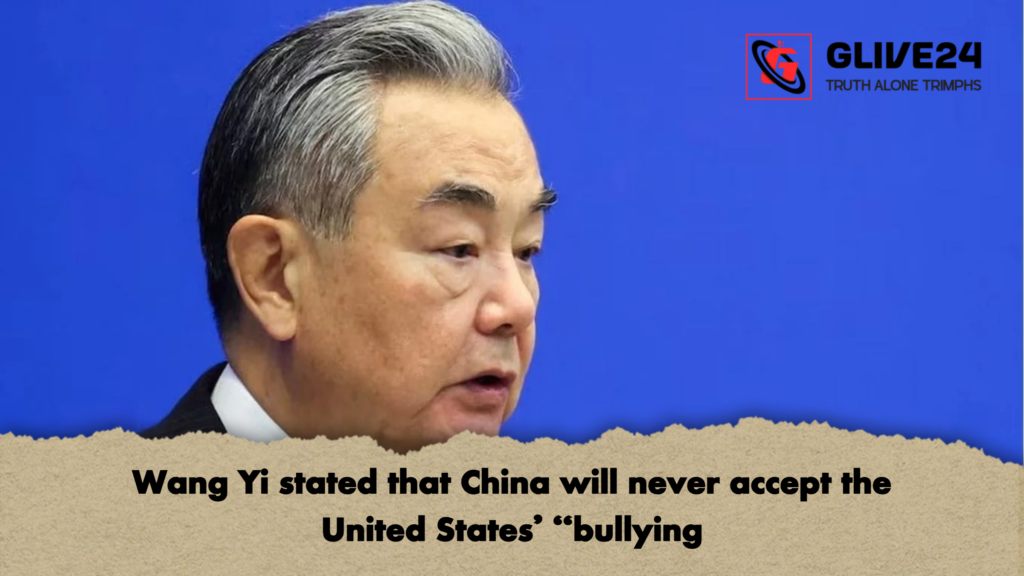
China will not accept any country assuming the role of the world’s enforcer or judge, Chinese Foreign Minister Wang Yi declared, following the arrest of Venezuelan President Nicolás Maduro.
Speaking during a meeting with Pakistan’s Foreign Minister Ishaq Dar in Beijing on Sunday, Wang alluded to what he described as a “sudden incident” in Venezuela, without explicitly naming the United States. He emphasised that Beijing does not subscribe to the idea that any nation can act as the world’s policeman or assume the authority to judge other states.
“Under international law, the sovereignty and security of all nations must be fully respected and protected,” Wang stated, underscoring China’s long-standing position on state sovereignty.
The remarks came in the wake of global controversy after photographs of the 63-year-old Maduro, blindfolded and handcuffed, circulated widely, sparking intense discussion in Venezuela and internationally. Maduro is currently being held in a detention centre in New York and is scheduled to appear in court on Monday on drug-related charges.
China has been steadily cultivating its image as a major diplomatic power, seeking to position itself as a constructive player in global crises. Its role in brokering the unexpected 2023 reconciliation between Saudi Arabia and Iran is often cited as the clearest demonstration of this ambition. Analysts note that China’s ability to engage the United States on an equal footing in trade negotiations has further strengthened its diplomatic confidence.
Analysts’ Perspective:
| Analyst | Key Observation | Implication |
|---|---|---|
| Li Wei, Beijing University | China asserts sovereignty norms | Reinforces China’s opposition to unilateral interventions |
| Maria Gonzalez, Latin America Institute | Maduro’s arrest controversial | Opportunity for China to position as a counterbalance |
| James Carter, Global Policy Forum | US global role questioned | Highlights tensions in international order |
Wang Yi’s comments mark China’s first official reaction to Maduro’s arrest, signalling Beijing’s intent to maintain a consistent stance on sovereignty while reinforcing its role as a prominent global diplomatic actor. Observers suggest that China’s rhetoric reflects a broader strategy to counter perceived US unilateralism, presenting Beijing as a stabilising force amid international uncertainties.
With rising tensions in Latin America and persistent global geopolitical rivalries, China’s reaffirmation of non-interventionist principles is likely to be closely monitored by both Washington and other regional actors.