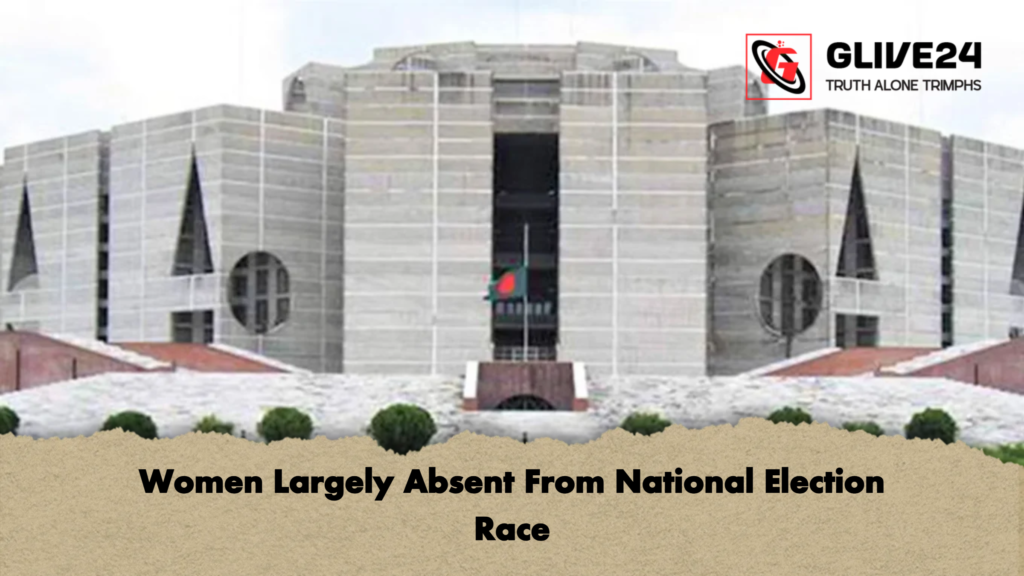
A stark gender imbalance has emerged ahead of the forthcoming national election scheduled for 12 February, with official figures revealing that a majority of political parties have fielded no female candidates at all. According to data released by the Election Commission, 30 of the 51 parties contesting the election have not nominated a single woman, underscoring the persistent marginalisation of women within the country’s electoral politics.
In total, 2,568 candidates are competing in the election, yet only 109 of them are women—just 4.24 per cent of the overall candidate pool. Of these, 72 women have been nominated by political parties, while the remaining candidates are standing as independents. This is in sharp contrast to the demographic reality of the country, where women constitute nearly half of the population.
Both major and minor parties have overwhelmingly relied on male candidates. No party, including the Bangladesh Nationalist Party (BNP), has nominated more than ten women, reinforcing claims by women’s rights advocates that gender inclusion in politics remains largely symbolic rather than substantive.
Election Commission data show that several prominent parties have submitted hundreds of nominations without including a single woman. Jamaat-e-Islami, for instance, filed 276 nominations, none of which were female, despite public assertions by party leaders that women make up at least 40 per cent of its leadership. Islami Andolan Bangladesh followed closely with 268 all-male nominations. A similar pattern is evident across a wide range of parties, from religious and conservative groups to centrist and smaller political organisations.
Selected Parties With No Female Candidates :
| Party | Total Candidates | Female Candidates |
|---|---|---|
| Jamaat-e-Islami | 276 | 0 |
| Islami Andolan Bangladesh | 268 | 0 |
| Bangladesh Khelafat Majlish | 94 | 0 |
| Liberal Democratic Party (LDP) | 24 | 0 |
| Jatiya Party (JP) | 13 | 0 |
Former Election Commission additional secretary and election reform expert Jesmin Tuli described the electoral process as deeply patriarchal. She argued that elections remain “far from women-friendly”, noting that large parties nominate very few women, a trend subsequently mirrored by smaller parties. Financial constraints, entrenched social attitudes, and the absence of muscle power traditionally associated with electoral politics further discourage women from contesting.
Tuli also observed that most women who do receive nominations tend to come from established political families, while grassroots activists rarely progress to candidacy. “Women are visible during protests and movements, but they are sidelined when elections arrive,” she said, adding that parties have failed to build women’s confidence or provide meaningful organisational and financial support.
Even among the 21 parties that have nominated women, representation remains limited. The Jatiya Party (GM Quader) and the recently registered Basad (Marxist) have nominated the highest number, with nine women each. BNP, despite being led by a woman for over four decades, has nominated only ten women from a pool of 328 aspirants.
Legal provisions further highlight the gap between policy and practice. The Representation of the People Order of 1972 mandates that at least 33 per cent of party committee positions be reserved for women. However, most parties have failed to comply, prompting the Election Commission in 2021 to extend the deadline to 2030.
Munira Khan, president of the Fair Election Monitoring Alliance, termed the situation “deeply disappointing”, pointing out that women play a vital role in the economy yet remain virtually absent from parliamentary nominations. Echoing this view, Women’s Reform Commission chief Shirin Haque said the figures were troubling but unsurprising, reflecting a long-standing patriarchal political culture.
To address this imbalance, the commission has proposed a 50–50 representation model, under which each constituency would have both a general seat and a women’s seat. If implemented, this would expand parliament to 600 members, with women elected through direct voting—an ambitious proposal aimed at reshaping the future of political representation.