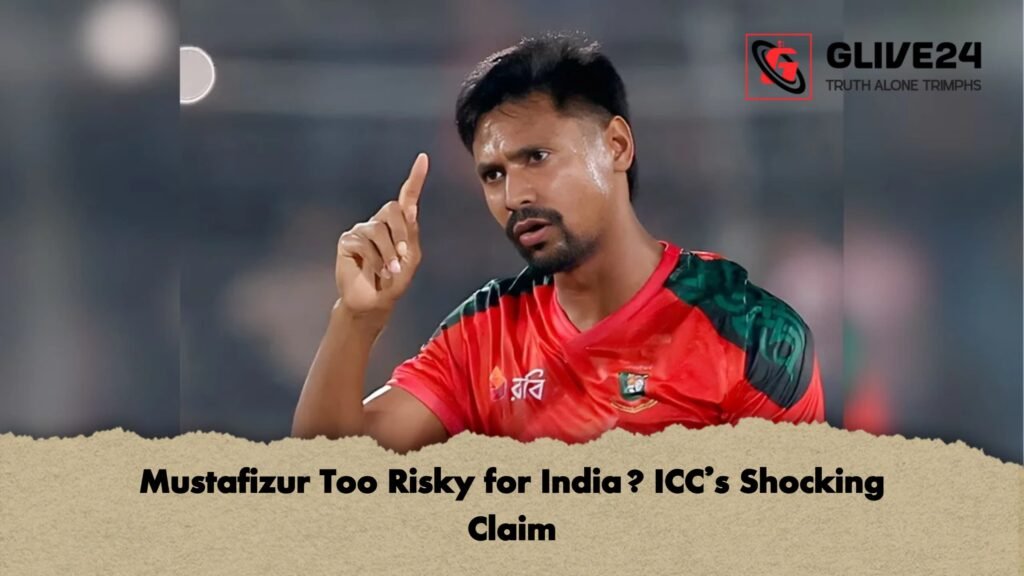
The upcoming T20 World Cup has been plunged into a diplomatic crisis following an extraordinary security assessment issued by the International Cricket Council (ICC). In a formal communiqué sent to the Bangladesh Cricket Board (BCB), the ICC’s security department warned that the presence of star pacer Mustafizur Rahman in the squad would significantly escalate the “security risk profile” for the Bangladesh national team while on Indian soil.
Table of Contents
The ICC’s Three Pillars of Risk
During a press conference at the Bangladesh Football Federation (BFF) headquarters, the Youth and Sports Adviser, Professor Asif Nazrul, disclosed the specific threats outlined by the governing body. The ICC reportedly identified three primary factors that would make a safe tour of India nearly impossible for the Bangladeshi contingent:
-
The ‘Mustafizur Factor’: The inclusion of the left-arm seamer is cited as a primary trigger for security concerns.
-
National Identity: A warning that supporters wearing the Bangladesh national jersey would face heightened risks of targeted harassment.
-
Political Timing: The proximity of the upcoming Bangladesh national elections is seen as a catalyst for potential unrest or targeting of the team abroad.
Professor Nazrul condemned these findings as “absurd” and “irrational,” suggesting that no sovereign nation should be asked to compromise its sporting integrity or its citizens’ identity to appease communal tensions in a host country.
Comparative Security Concerns: ICC vs. Bangladesh Govt
| ICC Security Assertion | Professor Asif Nazrul’s Rebuttal |
| Player Risk: Mustafizur’s presence invites hostility. | “Bizarre to ask a nation to omit its best bowler.” |
| Supporter Safety: National jerseys increase vulnerability. | “Unrealistic to expect fans to hide their identity.” |
| Political Timing: Election cycles heighten team risks. | “Elections and sports must remain separate.” |
| Host Viability: India remains the primary host. | “India is no longer a safe environment for us.” |
Allegations of Institutional Bias
The Adviser launched a scathing critique of the current social and political atmosphere in India, describing it as “extremist” and “anti-Bangladesh.” He argued that the ICC’s letter effectively confirms that the Board of Control for Cricket in India (BCCI) is unable or unwilling to protect visiting athletes from communal forces.
“Cricket should not be subject to anyone’s monopoly,” Nazrul asserted. “If the ICC is truly a global body and not merely acting at the beck and call of India, it must relocate Bangladesh’s matches to a neutral venue such as Sri Lanka, Pakistan, or the UAE.”
A Stand Against “Sporting Monopoly”
Professor Nazrul reaffirmed that Bangladesh would not “surrender” its dignity or its players’ safety for the sake of the tournament. He noted that if a national authority like the BCCI admits—even indirectly—that a specific player cannot be protected, the ICC has an obligation to move the event. The Adviser concluded by stating that the environment in India has become too toxic for international cricket to continue as planned.
The BCB is now expected to enter high-level negotiations with the ICC to seek a neutral venue, potentially setting a precedent for how security risks are managed in the modern game.