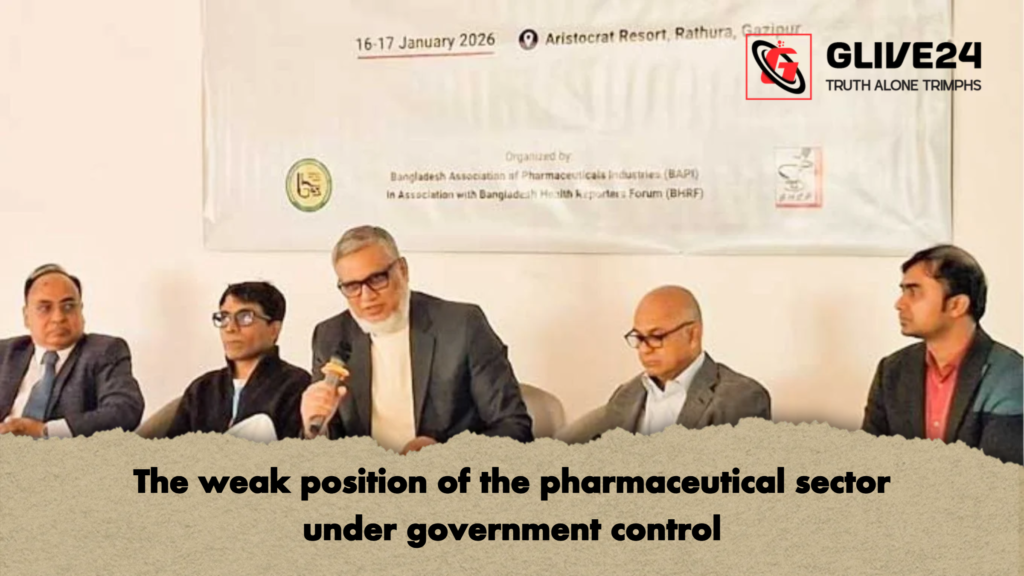
Dhaka: Bangladesh’s pharmaceutical sector is confronting one of its most severe crises in decades, with experts warning that the industry’s long-term sustainability—and the nation’s future healthcare security—is under serious threat. According to industry insiders, aside from a handful of large companies, almost 60% of pharmaceutical manufacturers are struggling to survive. Nearly 40% of these companies have either already shut down or are on the brink of closure.
These sobering figures were revealed at a workshop titled “Bangladesh Pharma Industry: Present Challenges and Future Prospects”, organised by the Bangladesh Association of Pharmaceutical Industries (BAPI) on Saturday at a resort in Gazipur.
BAPI President Abdul Muktadir emphasised the gravity of the situation, stating, “The strength of our pharmaceutical industry has traditionally rested on small and medium-sized enterprises. That foundation is now crumbling. Out of the 100 listed companies, only 15–20 are in relatively stable condition, while the rest are in a precarious state. The companies ranked between 50 and 100 are particularly alarming.”
He highlighted the pricing challenges facing manufacturers: “Many companies have been selling medicines at the same price for 30–40 years. The government has not permitted any significant price increase, even in 2025–26, based on 1990s pricing. Yet production costs, raw material prices on the international market, labour expenses, and quality-control costs have multiplied many times over. Under such conditions, survival is almost impossible.”
BAPI Secretary General Dr Md Zakir Hossain added, “Expanding the essential medicines list and fixing prices without consulting the industry is not a pragmatic approach. These decisions are not grounded in reality and hinder sustainable growth.”
Industry leaders warn that if small and medium-sized companies disappear, the consequences will extend beyond the sector itself. Should larger firms shift entirely toward export markets, the domestic supply of medicines, prices, and quality could become highly uncertain.
Current Overview of Bangladesh’s Pharmaceutical Industry
| Company Type | Approx. Number | Current Status |
|---|---|---|
| Large Companies | 10–15 | Stable, sustainable |
| Medium Companies | 30–35 | In crisis, unstable |
| Small Companies | 40–45 | Closing or on the verge of closure |
Reflecting on policy impacts, Muktadir said, “The 1994 pharmaceutical policy laid the foundation for the industry’s golden era, achieving self-sufficiency and preparing companies for international competition. However, since 2016, excessive regulation, discriminatory policies, and impractical decisions have weakened the sector. The Venezuelan example demonstrates how over-regulation can devastate both industry and economy.”
The workshop was attended by BAPI Organisational Secretary Md Mizanur Rahman, Treasurer Halimuzzaman, and leaders from the Bangladesh Health Reporters Forum, including President Protik Ijaz and General Secretary Mujahid Shuvo. Participants reiterated the urgent need for policy reforms to safeguard the industry’s future.