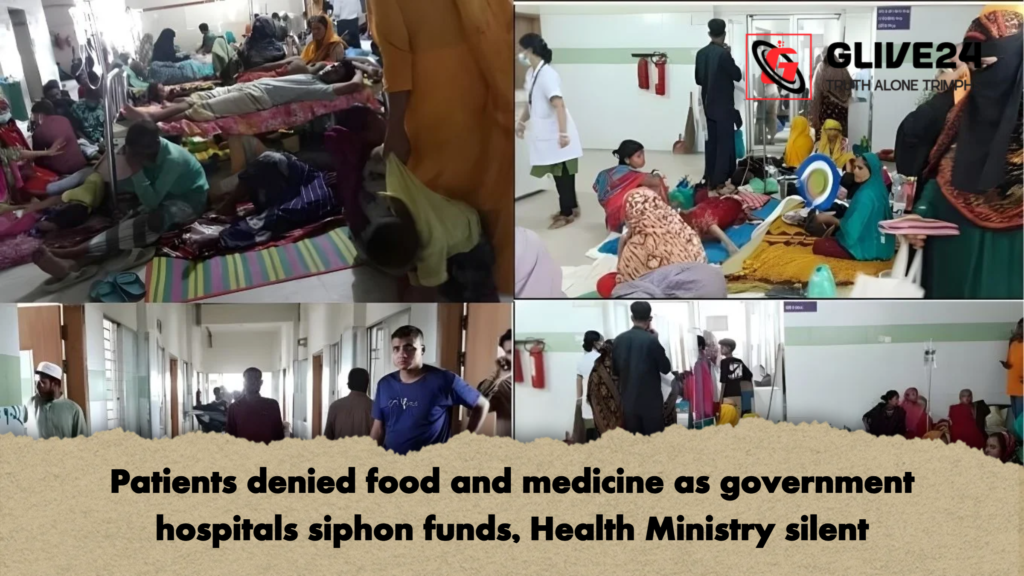
Government hospitals in the country have long been regarded as the last refuge for the poor and marginalised. Yet, beneath the official pledge to provide care, alarming reports of mismanagement, corruption, and financial embezzlement are increasingly coming to light. Essential services intended for patients—ranging from meals to medicines and medical supplies—are frequently reduced or, in some cases, not provided at all. Despite awareness within the Ministry of Health, effective measures to address these issues appear to be largely absent, leaving ordinary patients deprived of even the most basic healthcare.
Patient Hardship
Accounts from patients and their families paint a distressing picture. One family recounted that hospital-provided meals were withheld for several days, forcing them to procure food externally. “We are already struggling with medical expenses, and yet we have to buy food from outside. It is utterly inhumane,” they lamented.
According to official regulations, patients are entitled to a daily allocation of nutritious and sufficient food. In practice, however, the quantity is often cut and the quality compromised, exacerbating patients’ health conditions rather than improving them.
Shortages of Medicine and Medical Supplies
Although essential medicines and medical materials are formally available within hospitals, patients frequently do not receive them. Doctors and hospital officials admit that patients are often compelled to purchase medications from outside pharmacies, placing additional financial burdens on families, particularly the poor and vulnerable.
Procurement Irregularities
Hospital procurement processes have become a focal point for corruption. Practices such as inflated billing, provision of substandard goods, and fictitious purchases have facilitated large-scale embezzlement. Revenue generated from various hospital departments is often misappropriated instead of being deposited into the state treasury.
| Type of Irregularity | Description |
|---|---|
| Food Allocation | Reduced quantities, poor quality, misappropriation of remaining funds |
| Medicines & Medical Supplies | Not provided to patients; families forced to purchase externally |
| Procurement & Expenditure | Inflated bills, substandard goods, fictitious paperwork leading to losses |
| Revenue Collection | Funds diverted from official state accounts |
Silence from the Ministry
Perhaps most troubling is the Ministry of Health’s apparent inaction. Despite being aware of these irregularities, little to no punitive action has been taken against those responsible. In some cases, officials’ silence—or even tacit collusion—has allowed the malpractice to persist.
A Looming Public Health Crisis
Observers warn that corruption in public hospitals is not merely a financial issue; it is a direct threat to public health. When the poor and needy turn to government hospitals for hope and receive inadequate care, the consequences are both physical and psychological.
A senior official from the Directorate General of Health Services, speaking anonymously, stated: “These irregularities have been ongoing for years. Without urgent corrective action, they could escalate into a major health crisis.”