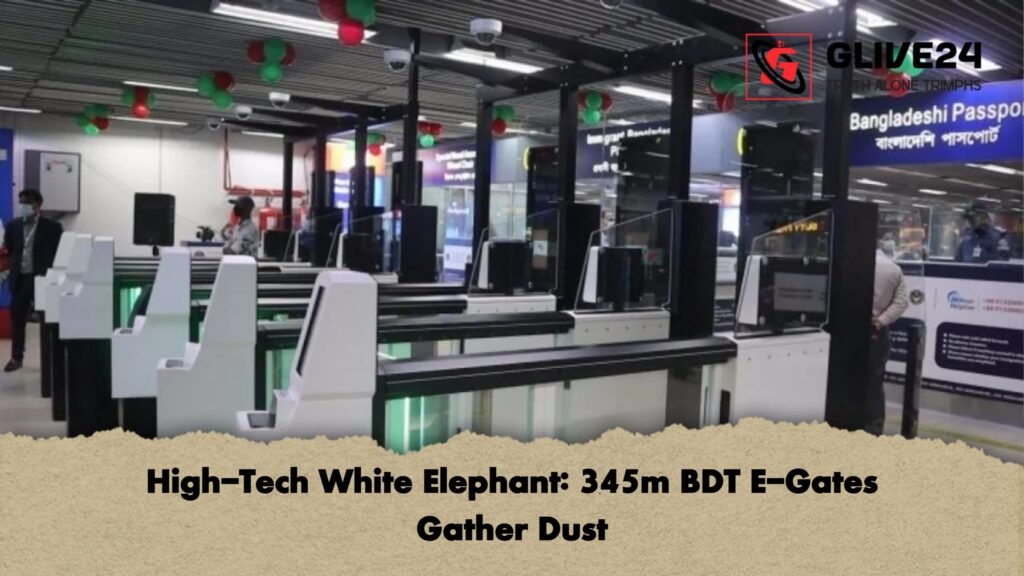
Despite a substantial national investment of 34.56 crore BDT, the 44 electronic gates (e-gates) installed to streamline travel for e-passport holders at Bangladesh’s international airports and land ports have been rendered effectively useless. Intended to usher in a new era of “Smart Border” management, the system has instead become a source of passenger harassment and administrative embarrassment.
Table of Contents
The 18-Second Myth
The e-gates, installed by the German firm Veridos GmbH, were launched with the bold promise of processing travellers in a mere 18 seconds. However, a recent inspection of the immigration halls at Hazrat Shahjalal International Airport (HSIA) in Dhaka reveals a starkly different scene: the gates are deactivated, and passengers are being funnelled into the same congested manual lanes they were promised to avoid.
“I arrived three hours early because I heard the e-gates were down,” said Rajib Ahmed, a holidaymaker travelling to Thailand. “We were told e-passports would make this seamless, but we are back to square one, standing in line while officials manually check every single stamp.”
Infrastructure Overview: The Silent Gates
| Strategic Location | Number of Gates | Operational Status (Jan 2026) |
| HSIA (Dhaka) | 26 | Deactivated (Departures) |
| Shah Amanat (Chattogram) | 6 | Inactive |
| Osmani (Sylhet) | 6 | Inactive |
| Benapole Land Port | 4 | Limited Functionality |
| Banglabandha Land Port | 2 | Inactive |
| Total Project Expenditure | 9,038 crore BDT | (Initial Budget: 4,635 crore BDT) |
A Failure of Integration
The primary reason for the system’s failure is a fundamental lack of software synchronisation. While the e-gates can biometrically verify a passport, they lack the interface to check visas, flight details, or destination requirements.
Immigration police, speaking on condition of anonymity, revealed that even when the gates are “open,” passengers still have to visit a manual desk for visa verification. “The e-gate doesn’t know where the passenger is going or if their visa is valid. If we let them through the gate, they still have to come to us. It creates a double-handling process that makes the crowds worse, not better,” one officer explained.
Escalating Costs and Accountability
The e-passport and automated border control project has been mired in controversy regarding its budget. What was originally a 4,635 crore BDT initiative mysteriously doubled to a staggering 9,038 crore BDT.
Group Captain S.M. Ragib Samad, Executive Director of HSIA, noted that the e-gates remain shut primarily due to directives from the Ministry of Home Affairs. Aviation expert Kazi Wahidul Alam expressed dismay at the waste: “This is public money. To invest such a sum and then find the system is ‘meaningless’ because of a lack of planning is unacceptable. If these gates stay closed, the hardware will simply rot.”
As of late January 2026, the Ministry of Home Affairs has declined to provide a timeline for when—or if—the system will be fully integrated. For the thousands of e-passport holders passing through Dhaka daily, the 345 million BDT gates remain nothing more than expensive obstacles on their way to the boarding gate.