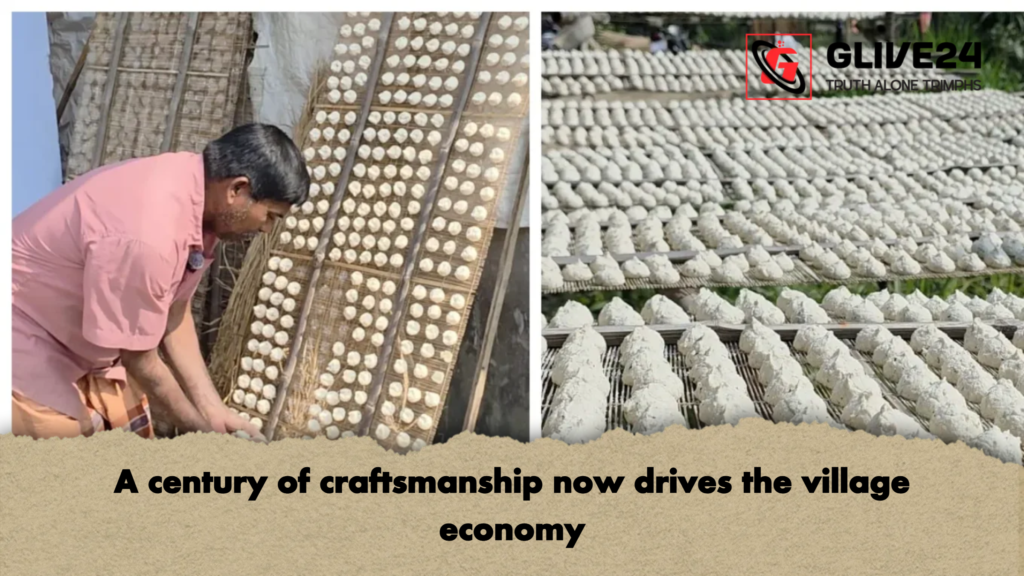
Before the first light of dawn spreads across Puthia, in the Shilmaria Union of Rajshahi, the village of Kashiapukur comes alive. Alongside the paved roads, mats laid out the previous night are lined with neatly arranged balls of Kalai dal, slowly drying under the early morning sun. Within these humble food items lies a hundred-year-old tradition and the livelihoods of several hundred villagers.
For generations, Kalai ball making has been the primary occupation of nearly 200 families in Kashiapukur. This centuries-old craft has been passed down from father to son and mother to daughter. Today, families earn between 30,000 and 70,000 Bangladeshi Taka per month from this trade, bringing much-needed financial stability and revitalising local economic activity.
During the winter and dry seasons, the village transforms into a hive of continuous labour. Preparation begins at midnight, when mung beans, pumpkin, and parched rice are soaked. By 3 a.m., the beans are washed in cold water and ground into a paste suitable for shaping into balls. By 6 a.m., men and women assemble rows of Kalai balls on mats. After three to four days of sun drying, the balls are ready for market.
The demand for these Kalai balls now extends far beyond Rajshahi. They are sold across Bangladesh and exported to India via the Hili border in Dinajpur. This expansion has made the business more profitable for farmers, enabling families to fund education, renovate homes, or invest in new livelihoods.
The history of Kalai balls stretches back to the British colonial period. Locally, it is said that Queen Bhuban Mohini Devi of Puthia favoured this dish, which has since become an enduring part of Bengali culinary culture.
Kalai Ball Production and Earnings (Per Family)
| Activity | Details | Monthly Earnings (BDT) |
|---|---|---|
| Daily production | ~2 maunds of Kalai | 50,000–60,000 |
| Wholesale price per kg | 160–350 | – |
| Labour (per worker) | 70 BDT/day | – |
Local artisan Mohammad Nurul Islam explains, “This has been our family trade for generations. I’ve heard my elders say that even the queen enjoyed our Kalai balls.” Farmer Sekandar Ali adds, “We produce about two maunds daily and sell them wholesale in Rajshahi markets. After expenses, a family earns around 50,000–60,000 Taka a month.”
Female artisan Nazma Khatun says, “Work starts before sunrise. Four to five women assist daily, each earning 70 Taka. This is my main occupation, and it sustains my family.”
Mita Sarkar, Additional Deputy Director (Crops) at the Rajshahi Department of Agricultural Extension, notes, “Kalai balls are deeply linked to Bengali culture and cuisine, offering farmers a significant source of supplementary income. We provide incentives for mung bean cultivation, the primary ingredient, to encourage production. With structured support and training, this craft could become a robust rural industry.”
Beyond Kashiapukur, the neighbouring village of Ardail in Ujankhalshi Union continues this ancestral occupation. For the villagers, Kalai balls are more than food—they represent identity, pride in their labour, and a vital engine of rural economic activity.