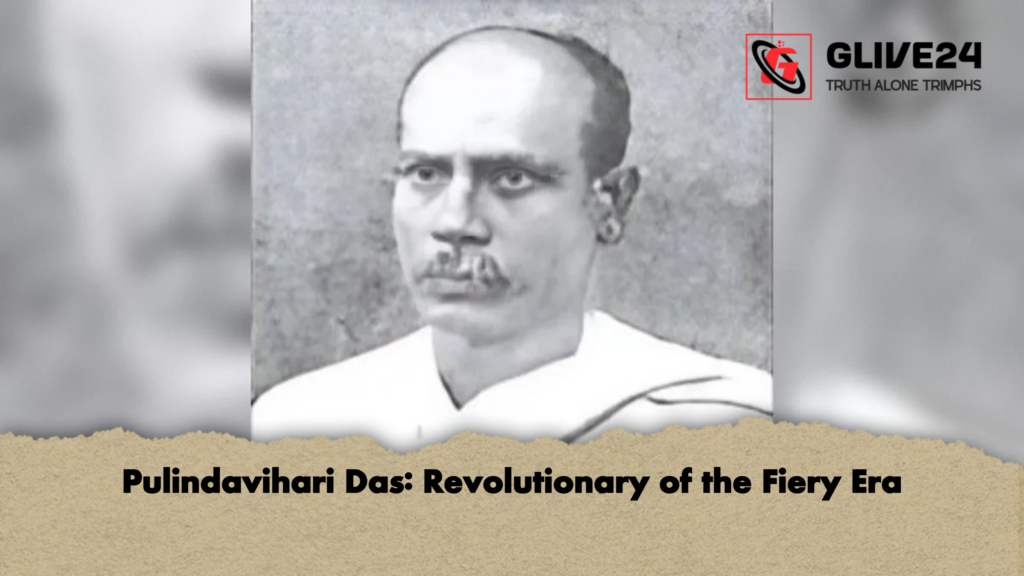
Pulindavihari Das stands as one of the foremost torchbearers of Bengal’s revolutionary movement against British colonial rule. Among the sons of the Fiery Era—those who risked life and limb to weave the dream of independence—he was not merely a revolutionary but also an organiser, a trainer, a symbol of courage, and the founder of the Dhaka Anushilan Samiti.
Born on 28 January 1877 in the village of Lonsing, Naria, in Shariatpur district, Pulindavihari hailed from a well-educated, affluent middle-class family. Though landowners by inheritance, the male members of his family were primarily employed in legal and administrative services. His father, Nabakumar Das, was a lawyer at the Sub-Divisional Court of Madaripur, while other relatives served as deputy magistrates and munsifs, reflecting a deep familial association with law and governance.
In 1894, Pulindavihari excelled in the Entrance Examination from Faridpur District School and enrolled at Dhaka College. Even as a student, his intellect and diligence were evident; he also served as a practical instructor in the college laboratory, showcasing early leadership qualities.
From childhood, he was passionate about physical training and martial arts, excelling as a lathial (stick-fighter). Inspired by Sarala Devi’s akhra in Kolkata, he established his own training centre in Tikatuli, Dhaka, in 1903. By 1905, under the tutelage of the celebrated lathial Murtaza, he mastered both stick-fighting and other martial techniques, which later became the foundation for revolutionary training.
A historical turning point came in September 1906 when the visits of Bipin Chandra Pal and Pramatha Nath Mitra to East Bengal and Assam inspired him to take a decisive stand against colonial rule. Responding to Mitra’s call, Pulindavihari pledged to break the chains of foreign domination. In October 1906, he founded the Dhaka Anushilan Samiti with 80 young men—a nucleus that quickly became a powerhouse of revolutionary activity. Through his exceptional organisational acumen, the Samiti expanded to over 500 branches across Bengal and Assam.
He also established the National School in Dhaka, ostensibly an educational institution but in reality a training ground for armed revolutionaries. Trainees progressed from stick-fighting and wooden swords to knives, and ultimately to pistols and revolvers, preparing for the final struggle for independence.
Pulindavihari played a key role in audacious plans against British officials, including the attempted assassination of Dhaka’s District Magistrate Basil Copleston Allen on 23 December 1907 at Goalanda Station, where Allen narrowly escaped with his life. He also led the defence of his home against an attack by nearly 400 rioters, demonstrating extraordinary bravery with only a handful of companions.
In 1908, he orchestrated a daylight raid on the Bara Zamindar House in Nawabganj, Dhaka, to procure arms, and later that year, he was arrested alongside fellow revolutionaries Bhupesh Chandra Nag, Shyam Sundar Chakraborty, and others, and imprisoned at Montgomery Jail. Despite inhumane torture, his revolutionary spirit remained unbroken.
Following partial release in 1918 and complete liberation in 1919, Pulindavihari resumed revolutionary activities, overseeing operations from Dhaka even after the death of Pramatha Nath Mitra led to the separation of the Bengal and Dhaka branches. His life of unwavering struggle concluded on 17 August 1949, leaving behind a legacy of courage, sacrifice, and organisational brilliance.
Key Milestones of Pulindavihari Das
| Year | Event |
|---|---|
| 1877 | Born in Lonsing, Naria, Shariatpur |
| 1894 | Entrance examination success; enrolment at Dhaka College |
| 1903 | Established first akhra (training centre) in Dhaka |
| 1905 | Trained in martial arts under Murtaza |
| 1906 | Founded Dhaka Anushilan Samiti |
| 1907 | Attempted assassination of District Magistrate Allen |
| 1908 | Arrested after arms raid; imprisoned in Montgomery Jail |
| 1910 | Life sentence in Dhaka Conspiracy Case; sent to Cellular Jail |
| 1918 | Partial sentence reduction; placed under house arrest |
| 1919 | Full release from captivity |
| 1949 | Passed away on 17 August |
Pulindavihari Das is remembered not only as a name in history but as a paragon of courage, sacrifice, and revolutionary organisation. The memory of this Fiery Era stalwart remains indelibly etched in the annals of India’s struggle for independence.