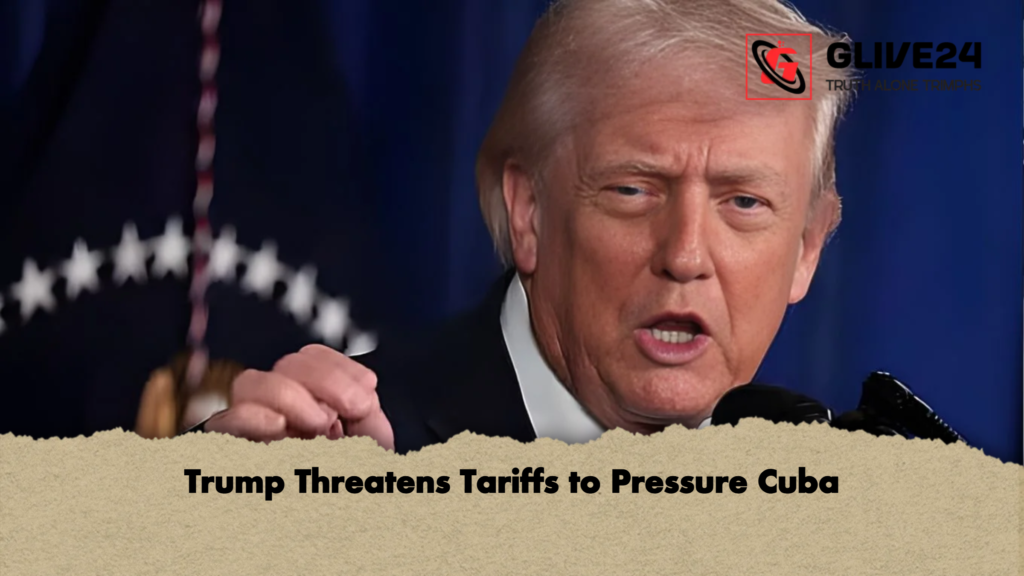
In a bold move to intensify pressure on Cuba’s communist government, United States President Donald Trump has unveiled a new strategy aimed at curbing foreign support for the island nation. On Thursday, he signed an executive order warning that any country supplying oil to Cuba could face steep tariffs on their exports to the United States.
Although the executive order did not specify particular countries or the exact tariff rates, analysts suggest that the primary targets are Latin American nations—particularly Mexico—that have been assisting Cuba amid its ongoing oil shortage. The measure is widely interpreted as an effort to control external aid and further isolate the Cuban government economically.
Earlier this month, U.S. military forces reportedly attempted an operation to remove Venezuelan President Nicolás Maduro from power. Following this incident, Trump vowed to increase pressure on Cuba. Speaking last week, he declared, “Cuba is on the verge of becoming a failed state,” adding that oil shipments and financial aid from Venezuela to Cuba had already ceased.
The Cuban government has strongly condemned the United States’ threats. Cuban President Miguel Díaz-Canel asserted, “Washington has no moral right to coerce us into any agreement.” He emphasised that both the Cuban people and government remain united and resilient in the face of external pressures.
Experts warn that Trump’s tariff threats could have ripple effects across Latin America, not only targeting Cuba but also affecting regional economies linked to oil and energy supply chains. Given Cuba’s heavy reliance on imported fuel, any disruption could exacerbate the country’s ongoing energy and economic crisis.
The following table summarises the potential impact of Trump’s new policy:
| Issue | Details |
|---|---|
| Target | Any country supplying oil to Cuba |
| Potential Impact | High tariffs on national exports, economic pressure |
| Context | Oil and financial aid from Venezuela halted; Cuba faces fuel shortages |
| Cuban Response | Condemnation of U.S. policy; emphasis on national sovereignty and unity |
Analysts observe that tariffs and economic pressure are becoming central instruments of Trump’s foreign policy. While intended to weaken Cuba’s ability to circumvent U.S. sanctions, the measures may further intensify the island’s fuel scarcity and economic distress. International observers are closely monitoring the escalating tensions between Washington and Havana, recognising that the situation could have far-reaching consequences for both regional stability and global energy markets.