
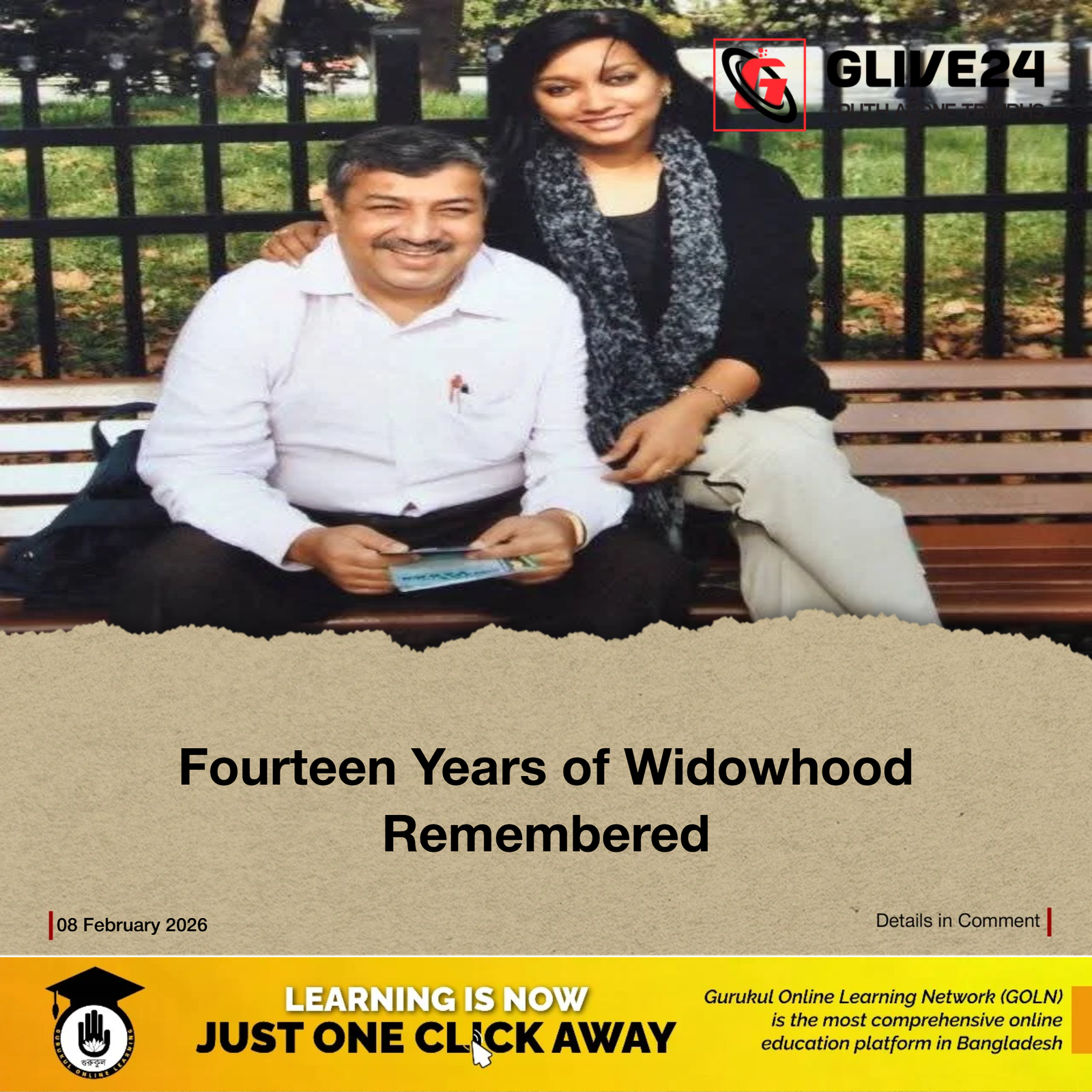
Fourteen years have passed since widowhood entered my life, yet the memory remains sharp, intimate and unyielding. After encountering countless people of many shades—faces hidden behind masks—I have grown weary. Witnessing the inhumanity, arrogance, vanity and quiet cruelty of so‑called influential figures has only deepened one conviction: Jahangir Sattar Tinku was, beyond question, a genuinely large‑hearted and profoundly humane man.
What follows is a reworked and expanded reflection, first written when I was newly widowed, and shared again today in remembrance.
It was four in the morning when he finally slipped away. I was sitting beside him, holding his hand. His body had become frighteningly still. When the doctor arrived and suggested moving him to the ICU, I refused. “Let him go,” I said. He left with pain etched across his body and unspoken sorrow heavy in his chest. For fifteen months I had prepared myself for this moment, or so I believed. Yet when it arrived, all preparation dissolved. My chest heaved with grief; the world suddenly felt unbearably empty.
Eighteen years of shared memories flooded my mind—dreams half‑lived, plans unfinished. His lifeless body lay beneath a white sheet, and I could not bring myself to look at him. Breathing in and out felt like the only definition of survival.
His illness began on 10 November—his birthday—when doctors discovered a brain tumour. Within days, we were in Singapore. At Gleneagles Hospital, the diagnosis came with devastating clarity: glioblastoma multiforme, grade four—one of the most aggressive forms of cancer. I held his hand as he wept behind an oxygen mask. I forced myself to remain composed, joking gently that nothing about him had ever been ordinary.
Over the next fifteen months, our lives became a relentless cycle of surgeries, chemotherapy, radiotherapy and travel between Bangladesh, Singapore, Saudi Arabia and the United States. Each medical opinion carried a different prognosis, each one shortening hope. Ultimately, we chose to focus on dignity and shared time rather than despair.
Despite paralysis, pain and loss of speech, his spirit remained remarkably resilient. He loved company, laughter and conversation. Our home was constantly filled with friends from across the world, drawn by his warmth. Even as his body failed, his humanity did not.
Beyond personal loss, his illness revealed painful truths about society. Wheelchair access was almost non‑existent in public institutions, clubs, hotels and community spaces. Disability, I learned, is treated less as a shared human condition and more as an invisible burden—something to be hidden rather than accommodated.
On the day of his burial in Rauzan—his beloved village—dreams we once nurtured there lay unfinished. I arrived not as a bride in red, but as a widow in white, carrying a grief too heavy for words. Yet amidst loss, the villagers’ compassion sustained me. Their simple love mattered more than any title or position I had ever held.
Even now, I find myself searching for him—in rooms, in memories, in silence. He once told me, “One day you will look for me everywhere and not find me.” That day has come, and it has never truly ended.
Key Milestones in Tinku’s Illness
| Date / Period | Event |
|---|---|
| 10 November | Brain tumour diagnosed |
| November | First and second surgeries in Singapore |
| Feb (following year) | Completion of chemotherapy and radiotherapy |
| Mid-year | Further surgeries, including Gamma Knife |
| Final months | Progressive paralysis and hospitalisation |
| Final day | Passed away peacefully at dawn |
Author: The widow of the late Jahangir Sattar Tinku