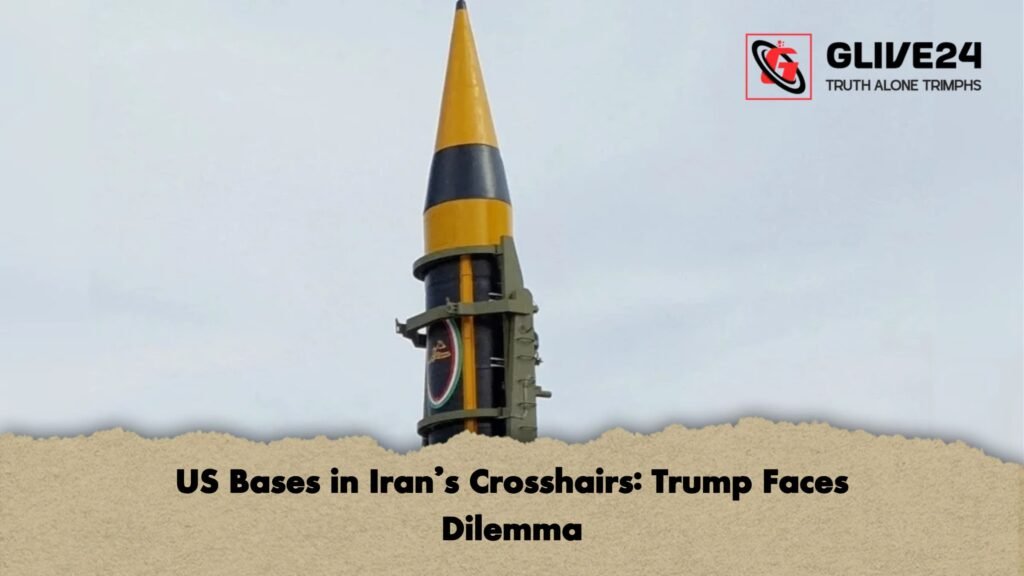
As geopolitical friction between Tehran and Washington reaches a fever pitch, Iran has issued a stark warning regarding the vulnerability of United States military installations across the Middle East. Iranian Foreign Minister Abbas Araghchi delivered an uncompromising message, asserting that should the United States initiate an offensive against Iranian soil, every American base in the region will be designated a primary target for Tehran’s ballistic missile arsenal.
Table of Contents
A Geographic Reality Check
While acknowledging that a conventional strike on the US mainland remains beyond current capabilities, Araghchi pointedly noted that regional US infrastructure sits comfortably within Iran’s “strategic reach.” This escalation follows President Donald Trump’s decision to deploy a powerful naval flotilla to the Persian Gulf—a move the White House frames as “peace through strength,” but which Tehran perceives as an overt provocation.
In an interview with Al Jazeera, Araghchi clarified that Iran does not seek war but is fully prepared for a “crushing response” to any aggression. Crucially, he specified that while Iran would respect the sovereignty of its neighbours, the American military hardware stationed within those sovereign borders would not be spared.
The Missile “Swiss Army Knife”
Military analysts often describe Iran’s missile stockpile—the largest in the Middle East—as a “Swiss Army knife” for asymmetric warfare. With over 2,000 medium and short-range ballistic missiles, Tehran possesses the capacity to overwhelm even sophisticated air defence systems through sheer volume. Advanced models such as the Khorramshahr and Sejjil boast ranges of up to 2,000 kilometres, placing key strategic hubs under a permanent shadow of threat.
Key US Military Installations Within Iranian Missile Range
| Base Name | Country | Strategic Significance |
| Al Udeid Air Base | Qatar | Forward HQ for US Central Command (CENTCOM) |
| NSA Bahrain | Bahrain | Headquarters for the US Navy’s 5th Fleet |
| Al Dhafra Air Base | UAE | Major regional hub for US aerial surveillance |
| Incirlik Air Base | Turkey | Key NATO/US facility on the northern periphery |
| Camp Arifjan | Kuwait | Vital logistical and support base for US Army |
| Al-Tanf Garrison | Syria | Critical outpost for counter-insurgency operations |
Pentagon on High Alert
The Pentagon has taken these threats with “grave seriousness,” particularly following last year’s demonstration of Iranian capability when nearly 500 missiles were launched towards Israel. Although the damage was mitigated by advanced interceptors, the sheer scale of the salvo served as a proof of concept.
In response, the US has bolstered its defensive posture by deploying THAAD (Terminal High Altitude Area Defense) and Patriot missile batteries across Jordan, Kuwait, and Saudi Arabia. These measures aim to protect thousands of American service members and reassure regional allies who fear being caught in the crossfire of a broader conflict.
The Uranium Deadlock
Despite the drumbeat of war, a slender diplomatic thread remains active via indirect talks in Oman. However, Minister Araghchi has signalled that Iran’s core national security pillars—uranium enrichment and its missile programme—remain non-negotiable. With President Trump’s administration maintaining its “maximum pressure” rhetoric and Iran keeping its “finger on the trigger,” the Middle East stands at a perilous crossroads where a single miscalculation could ignite a regional conflagration.