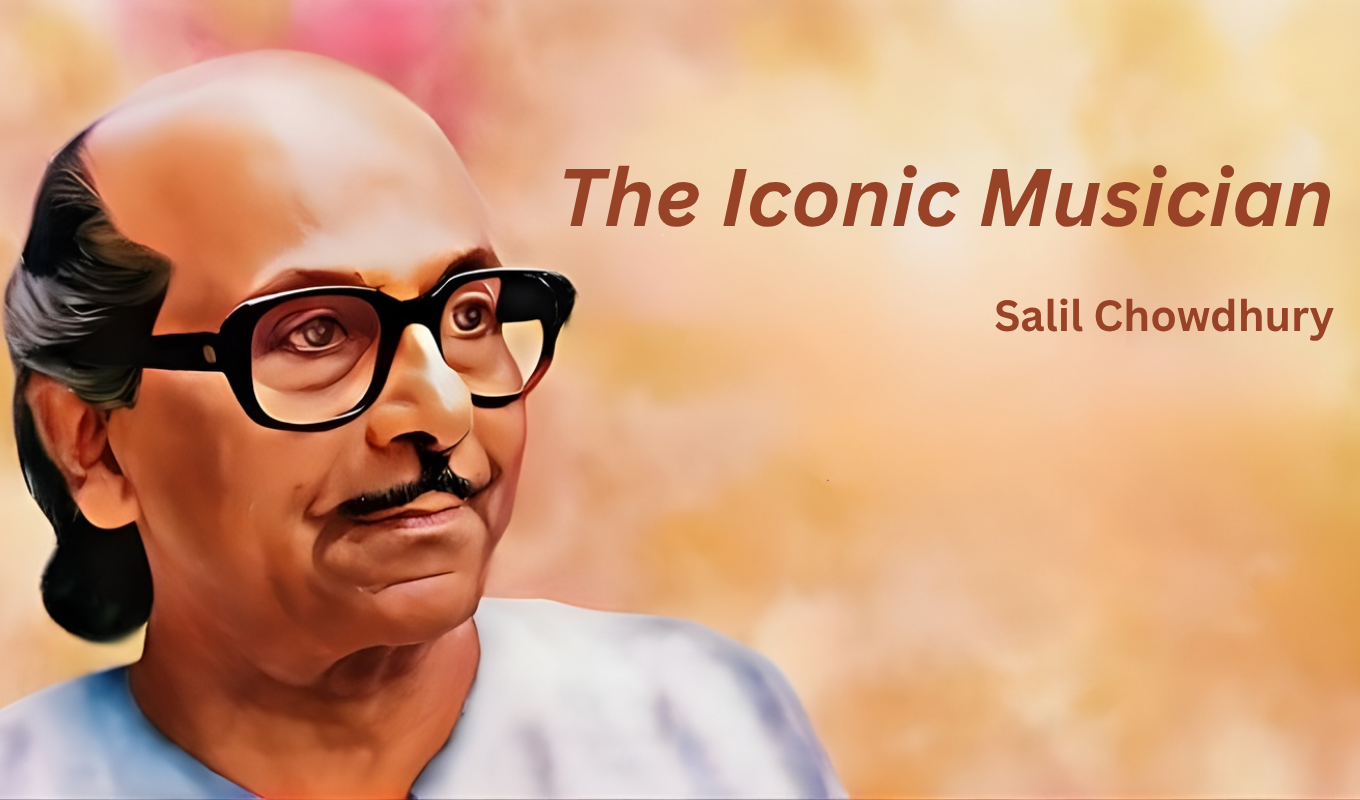
November 19th marks the birthday of a creator whose contributions to Bengali, Indian, and world music are so vast that it’s hard to describe him using just one title. Salil Chowdhury was not just a composer or lyricist, but a storyteller, poet, organizer, and revolutionary thinker—a true maestro of human art.
Salil Chowdhury was a permanent fixture in the world of music, whose works cannot be understood simply through knowledge of musical grammar but require a deep understanding of human psychology, social consciousness, and intellectual scope. His creations were more than just songs; they were milestones in an era he helped create.
Early Life:
Born in 1925 in Gazipur, South 24 Parganas, Salil spent his childhood in the tea gardens of Assam, where his father, Jnanendramoy Chowdhury, was a doctor. His father’s love for music and Western classical music, combined with his experience in stage theatre, had a profound impact on young Salil.
He was introduced to various musical instruments such as the flute, piano, and esraj in his childhood. After completing his studies at Bangabashi College in Kolkata, he grew intellectually, both philosophically and politically.
Cultural Revolution:
In 1944, Salil joined the Indian People’s Theatre Association (IPTA), where he began writing songs about the struggles of everyday people, which would later be known as ‘people’s music.’ His famous songs such as “Gayer Bodhu”, “Bicharpoti”, and “Obak Prithibi” were not just melodies but expressions of the blood and flesh of the common people’s struggles.
Entry into Cinema:
Salil’s first Bengali film, Paribartan, was released in 1949. His most notable work came in 1953 with Do Bigha Zamin, a film directed by Bimal Roy. The film’s story was based on his short story Rickshaw Wala, which helped him gain international recognition.
Expanding Musical Horizons:
Salil Chowdhury was equally proficient in Bengali, Hindi, and Malayalam music. He also composed music for Tamil, Telugu, Marathi, and Assamese films. His work spanned 75+ Hindi films, 40+ Bengali films, 26+ Malayalam films, and many more in Indian regional languages.
Fusion of Western Classical and Indian Music:
Salil’s hallmark was his unique fusion of Western classical music and Indian classical music. He famously incorporated Mozart’s Symphony No. 40 in Itna Na Mujhe Pyar Badha and Chopin’s musical lines in Rato Ki Saaye Ghaane, creating a fusion previously unseen in Indian cinema.
Family Life:
Salil was first married to Jyoti Chowdhury and later to Sabita Chowdhury, a renowned singer who recorded many of his songs. He had two daughters and a son.
Books and Literary Contributions:
Salil was also a remarkable poet and writer. His notable books include:
Prantorer Gaan
Salil Chowdhury’s Gaan (1983)
Jeevan Ujjiban (Autobiography)
Awards:
Salil won the Filmfare Award for Best Music Director in 1958 for Madhumati and the Sangeet Natak Akademi Award in 1988.
Intellectual Vision:
Salil Chowdhury was an artist unafraid to use his music to speak about a classless society, equal rights, and human justice. His songs spoke of the common man’s struggles, workers’ rights, and the revolutionary spirit of the people.
Eternal Relevance:
Salil Chowdhury is today regarded as a pioneer of Indian fusion music, the greatest creator of people’s songs, a realist storyteller, and a key figure in humanistic art. His melodies continue to resonate, proving that true talent transcends time.
Final Tribute:
Salil passed away on September 5, 1995, but his music, ideas, and humanistic values continue to inspire new generations. On his birthday, we honor him not just as an artist, but as a visionary whose legacy still echoes through every note.
SS