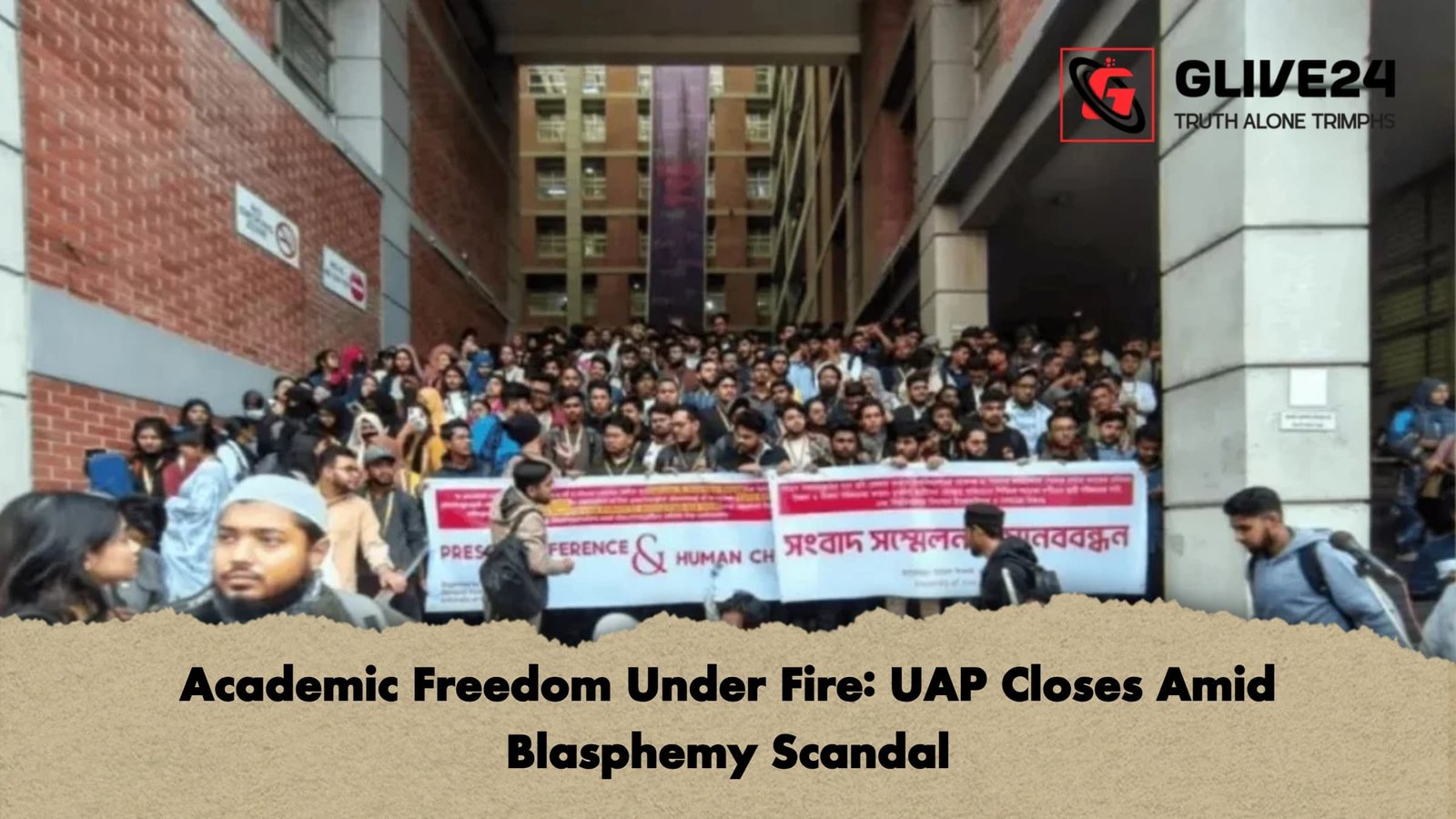
The University of Asia Pacific (UAP) has shuttered its doors indefinitely following a volatile weekend that saw two senior academics summarily dismissed. On Monday, 19 January, the administration issued an emergency directive via email, suspending all academic activities just twenty-four hours after bowing to student demands to terminate the staff members over allegations of “religious defamation.”
The dismissals of Assistant Professor Laeka Bashir and Associate Professor Dr A.S.M. Mohsin, both associated with the Department of Basic Science and Humanities, have sparked a fierce debate regarding the influence of “mob pressure” on institutional governance.
Table of Contents
A Social Media Spark
The roots of the crisis trace back to 10 December, when Assistant Professor Laeka Bashir published a Facebook post critiquing the cultural practice of face-veiling. While Bashir maintains her comments were a sociological critique of purdah culture, a faction of current and former students branded the remarks as blasphemous.
As the new semester commenced, the campus transformed into a site of protest. Demonstrators held sit-ins and press conferences, alleging that the professors had a history of “Islamophobic” commentary and political bias. Bashir, conversely, reported receiving a torrent of abuse and threats, claiming that the university failed to provide her with adequate protection or a fair hearing.
Overview of the UAP Academic Crisis
| Key Metric | Details |
| Institution | University of Asia Pacific (UAP) |
| Faculty Dismissed | Laeka Bashir (Asst. Prof) & Dr A.S.M. Mohsin (Assoc. Prof) |
| Primary Allegation | Defamation of religious sentiments via social media |
| Administrative Action | Immediate termination without formal defence |
| Campus Status | Closed indefinitely as of 19 January |
Procedural Failures and “Mob Justice”
The speed of the dismissals has drawn sharp rebukes from the University Teachers’ Network. In a formal statement, the body condemned the UAP administration for setting a “terrifying precedent.” They argue that the university bypassed established disciplinary protocols—which typically include a show-cause notice and a formal inquiry—to appease an angry crowd.
While the university registrar maintains that an investigation was technically “underway,” they conceded that the “sensitivities of the situation” required an immediate resolution to prevent further unrest. This admission has led critics to label the move as “arbitrary and exclusionary,” suggesting that the administration prioritised optics over due process.
An Uncertain Future
The indefinite closure has left the student body in a state of limbo. While the protesting faction celebrated the dismissals as a victory for their values, a silent portion of the student community expressed concern over the “tagging” of teachers and the resulting disruption to their education.
The University Teachers’ Network has called for the immediate reinstatement of the professors and a transparent, independent investigation, warning that the “politicisation of blasphemy” within higher education threatens the very foundation of academic inquiry in Bangladesh.