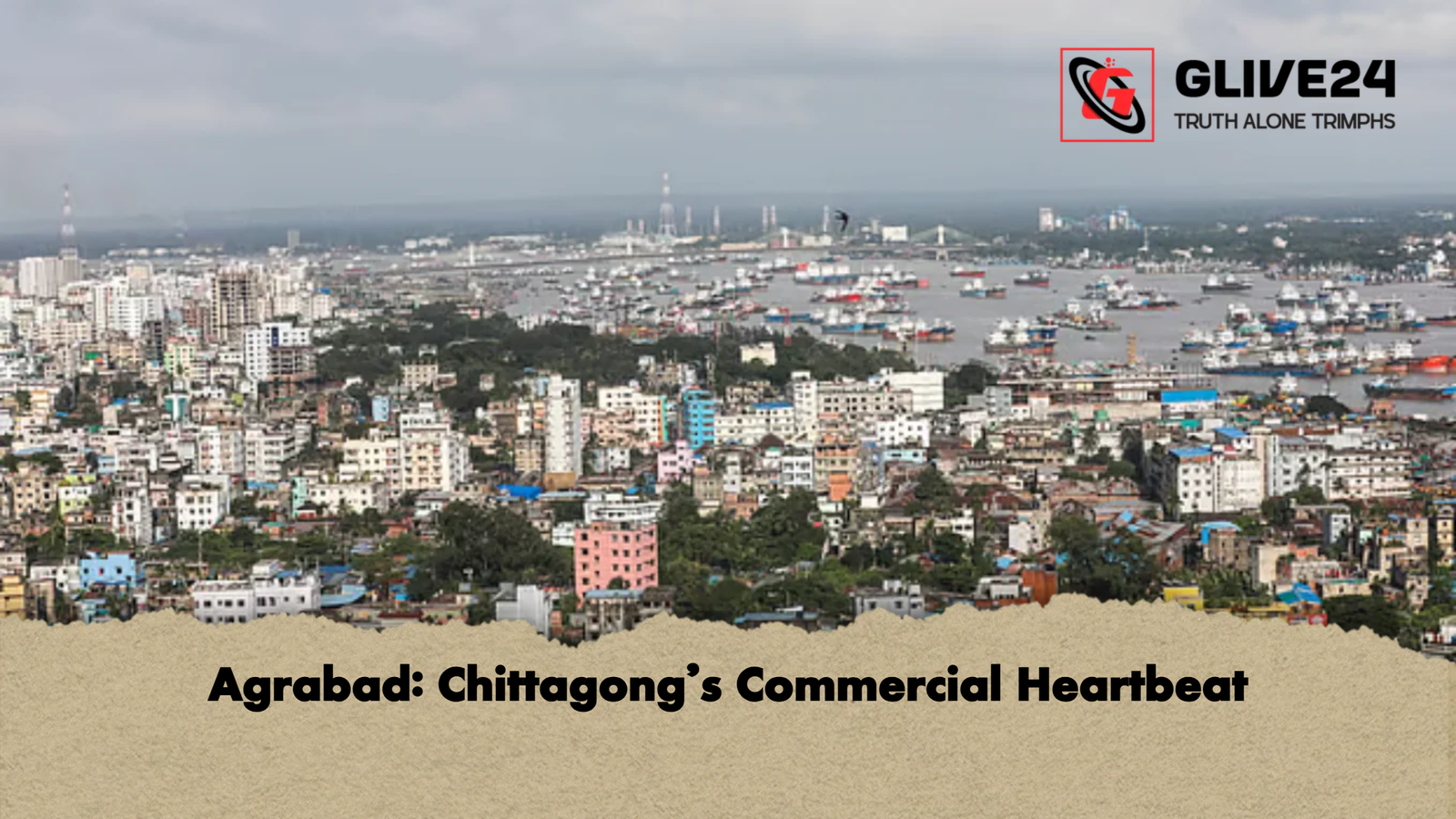
Agrabad, situated in the port city of Chittagong, has evolved into the city’s primary commercial hub over centuries. Historical records indicate that in 1665, when Chittagong became part of the Mughal Empire, a substantial segment of the Mughal military settled permanently in the region. Scholars suggest that one of the Mughal soldiers, recalling his birthplace in Agra, named the settlement “Agrabad.” Today, Agrabad stands as a bustling centre of trade and commerce, reflecting a rich blend of history and modernity.
Table of Contents
Historical Evolution
Prior to the Partition of India, Agrabad was little more than a rural hamlet. The area was characterised by unpaved roads, scattered dwellings, and limited population. Under Pakistan’s administration, structured urban planning transformed the area into a more organised township. Post-independence, these initiatives intensified, cementing Agrabad’s status as a commercial nucleus.
By the 1950s, planned development projects began to reshape the neighbourhood. The 1980s witnessed accelerated urbanisation, which positioned Agrabad as the commercial backbone of Chittagong. Historian Abdul Haque Chowdhury, in his book Port City Chittagong, describes Agrabad as the emblem of the city’s trade network, noting that a significant portion of the city’s economic activity revolves around this area.
Currently, Agrabad hosts a wide array of businesses, including import-export operations, banking institutions, multinational headquarters, insurance firms, technology companies, and large retail complexes. Regional offices of the country’s leading banks, major shipping and logistics companies, and industrial offices are concentrated here, generating daily employment for thousands.
Geographic Significance and Connectivity
Agrabad is bordered by Choumuhani to the north, Barik Building Mor to the south, Mogoltuli and Madarbari to the east, and Halishahar to the west. Key arteries such as Badamtali Mor, Dhaka Trunk Road, and Sheikh Mujib Road enhance connectivity. Its proximity to Strand Road and Sadarghat links Agrabad directly with the port, facilitating trade and commerce.
| Key Roads & Areas | Connection / Purpose |
|---|---|
| Strand Road | Access to Chittagong Port and Customs |
| Badamtali Mor | Commercial centre, banks, corporate offices |
| Dhaka Trunk Road | Internal urban connectivity |
| Sheikh Mujib Road | Links to World Trade Centre and government offices |
Banking, Trade, and Corporate Presence
The area around Agrabad Mor and Badamtali hosts at least 25 bank branches, while historic and institutional buildings elevate property values. Landmarks like the Ethnological Museum, government offices, and Hotel Agrabad have reinforced the area’s corporate identity. Notably, the four-star Hotel Agrabad, established in 1969, has served as a centre for corporate events and conferences.
The World Trade Centre, inaugurated in 2016, lies along Sheikh Mujib Road near Commerce College. Operated by the Chittagong Chamber of Commerce and Industry—founded in 1906—the centre connects over 14,000 enterprises, including garment factories, trading houses, chemical and machinery firms, and automobile importers.
Government Offices and Administration
Beyond the commercial district lies the government zone, where at least 30 departments operate, including the Anti-Corruption Commission, Department of Fisheries, and offices linked to port management, industry, and revenue administration. The area also encompasses ten government colonies.
Challenges and Opportunities
Kazi Ainul Haque, Managing Director of Equity Property Management Ltd., notes that while Agrabad is a prime commercial area, the proliferation of street vendors along pavements disrupts its aesthetic and order. He emphasises that improving parking facilities, traffic management, and urban planning will attract greater investment in both commercial and residential sectors.
In conclusion, Agrabad’s historical legacy, port-proximate economy, and sustained urban planning have combined to make it Chittagong’s most stable and valuable commercial zone. Its blend of modernity, accessibility, and corporate infrastructure continues to define it as the city’s economic heartbeat.