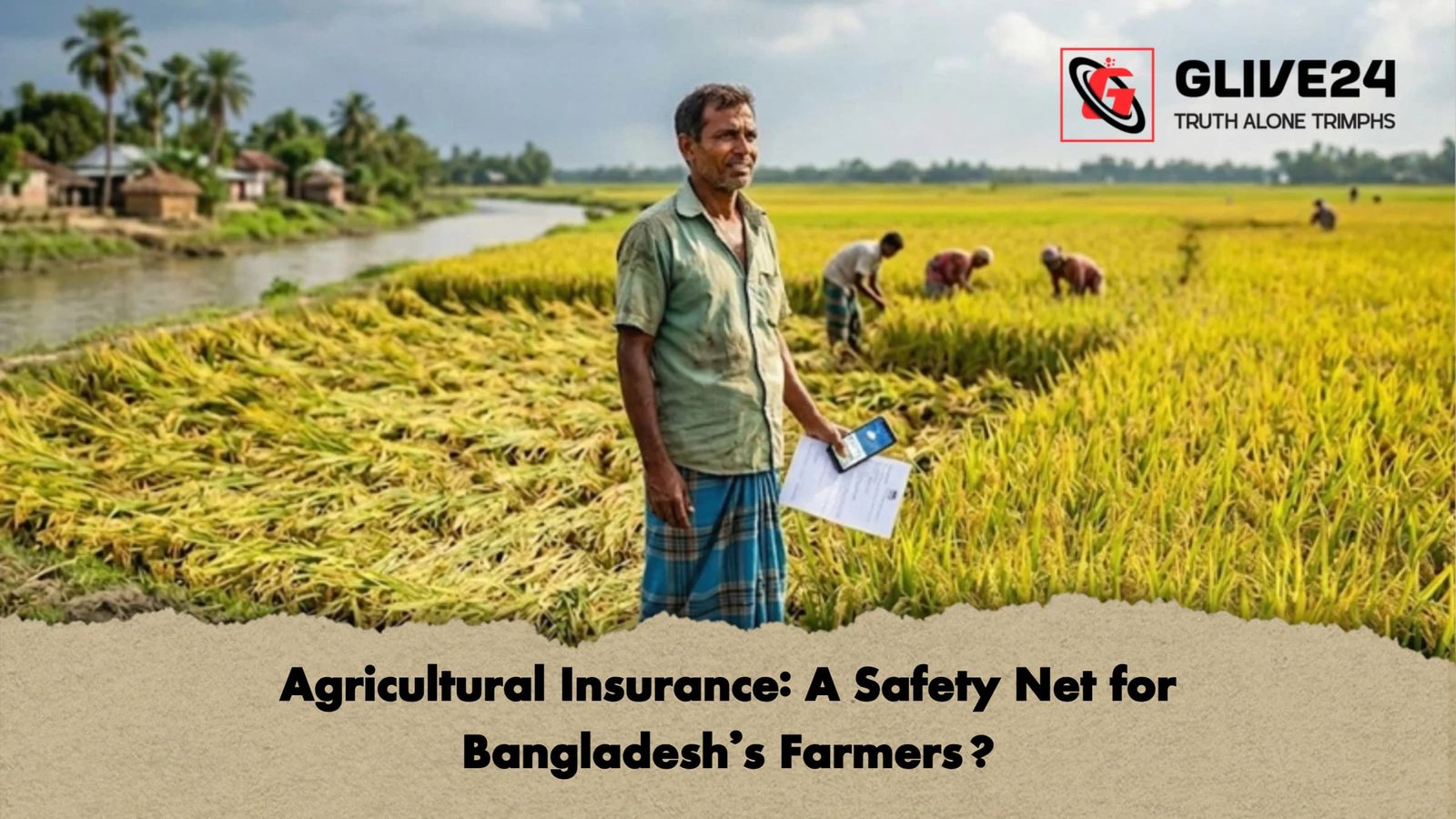
In the fertile yet volatile delta of Bangladesh, the agricultural sector remains the backbone of the national economy. However, this vitality is perpetually threatened by a cruel cycle of natural disasters. Every year, thousands of farmers witness their livelihoods decimated by flash floods, prolonged droughts, erratic rainfall, and devastating cyclones. For the majority who rely on high-interest loans from banks or NGOs to fund their seeds and fertiliser, a single failed harvest does not merely mean a lost season—it signifies a descent into a relentless debt trap. As climate change intensifies these risks, the urgent question arises: can Agricultural Insurance provide the robust institutional safety net these farmers so desperately require?
Table of Contents
From Theoretical Concept to Pilot Reality
Agricultural insurance is no longer a mere theoretical construct in Bangladesh. Over the past decade, various Weather Index-Based Crop Insurance (WIBI) pilot schemes have been implemented. These initiatives, often spearheaded by the Shadharan Bima Corporation (SBC) in partnership with international development agencies, have demonstrated that the model is functional. Private insurers have also dipped their toes into livestock and crop coverage, successfully settling claims in several experimental districts.
Despite these successes, a significant “coverage gap” remains. Most initiatives are restricted to specific project areas, leaving the vast majority of the country’s marginal and small-scale farmers—the very individuals most vulnerable to climate shocks—without any formal protection.
The Mechanism: Weather Index vs. Traditional Models
The shift toward index-based insurance is particularly promising for a developing economy. Unlike traditional indemnity insurance, which requires lengthy, manual on-site damage assessments, index-based systems trigger payouts automatically when a pre-defined weather parameter (such as millimetres of rainfall or temperature thresholds) is breached.
Comparison of Insurance Approaches in Bangladesh:
| Feature | Traditional Crop Insurance | Weather Index-Based Insurance (WIBI) |
| Claim Settlement | Based on physical loss assessment | Based on weather data (Rain/Temp) |
| Processing Speed | Slow (Weeks or Months) | Rapid (Automatic/Digital) |
| Administrative Cost | High (Requires field visits) | Low (Data-driven) |
| Key Challenge | High potential for moral hazard | Basis Risk (Local loss vs. Station data) |
| Transparency | Subjective / Prone to disputes | Objective and verifiable |
Barriers to National Scalability
For agricultural insurance to evolve from a “boutique project” into a national “safety net,” several systemic hurdles must be cleared:
The Premium Burden: For a marginal farmer living on the brink of poverty, regular premium payments are an unattractive, if not impossible, expense. Globally, successful agricultural insurance regimes—such as those in India or China—rely heavily on government subsidies to make premiums affordable.
The Data Deficit: Reliable payouts require a dense network of automated weather stations. Without high-quality, localised digital data, “basis risk” increases—where a farmer suffers a loss that the nearest weather station fails to record, leading to a denial of claims and a total collapse of trust in the system.
Institutional Synergy: Insurance must be bundled with existing services. Integrating insurance with agricultural credit (loans) and the national agricultural extension network would simplify distribution and ensure that when a disaster strikes, the insurance payout directly offsets the farmer’s debt.
The Path Forward
The pilot programmes have proven that the plumbing for agricultural insurance works. However, for a country on the front lines of the climate crisis, limited experiments are no longer sufficient. To transform this into a genuine safety net, Bangladesh requires a cohesive national policy that includes a clear subsidy framework, investment in digital weather infrastructure, and a transparent, technology-led claims process.
Without these pillars, agricultural insurance will remain a fleeting project for a lucky few, rather than the institutional shield that could protect millions from the whims of a changing climate.