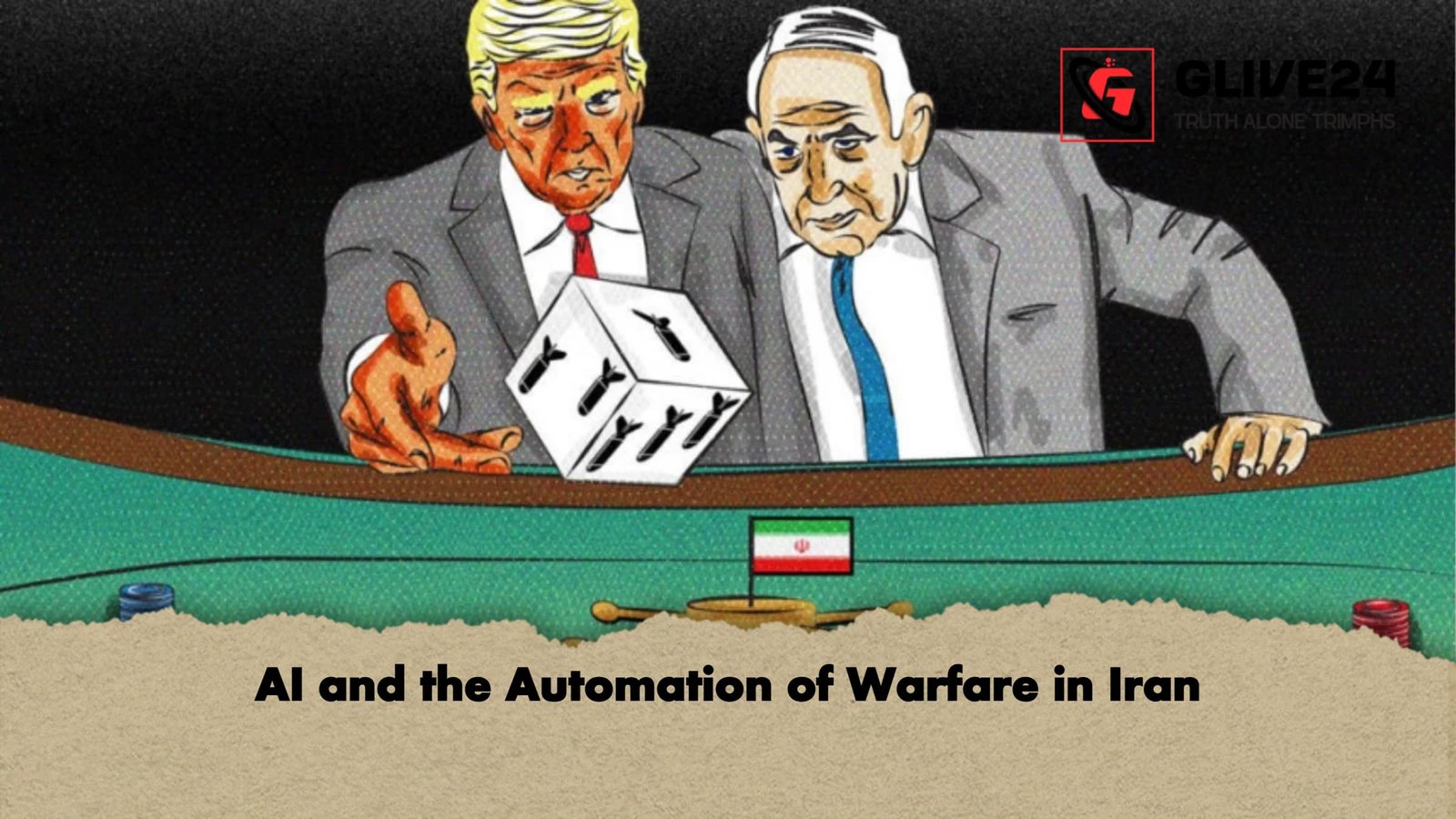
The recent joint military operations conducted by the United States and Israel against Iran have sparked intense global debate, not merely for their geopolitical ramifications, but for the unprecedented role of Artificial Intelligence (AI) in the theatre of war. Experts warn that the integration of AI is accelerating the “kill chain”—the process from target identification to lethal strike—at a velocity that is beginning to outpace human cognition, a phenomenon described as “warfare at the speed of thought.”
Table of Contents
The Rise of ‘Decision Compression’
In conventional warfare, planning complex aerial sorties and vetting targets for legal and ethical compliance typically requires days or weeks. However, during the initial twelve hours of the campaign in Iran, the coalition reportedly executed nearly 900 strikes. This included the high-profile missile strike that resulted in the death of Iran’s Supreme Leader, Ayatollah Ali Khamenei.
This operational tempo is made possible by a concept known as “Decision Compression.” By utilising large language models and machine learning, military planners have condensed the decision-making window from days to mere seconds.
| Feature | Traditional Warfare | AI-Enhanced Warfare (Current) |
| Target Vetting Period | Days to Weeks | Seconds to Minutes |
| Data Sources | Human Intel & Satellite Imagery | Real-time Drone Feeds, Signals, & AI Analysis |
| Strike Capacity | Moderate (Phased) | Massed & Simultaneous (e.g., 900 in 12hrs) |
| Primary Tooling | Manual Review Boards | Models like Claude (Anthropic) & Palantir AIP |
| Human Role | Active Decision Maker | Passive “Rubber Stamper” / Reviewer |
The Silicon Soldiers: Anthropic and Palantir
According to reports from The Guardian, the US military has integrated Anthropic’s AI model, Claude, into its tactical planning frameworks. While Anthropic has previously expressed reservations regarding the use of its technology for autonomous weaponry, it currently facilitates national security missions. Simultaneously, Palantir Technologies has deployed its Artificial Intelligence Platform (AIP) to assist the Pentagon in real-time intelligence synthesis.
These systems do more than just identify targets; they recommend the most efficient weaponry, assess current ammunition stocks, and even generate automated legal justifications based on international law. Dr Craig Jones, a Senior Lecturer at Newcastle University, suggests that humans are being relegated to a secondary role. “The AI is making recommendations faster than a human can think,” he noted. “We are reaching a point where humans simply ‘rubber-stamp’ machine-generated lethality.”
The Human Cost of Algorithmic Precision
Despite claims of “surgical precision,” the reliance on AI has not prevented significant civilian casualties. A tragic strike on a school in southern Iran last Saturday resulted in the deaths of at least 165 people, many of whom were children. While the US military claims the school was adjacent to a legitimate military barrack, the United Nations has condemned the incident as a “grave violation of international humanitarian law.”
Ethicists like Professor David Leslie of Queen Mary University of London warn of “cognitive off-loading.” As the burden of moral and tactical thought is shifted to machines, there is a risk that human operators may become emotionally and accountably detached from the consequences of the violence they authorise.
The Geopolitical Divide
While Iran claimed in 2025 to have developed its own AI-driven missile guidance systems, international sanctions have left Tehran significantly behind the US, Israel, and China in the AI arms race. This technological asymmetry creates a dangerous imbalance, where one side can overwhelm the other’s defences through sheer algorithmic speed.
As the US administration navigates its relationship with AI pioneers like OpenAI and Anthropic, the future of conflict appears set on an automated path. The challenge for the coming years will not be the efficacy of these weapons, but whether human accountability can survive in an age of automated war.