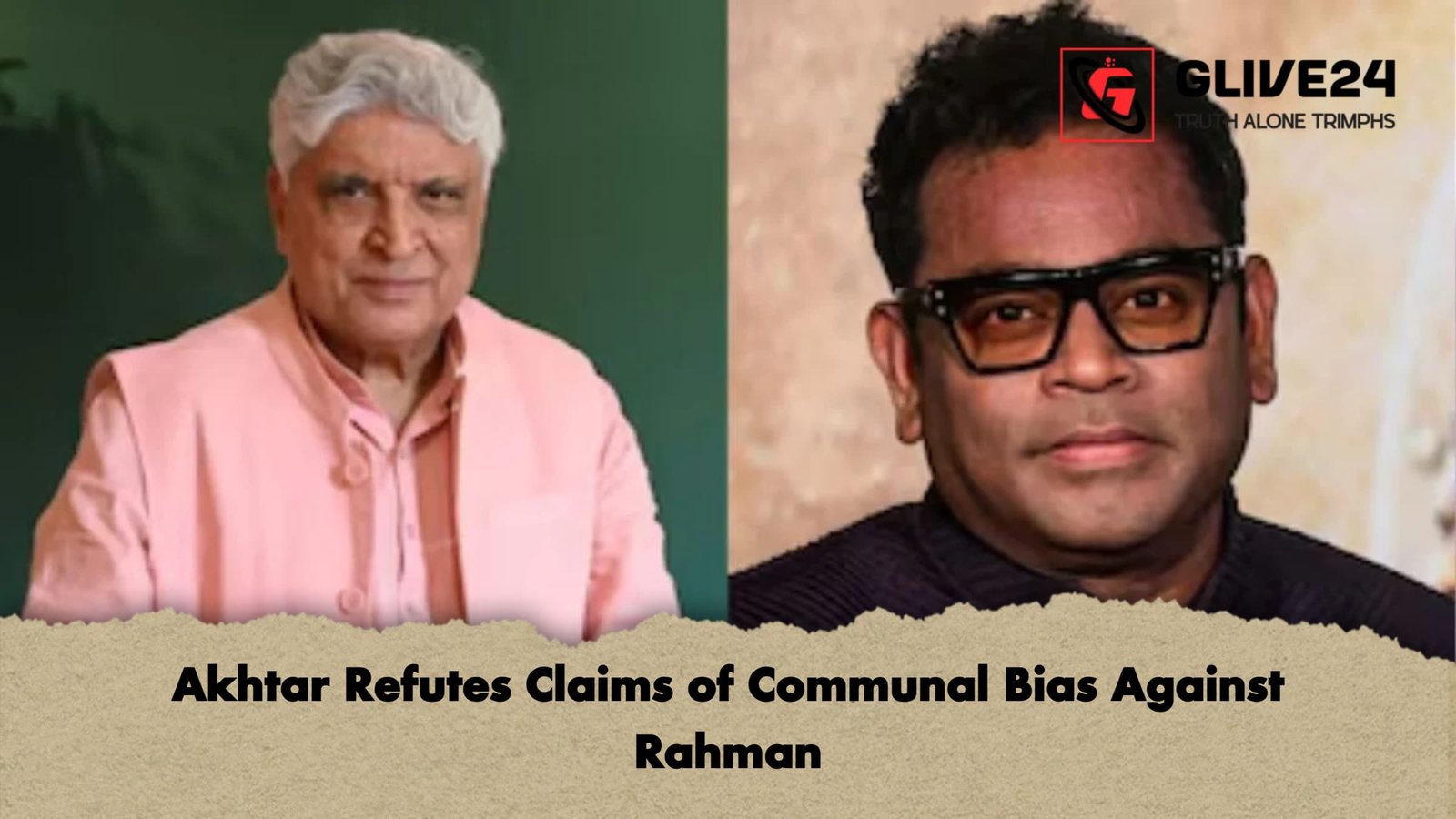
The legendary lyricist and veteran of Hindi cinema, Javed Akhtar, has stepped forward to address the growing controversy surrounding A.R. Rahman’s recent comments regarding his diminishing workload in Bollywood. During a conversation with news agency IANS on Wednesday, 21 January 2026, Akhtar categorically ruled out the existence of a “communal element” in the industry, suggesting instead that Rahman’s own towering success may be the reason for his perceived exclusion.
Table of Contents
The Origins of the Dispute
The debate was ignited following Rahman’s interview with the BBC Asian Network, where the Oscar-winning composer mused on why his Hindi film projects have become fewer and further between. Rahman hinted that a shift in power dynamics—where non-creative executives now hold the reins—might have introduced a “communal thing,” though he admitted this information reached him only via “Chinese whispers.”
Akhtar, who has collaborated with Rahman on numerous cinematic masterpieces, was quick to defend the pluralistic nature of Mumbai’s film fraternity. “I have never felt this way,” Akhtar stated. “I meet people here in Mumbai regularly. They have nothing but great respect for him.”
Analysing the ‘Rahman Gap’: Perspectives on the Industry
| Factor | Description | Akhtar’s View |
| Global Presence | Rahman’s extensive international tours and Hollywood scoring. | “People think he is too busy in the West to take local projects.” |
| Commitment Scale | Large-scale stage shows require months of preparation. | “Producers assume he cannot give the time required for a film.” |
| Producer Awe | The “fear factor” associated with approaching a global icon. | “Small producers are afraid to even go to such a big man.” |
| Corporate Shift | Power moving from directors to music labels/CEOs. | “I don’t think there is a communal element in this shift.” |
A Conflict of Stature
According to Akhtar, the issue is one of logistics and intimidation rather than prejudice. He argued that many directors and producers assume the “Mozart of Madras” is simply out of reach due to his international commitments and high-profile shows.
“Rahman is such a big man. Even a small producer is afraid to go to him,” Akhtar explained. He urged filmmakers to bridge the gap through direct communication, dismissing the notion that the composer’s faith or background plays any role in casting decisions. “Why don’t you see him? He will definitely come,” he assured, insisting that Rahman remains approachable to those who dare to ask.
The Echo of the “Chinese Whispers”
Rahman’s original comments touched upon the frustration of being booked for a project, only for a music company to override the director’s choice and hire multiple composers instead. While Rahman laughed it off as an opportunity to “chill out with family,” the suggestion of a communal undercurrent sparked a national conversation.
Akhtar’s intervention is seen as a significant attempt to maintain the industry’s image as a meritocratic and secular space. Having worked on films like Lagaan and Jodhaa Akbar alongside Rahman, Akhtar’s perspective carries the weight of decades of experience in the heart of Mumbai’s creative engine.