
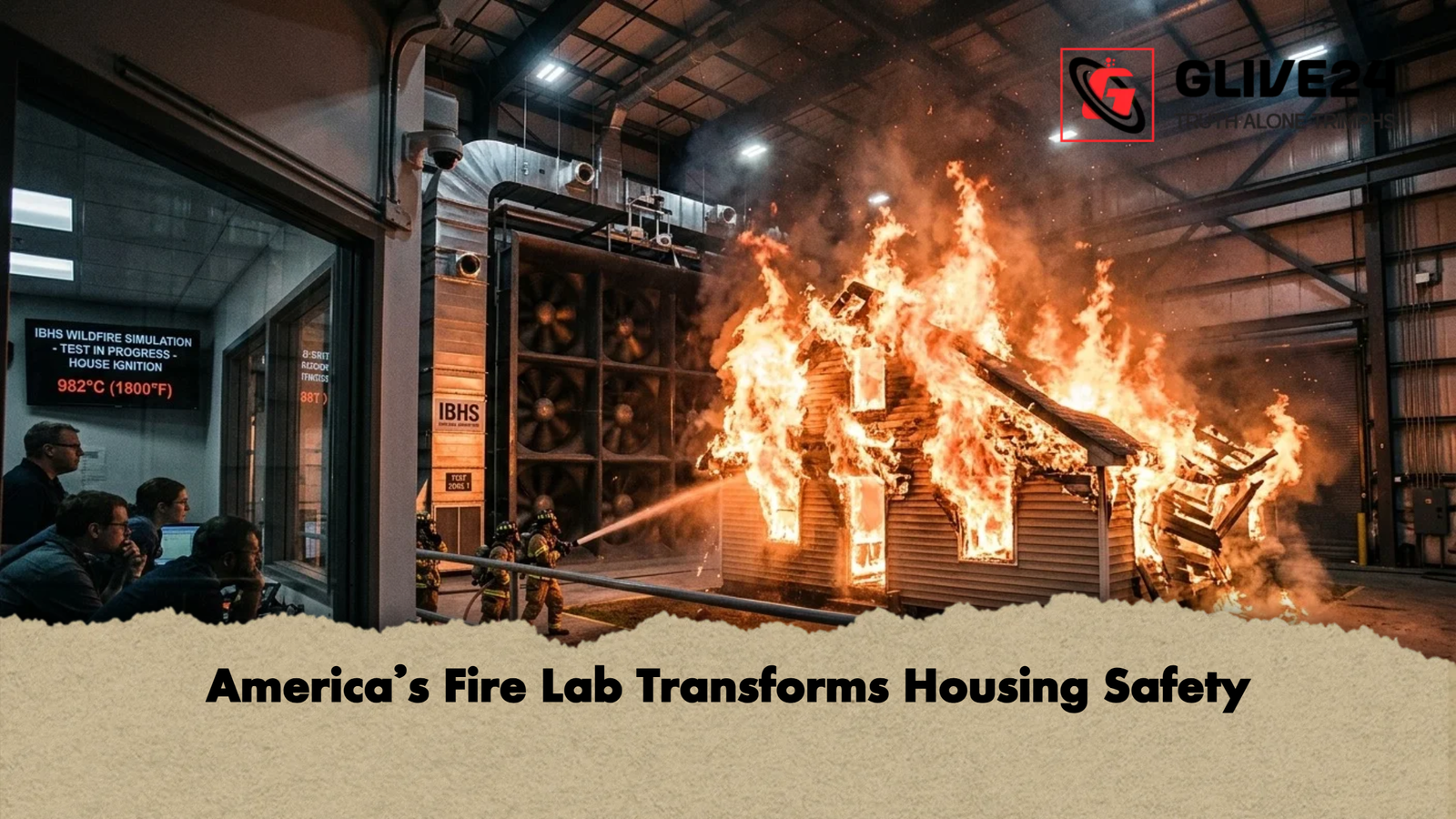
A pioneering disaster simulation laboratory in the United States is reshaping how homes are designed, constructed, and insured, as climate-driven hazards exert unprecedented pressure on the housing sector—particularly in wildfire-prone regions such as California.
At the forefront of this effort is the Insurance Institute for Business & Home Safety (IBHS), which operates a full-scale, state-of-the-art “disaster laboratory” in South Carolina. Established in the wake of Hurricane Katrina, the facility allows engineers and scientists to replicate extreme natural events with astonishing precision, including hurricane-force winds, severe hailstorms, and rapidly spreading wildfires.
One of the most striking experiments involves exposing a conventional wooden house to simulated wildfire conditions. Within minutes, controlled flames—driven by hurricane-speed winds generated in a vast wind tunnel—can engulf the structure. Temperatures frequently surpass 980°C, providing a stark demonstration of how quickly fire can escalate from embers to full structural collapse. Observers, positioned at a safe distance, witness entire rooms consumed in moments, illustrating the ferocity of such disasters.
Yet the laboratory’s purpose extends beyond dramatic visuals. Its central mission is to identify practical, scalable measures that improve residential resilience. Research has validated numerous innovations, including ember-resistant ventilation systems, non-combustible cladding, and reinforced roofing materials. These enhancements can delay ignition, slow fire progression, and provide crucial time for evacuation and emergency response.
Experts stress, however, that individual home upgrades alone are insufficient. The concept of “collective resilience” has emerged, emphasising the need for coordinated, neighbourhood-level strategies. Without such collective planning, even fortified properties remain vulnerable if surrounding structures fail.
The implications for the insurance sector are profound. As climate change drives more frequent and severe disasters, insurers face escalating financial exposure. Since 2019, average U.S. home insurance premiums have risen by roughly 64 per cent, while numerous insurers have scaled back operations in high-risk regions.
California exemplifies this trend. Several major insurers have reduced or withdrawn coverage in wildfire-prone areas, citing unsustainable losses. The result is a widening protection gap, leaving more homeowners underinsured—or without coverage altogether.
Key Trends in U.S. Home Insurance
| Indicator | Recent Data | Implication |
|---|---|---|
| Premium increase | +64% since 2019 | Rising financial burden on households |
| Uninsured homes | 14.1% in 2025 | Greater exposure to catastrophic loss |
| Major risk factor | Wildfires, storms | Intensifying climate-related threats |
| Market response | Insurer withdrawal | Limited access to affordable coverage |
The consequences extend beyond insurance. Mortgage lenders typically require comprehensive coverage, so reduced availability can disrupt home sales and depress property values. For many households, whose primary asset is their home, this creates a precarious financial outlook.
IBHS researchers hope their findings will inform stricter building codes and resilient urban planning policies. By promoting construction standards capable of withstanding extreme conditions, they aim to mitigate losses and stabilise insurance markets. However, insurers have been slow to reward resilience measures with meaningful premium reductions, limiting homeowners’ incentives to invest in safer designs.
As climate risks intensify, the work conducted at this disaster laboratory offers both a warning and a blueprint for adaptation. The message is clear: future housing security will depend not only on location but also on the ability of homes and communities to withstand increasingly volatile natural forces.