
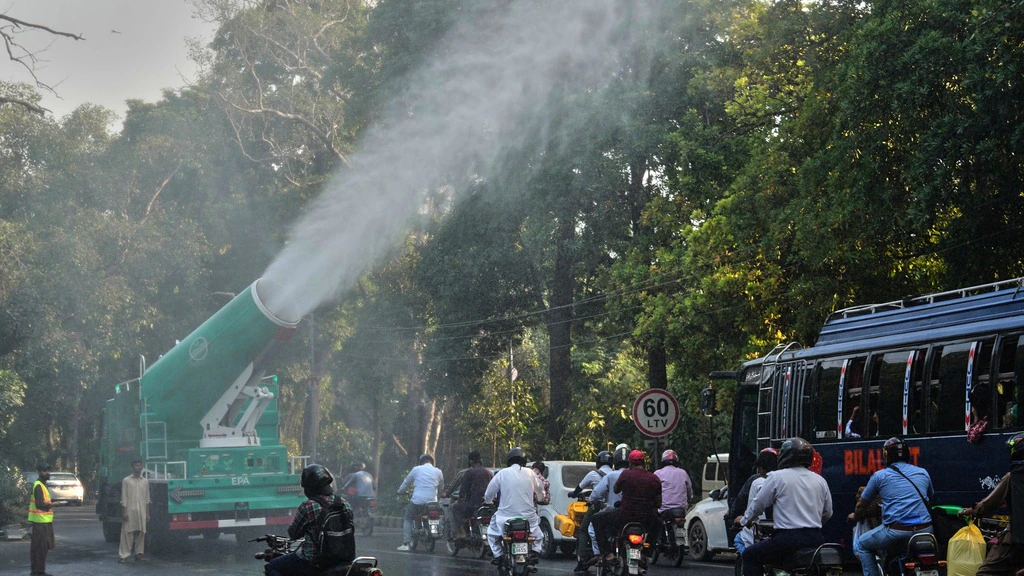
Air pollution in Lahore, Pakistan, remains out of control despite ongoing efforts. Experts have warned that the air quality has reached an extremely hazardous level. In response to the worsening situation, Lahore police have intensified their ongoing anti-smog operation.
A similar scenario can be seen in neighbouring India. Despite attempts to induce artificial rain, the heavy smog over the capital, New Delhi, has not cleared. Although the situation slightly improved on Friday, it still remains within the unhealthy range, according to Swiss air-quality monitoring organisation IQAir.
Pakistan, a South Asian country severely affected by air pollution, is facing an environmental crisis as smog in its second-largest city, Lahore, has reached dangerous levels. The city is blanketed in a thick grey haze, making it difficult to see clearly even within a short distance.
Residents have been forced to drive with their headlights on during the day. Locals, expressing frustration, admitted that human activities are largely to blame for the crisis. One resident said, “We ourselves are responsible for this situation. Sadly, we are neglecting our own country. It is our children and the elderly who are suffering the most.”
Meanwhile, Lahore police have intensified their ongoing anti-smog campaign. So far this year, nearly 200 cases have been filed at various police stations across the city, and over two hundred suspects have been arrested.
In India, despite much publicised efforts to bring about artificial rain, the smog in Delhi has not lifted. While there was some slight improvement in conditions on Friday, the air quality still remains in the unhealthy range, according to IQAir.
Every winter, pollution levels in and around the Indian capital skyrocket due to construction dust, vehicle emissions, and smoke from crop burning. Locals believe that strict enforcement and a series of sustained measures are the only effective ways to control the situation.
They argue that a well-planned, long-term strategy is necessary to tackle pollution. Although some initiatives have been introduced, few people comply with them, and the authorities have failed to ensure proper implementation.
Due to severe air pollution, millions of residents across India are suffering from respiratory problems and other health complications. In an effort to reduce pollution levels, authorities recently closed educational institutions, suspended construction work, and restricted the use of private vehicles.