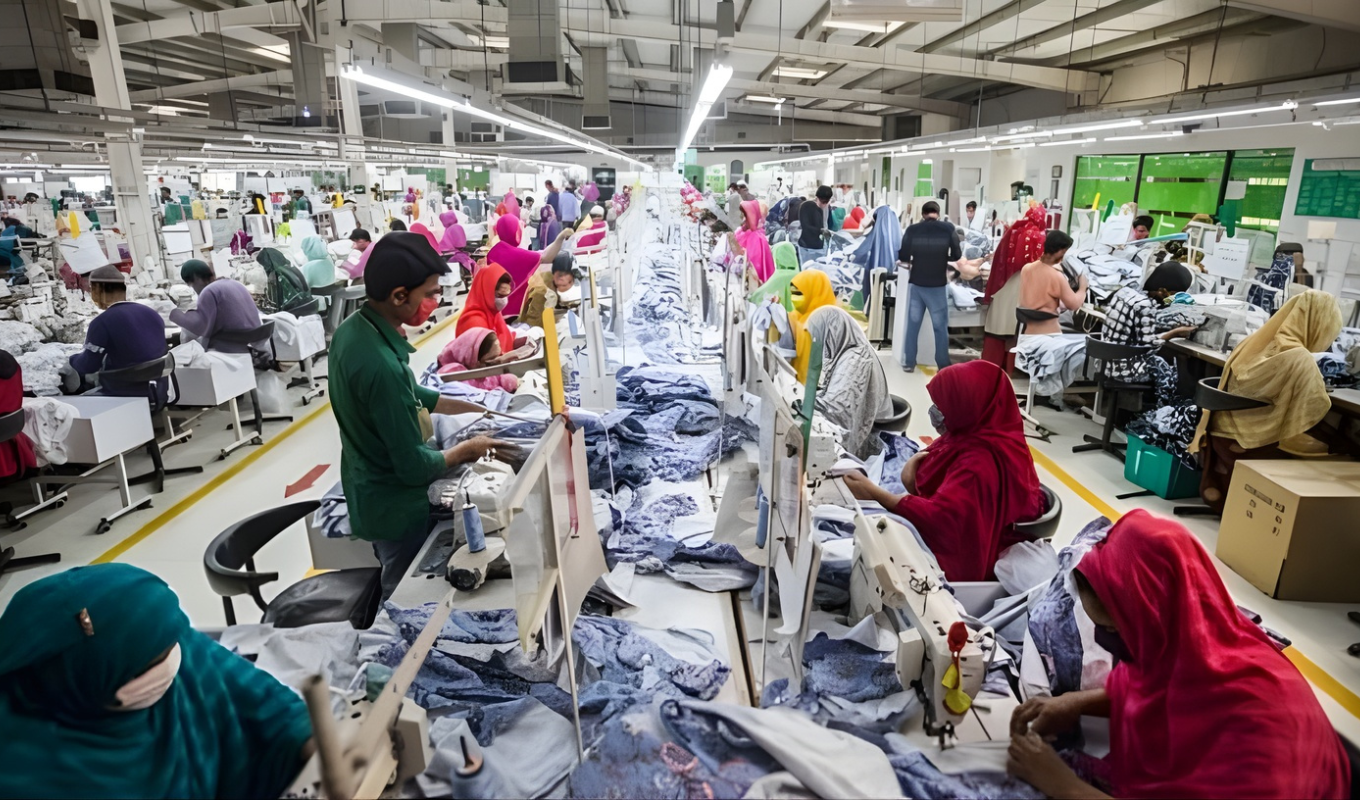
More than two hundred export-oriented garment factories in Narayanganj have been shut down over the past two years due to various obstacles, including lack of support from banks, customs complications, unwillingness of foreign buyers, labour unrest and energy shortages. As a result, more than one hundred thousand workers who lost their jobs are living in distress. The garment export sector has suffered a loss of 1.5 billion dollars in the current fiscal year.
Factory owners are struggling to keep the operational units running. Labour leaders fear that if the closed factories are not reopened soon and the workers reinstated, criminal activities may increase.
However, the district industrial office and BKMEA have assured that they will discuss the matter with the government with due importance to overcome the crisis.
According to BKMEA, the top association of knitwear exporters, Narayanganj contributes 40 percent of the country’s total knitwear exports. However, due to political violence, increase in the dollar rate, dollar shortage, lack of bank loans and the country’s overall situation, at least one hundred export-oriented factories under BKMEA and BGMEA have closed in the past two years. As a result, thousands of workers have lost their jobs.
Sources say that outside BKMEA and BGMEA, more than one hundred medium-sized export-oriented factories have also been shut down. Labour leaders are demanding the immediate reopening of these factories and reinstatement of the workers. Otherwise, they fear criminal activities may rise and the law and order situation may deteriorate.
MA Shaheen, President of Garment and Sweater Workers Trade Union Centre, Narayanganj district, told the media that two to two-and-a-half hundred garment factories have been closed over the past two years. Thousands of workers have become unemployed. To survive, some are driving autorickshaws while others are selling goods on footpaths, but they are also facing difficulties there. He said the government must take measures to reopen the closed factories quickly. If not, many workers may become involved in criminal activities, worsening the law and order situation.
Rajib Chandra Ghosh, Deputy Chief Inspector of the Narayanganj district office of the Department of Inspection for Factories and Establishments, said that factories are often shut down without informing them. They learn of it only when workers take to the streets demanding their unpaid salaries, after which they take action. If any worker files a written complaint regarding unpaid wages, they call both parties for discussion. If the owners fail to pay, legal action is taken.
In this crisis, sustaining the operational factories has become a major challenge. Masud Ahmed, Managing Director of export-oriented knit factory Knit Radix Limited in Fatullah, told the media that nearly 200 factories have closed in the past two years. Banks are not cooperating, there are customs complications, gas and electricity shortages, and foreign buyers are reducing orders. Their overall orders have dropped by almost 40 percent. He fears how long they will be able to keep the factory running.
According to BKMEA, among more than a thousand member factories in Narayanganj, only 350 remain operational. Last fiscal year, garments worth 9 billion dollars were exported from Narayanganj, but this year the figure has dropped to 7.5 billion dollars—resulting in a loss of 1.5 billion dollars. The GDP has also fallen from above 5.5 percent to 4.5 percent. This is affecting the country’s overall economy.
BKMEA President Mohammad Hatem said the garment sector is now under severe threat. Many factories are surviving like patients in an ICU. Banks are not cooperating. In such a situation, Bangladesh Bank must play the key role. Long-term support and rescheduling are essential. If needed, factories must be given long-term support for 10 to 20 years.
SS