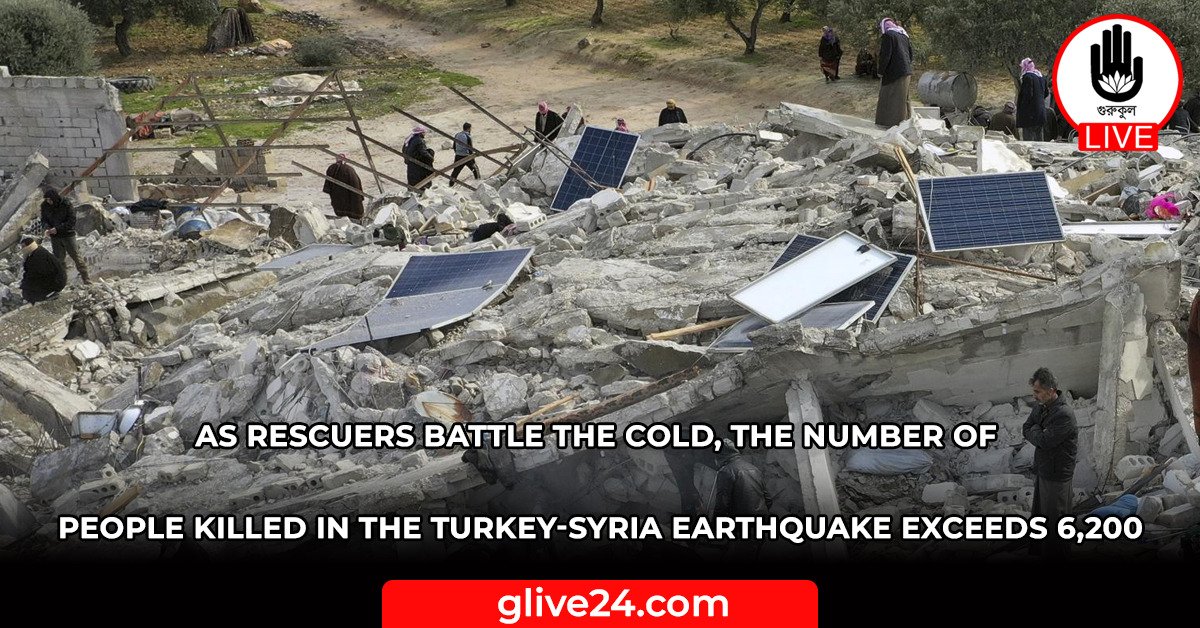
As rescuers battle the cold in Turkey and Syriabattled frigid cold Tuesday in a race against time to find survivors underbuildings flattened by a earthquake that killed more than 6,200 people.Tremors that inflicted more suffering on a border area, already plagued byconflict, left people on the streets burning debris to try to stay warm asinternational aid began to arrive.But some extraordinary survival tales have emerged, including a newborn
baby pulled alive from rubble in Syria, still tied by her umbilical cord to her mother who died in Monday’s quake.
As rescuers battle the cold, the number of people killed in the Turkey-Syria earthquake exceeds 6,200
“We heard a voice while we were digging,” Khalil al-Suwadi, a relative,told AFP. “We cleared the dust and found the baby with the umbilical cord(intact) so we cut it and my cousin took her to hospital. The infant is the sole survivor of her immediate family, the rest of whomwere killed in the rebel-held town of Jindayris.The 7.8-magnitude quake struck Monday as people slept, flattening thousandsof structures, trapping an unknown number of people and potentially impactingmillions.

Whole rows of buildings collapsed, leaving some of the heaviest devastationnear the quake’s epicentre between the Turkish cities of Gaziantep andKahramanmaras.The destruction led to Turkish President Recep Tayyip Erdogan declaringTuesday a three-month state of emergency in 10 southeastern provinces.- ‘Children are freezing’ –
Dozens of nations like the United States, China and the Gulf States havepledged to help, and search teams as well as relief supplies have begun toarrive by airplane.Yet people in some of the hardest-hit areas said they felt like they hadbeen left to fend for themselves.”I can’t get my brother back from the ruins. I can’t get my nephew back.Look around here. There is no state official here, for God’s sake,” said Ali Sagiroglu in the Turkish city of Kahramanmaras.
“For two days we haven’t seen the state around here… Children arefreezing from the cold,” he added.A winter storm has compounded the misery by rendering many roads — some ofthem damaged by the quake — almost impassable, resulting in traffic jams thatstretch for kilometres in some regions.The cold rain and snow are a risk both for people forced from their homes
— who took refuge in mosques, schools or even bus shelters — and survivorsburied under debris.
“It is now a race against time,” said World Health Organization chiefTedros Adhanom Ghebreyesus.”We have activated the WHO network of emergency medical teams to provideessential health care for the injured and most vulnerable,” he added.- 23 million could be affected
The latest toll showed 4,544 people killed in Turkey and 1,712 in Syria,for a combined total of 6,256 fatalities.There are fears that the toll will rise inexorably, with WHO officialsestimating up to 20,000 may have died.WHO warned that up to 23 million people could be affected by the massiveearthquake and urged nations to rush help to the disaster zone.
The Syrian Red Crescent appealed to Western countries to lift sanctions andprovide aid as President Bashar al-Assad’s government remains a pariah in theWest, complicating international relief efforts. Washington and the European Commission said on Monday that humanitarian programmes supported by them were responding to the destruction in Syria.
The UN’s cultural agency UNESCO also said it was ready to provideassistance after two sites listed on its World Heritage list in Syria andTurkey sustained damage.In addition to the damage to Aleppo’s old city and the fortress in thesoutheastern Turkish city of Diyarbakir, UNESCO said at least three other WorldHeritage sites could be affected. Much of the quake-hit area of northern Syria has already been decimated by
years of war and aerial bombardment by Syrian and Russia forces that destroyed homes, hospitals and clinics.
Residents in the quake-devastated town of Jandairis in northern Syria usedtheir bare hands and pickaxes to for survivors, as that was all they had to getthe job done “My whole family is under there — my sons, my daughter, my son-in-law…There’s no one else to get them out,” said Ali Battal, his face streaked withblood and head swathed in a wool shawl against the bitter cold.
“I hear their voices. I know they’re alive but there’s no one to rescuethem,” adds the man in his 60s.The Syrian health ministry reported damage across the provinces of Aleppo,
Latakia, Hama and Tartus, where Russia is leasing a naval facility.
Even before the tragedy, buildings in Aleppo — Syria’s pre-war commercialhub — often collapsed due to the dilapidated infrastructure. Following the earthquake, prisoners mutinied at a jail holding mostly Islamic State group members in northwestern Syria, with at least 20 escaping, asource at the facility told AFP.
Turkey is in one of the world’s most active earthquake zones.The country’s last 7.8-magnitude tremor was in 1939, when 33,000 died inthe eastern Erzincan province. The Turkish region of Duzce suffered a 7.4-magnitude earthquake in 1999,when more than 17,000 people died. Experts have long warned a large quake could devastate Istanbul, amegalopolis of 16 million people filled with rickety homes.