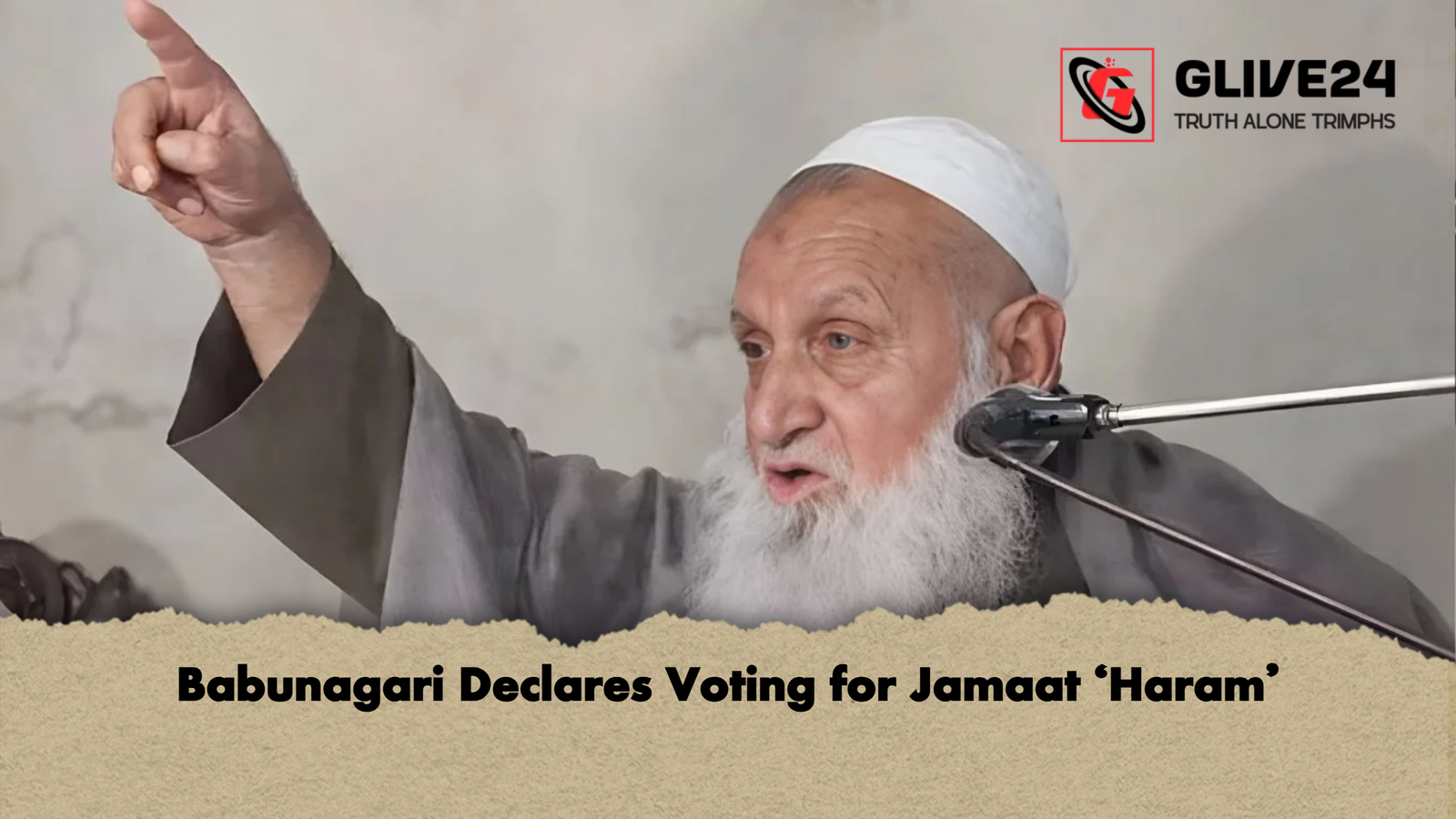
Allama Muhibbullah Babunagari, the Amir of Hefazat-e-Islam, has stirred fresh debate in Bangladesh’s political sphere by declaring that it is both “haram” and impermissible for Muslims to vote for the Jamaat-e-Islami party. His remarks, made at a religious gathering in Chattogram’s Fatikchhari Upazila, quickly went viral on social media, provoking intense reactions from multiple quarters.
The incident occurred on Thursday, 5 February, during a Mahfil organised at the Kazi’s Hat Boro Madrasa to mark the completion of the Bukhari Sharif Khatm. The event saw the presence of Sarwar Alamgir, the BNP-nominated candidate for Chattogram-2 (Fatikchhari) constituency. Speaking before the audience, Babunagari directly criticised Jamaat-e-Islami’s political role and ideological stance. “Tell all Muslims—voting for them is not permissible. It is haram,” he said. He further attempted to justify his statement from a religious perspective, labelling the party as harmful to the core principles of Islam.
Babunagari argued that if Jamaat-e-Islami were to attain power, it would undermine the foundations of Islam and weaken believers’ faith. He described the party as a misleading political force exploiting the name of Islam to confuse ordinary Muslims. Referring to it as “Maududi’s Jamaat,” he framed his opposition not merely as a political contest but as a form of ideological jihad. Pointing towards Sarwar Alamgir, Babunagari indicated that his efforts were being directed in alignment with the broader struggle against Jamaat’s influence.
The rhetoric employed by Babunagari was notably severe. He labelled Jamaat-e-Islami a “bloodsucking group,” raising questions over the boundaries and influence of religious leaders in political discourse. Analysts suggest that his remarks could be viewed as an attempt to mobilise religious sentiment ahead of the upcoming elections. While some followers expressed support for his stance, others warned that such statements risk deepening societal divisions and complicating democratic engagement, particularly by framing voting rights in terms of “halal” and “haram.”
This is not the first instance of Babunagari making stringent remarks against Jamaat-e-Islami. While Hefazat-e-Islam generally maintains a non-partisan position, it has historically shown strategic alignment with certain political forces at times. The broader social and political implications of these statements continue to unfold.
Key Details of the Event:
| Topic | Details |
|---|---|
| Speaker | Allama Muhibbullah Babunagari |
| Position | Amir, Hefazat-e-Islam |
| Venue | Kazi’s Hat Boro Madrasa, Fatikchhari |
| Date | 5 February (Thursday) |
| Occasion | Completion of Bukhari Sharif Khatm |
| Main Statement | Voting for Jamaat is haram |
| Political Presence | Sarwar Alamgir (BNP candidate) |
| Source of Controversy | Religious framing of voting |
In summary, Babunagari’s remarks have reopened discussions at the intersection of religion, politics, and electoral culture in Bangladesh. How such statements will influence political polarisation and the role of religious leadership in shaping public opinion remains to be seen in the coming weeks.