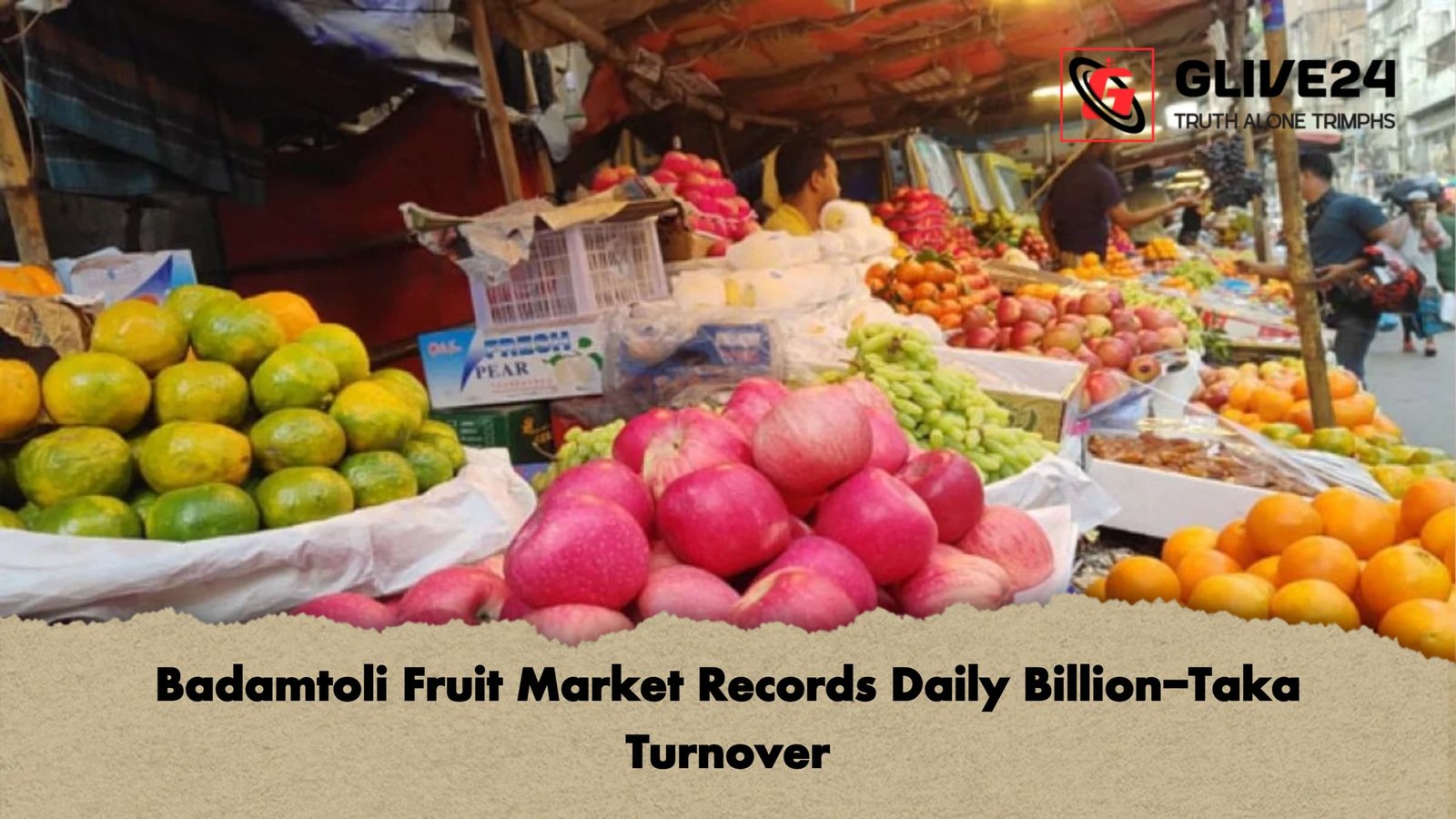
As the holy month of Ramadan commences, the historic Badamtoli Wholesale Market in Old Dhaka has transformed into a sprawling hub of frantic commerce. Serving as the primary artery for the nation’s fruit supply, this century-old marketplace is currently witnessing a staggering daily turnover estimated between 200 and 300 crore BDT. From the early hours of the morning, the riverfront near Sadarghat is a symphony of shouting auctioneers, laborous porters, and wholesalers distributing goods to every corner of Bangladesh.
Table of Contents
A Global Gateway for Ramadan Essentials
Badamtoli acts as the central clearinghouse for fruits imported from 46 different countries. While domestic produce remains popular, the demand for imported staples—particularly dates, apples, malta, and grapes—skyrockets during Ramadan. Dates, the quintessential Iftar item, see a sales volume in this single month that often eclipses the total sales of the remaining eleven months combined.
Despite a noticeable hike in the prices of import-dependent goods due to global economic fluctuations, the market remains resilient. Seasonal traders join established wholesalers, having booked slots months in advance to capitalise on the Ramadan rush.
Price Index: A Guide to the Date Market
The cost of dates varies significantly based on origin, size, and quality. While some varieties have remained stable, others, such as the Jihadi date, have seen a price surge of nearly 60% compared to last year.
Wholesale Price List (as of 3 March 2026):
| Date Variety | Weight/Unit | Wholesale Price (BDT) |
| Medjool (Premium Jumbo) | 5 kg Carton | 7,000 |
| Medjool (Standard) | 5 kg Carton | 5,500 |
| Mariam | 5 kg Carton | 4,000 – 5,000 |
| Ajwa | 5 kg Carton | 3,000 – 5,000 |
| Mabroom | 5 kg Carton | 4,000 – 5,000 |
| Kalmi | 5 kg Carton | 2,500 – 3,500 |
| Sukkari | 3 kg Carton | 1,800 – 2,400 |
| Jihadi | 10 kg Carton | 2,700 (vs 1,700 last year) |
Logistics and Economic Impact
Founded in 1935 during the British Raj, Badamtoli is not merely a local market but a significant contributor to the national exchequer, generating billions in revenue. Approximately 70% of the imported fruit arrives via the Chattogram Port, while the remaining 30% enters through land ports such as Hili, Benapole, and Bhomra.
Haji Mohammad Farhad Rana, a local political leader and businessman, emphasised the need for modernisation: “The government earns immense revenue from this sector. It is imperative to make this market business-friendly by resolving the chronic traffic congestion that plagues the Sadarghat and Ahsan Manzil areas.”
Domestic Fruit and Quality Control
Local seasonal fruits are also seeing high demand, though prices have crept upward. Watermelons are currently trading at 100–120 BDT per kg, while papayas reach 180 BDT. To ensure consumer safety during the peak season, the Fruit Traders Association has enforced strict guidelines. Selling expired or rotten dates is strictly prohibited, and traders are mandated to store goods on wooden planks rather than bare floors to maintain hygiene.
As the first fortnight of Ramadan progresses, traders remain optimistic. Despite the inflationary pressure on the middle and lower-income brackets, the cultural and religious significance of fruit for Iftar ensures that the “billion-taka-a-day” momentum at Badamtoli shows no signs of slowing down.f