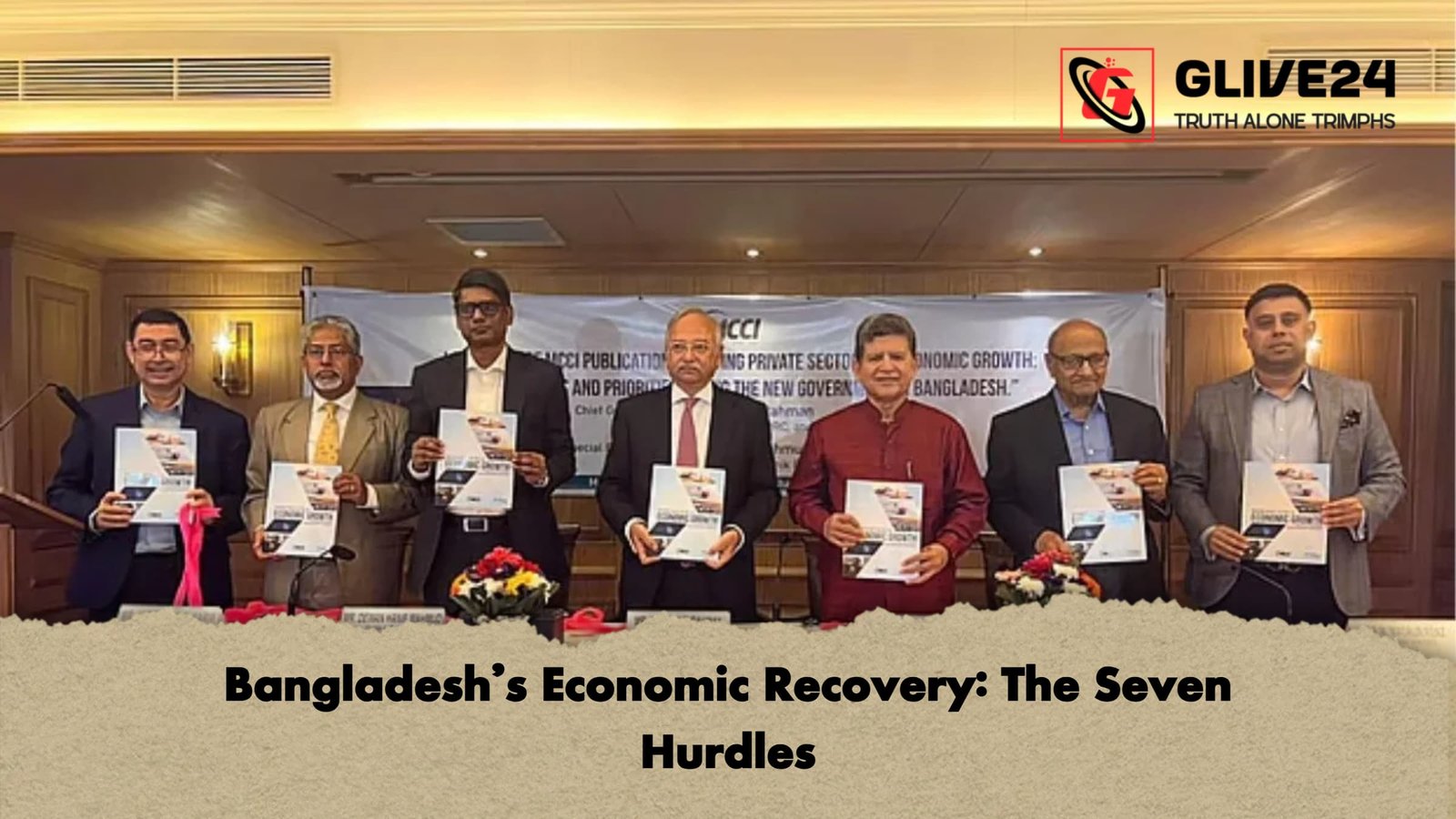
As the newly formed administration takes the helm, it inherits a landscape fraught with systemic vulnerabilities. A joint report released on Monday by the Metropolitan Chamber of Commerce and Industry (MCCI) and Policy Exchange Bangladesh has identified seven formidable hurdles that threaten to derail the nation’s growth trajectory.
During the launch event, titled “Revitalising Private Sector-Led Economic Growth,” experts warned that the government’s first 100 days will be a litmus test for its ability to restore investor confidence and initiate long-overdue structural reforms.
Table of Contents
The Seven Pillars of Economic Stress
The report categorises the current crisis into seven distinct areas requiring immediate intervention:
| Challenge | Primary Concern |
| Macroeconomic Pressure | Persistent high inflation eroding purchasing power. |
| Fiscal Management | Weak revenue collection and rising debt-servicing costs. |
| Financial Fragility | Governance deficits in banking and surging non-performing loans (NPLs). |
| Export Concentration | Over-reliance on the RMG sector with limited diversification. |
| Investment Climate | Stagnant private investment and bureaucratic red tape. |
| Energy Insecurity | Rising costs and supply shortages impacting industrial output. |
| Human Capital | A widening gap between market demand and available workforce skills. |
The Perils of “Short-Termism”
Hossain Zillur Rahman, Executive Chairman of the Power and Participation Research Centre (PPRC), delivered a scathing critique of the prevailing administrative culture. He argued that the state has become trapped in “short-termism”—focusing on temporary fixes rather than long-term structural integrity.
Citing the energy sector as a primary example, Rahman noted that while Bangladesh successfully defined its maritime boundaries in the Bay of Bengal years ago, it has failed to follow through with effective gas exploration. “Our neighbours, such as Myanmar, have fully explored their territories,” he remarked. “We celebrate the ‘conquest of the sea’ in seminars, yet our actual extraction capacity remains stagnant.”
Bureaucracy and the Cost of Harassment
The forum also highlighted that institutional “harassment” is often more damaging than outright corruption. Rahman pointed out that when a one-day permit takes a month to process, the resulting economic paralysis is profound. He further noted that the government’s ability to command the bureaucracy remains a concern, referencing the controversial appointment and removal processes within the Central Bank as evidence of administrative friction.
A Call for Transparency
Dewan Hanif Mahmud, Editor of Bonik Barta, urged the government to conduct comprehensive forensic audits of major state-owned enterprises, including Petrobangla, the Bangladesh Petroleum Corporation (BPC), and state-run banks. “We need a realistic picture of assets and liabilities,” he asserted. “Many of these institutions are financially frail, yet their true condition remains obscured due to a lack of investigation.”
The consensus among the business elite is clear: isolated efforts will fail. Only an integrated economic management strategy—one that empowers the private sector and embraces transparency—can pull the economy back from the brink.