
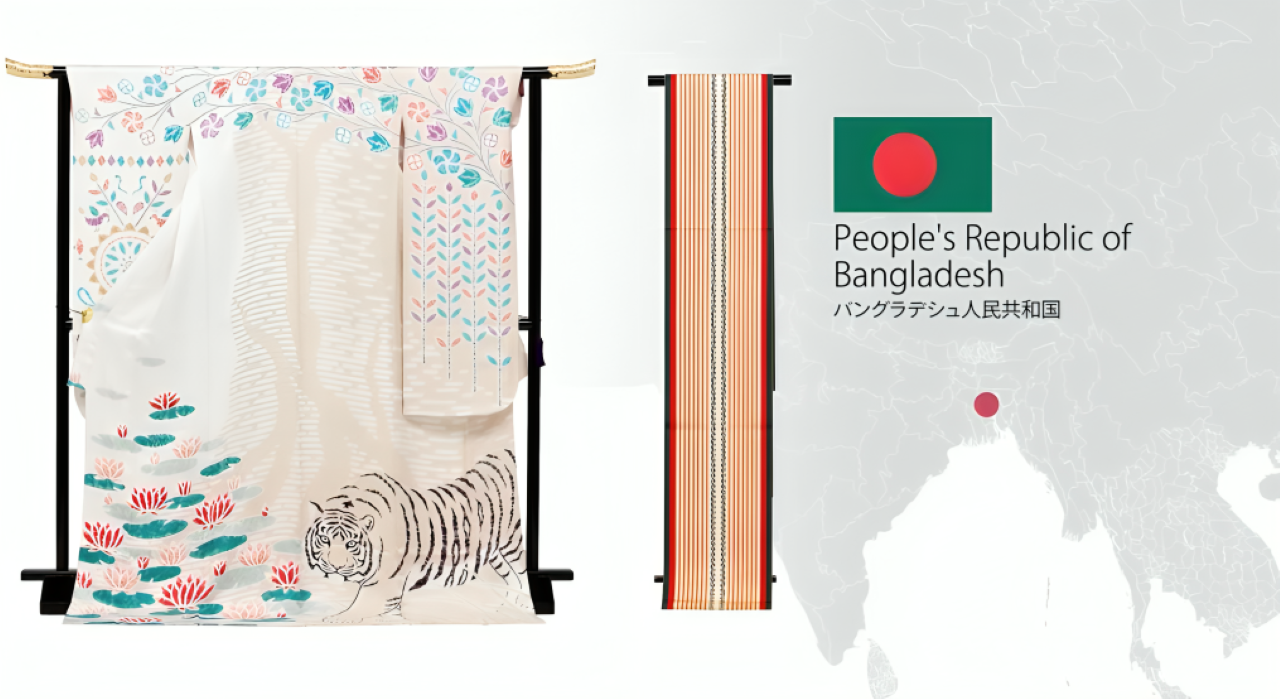
In a remarkable blend of tradition, artistry and cross-cultural respect, Bangladesh was honoured at the Tokyo Olympics through a specially designed kimono, created by Japanese artists to reflect the country’s rich heritage. This unique garment was produced as part of “The Kimono Project”, an international cultural initiative launched in connection with the Tokyo 2020 Olympic Games.
The Bangladesh kimono was designed by Takeshi Fukumura, a kimono artist from Kyoto Prefecture, while the accompanying obi—the wide sash worn around the waist—was crafted by Kaoru Sei from Fukuoka Prefecture. Together, their work sought to visually interpret Bangladesh’s identity through traditional Japanese textile art.
Table of Contents
A Vision of “Golden Bengal”
The central theme of the kimono is inspired by the concept of “Golden Bengal”, a poetic phrase symbolising Bangladesh’s natural beauty, fertility, and cultural depth. The robe features a golden base, upon which lotus flowers are delicately dyed—an emblem of purity and renewal. Interwoven into the design are motifs of cotton and jute flowers, both of which are deeply connected to Bangladesh’s agrarian economy and historical trade.
The overall pattern draws inspiration from nakshi kantha, the traditional embroidered quilts of rural Bengal, known for their intricate stitching and storytelling motifs. Adding a powerful national symbol, a Royal Bengal Tiger—Bangladesh’s national animal—appears printed on the lower half of the kimono, representing strength, resilience, and pride.
The obi complements the robe beautifully. Inspired by the traditional Hakata weave, it is entirely handwoven and incorporates the green and red colours of the Bangladeshi flag, reinforcing the garment’s national symbolism.
The Kimono Project: Art as Cultural Diplomacy
The Kimono Project was initiated in 2014 by Yoshimasa Takakura, president of Fukuoka-based kimono retailer Choya Co. The project’s mission is twofold: to preserve and showcase the craftsmanship of kimono-making, and to foster cultural unity by representing each Olympic nation through a uniquely designed kimono.
Every country participating in the Tokyo Olympics received its own custom kimono. Bangladesh’s version was completed in March 2017 and officially unveiled at a special event in June 2018.
Key Facts at a Glance
| Aspect | Details |
|---|---|
| Designers | Takeshi Fukumura (kimono), Kaoru Sei (obi) |
| Theme | “Golden Bengal” |
| Key Motifs | Lotus, nakshi kantha, cotton, jute, Royal Bengal Tiger |
| Project Initiated | 2014 |
| Bangladesh Kimono Released | March 2017 |
| Estimated Cost | ¥1,000,000 (approx. BDT 770,000) |
| Funding | Crowdfunding & corporate sponsorship |
| Sponsor | JCI RUMOI/Nishikido |
| Exhibitions | Tokyo Olympics, Osaka-Kansai Expo 2025 |
Each kimono reportedly cost around one million Japanese yen, funded entirely through crowdsourced donations and corporate sponsorships. The Bangladesh kimono was sponsored by Junior Chamber International (JCI), RUMOI/Nishikido.
Exhibition and Legacy
Originally, the plan was for athletes to wear these kimonos during the Olympic opening ceremony parade. However, this idea was abandoned due to restrictions imposed by the COVID-19 pandemic. Instead, the kimonos were displayed as part of the Olympic cultural exhibitions.
While most garments were created exclusively by Japanese designers, the project also embraced inclusivity—most notably in the Palestinian kimono, whose obi was made by refugees.
As of now, there has been no confirmation on whether the kimonos will be sold commercially. Following their Olympic exhibition, they are scheduled to be displayed again at the Osaka-Kansai Expo in 2025, ensuring that Bangladesh’s cultural story—woven in silk, colour, and symbolism—continues to reach a global audience.