
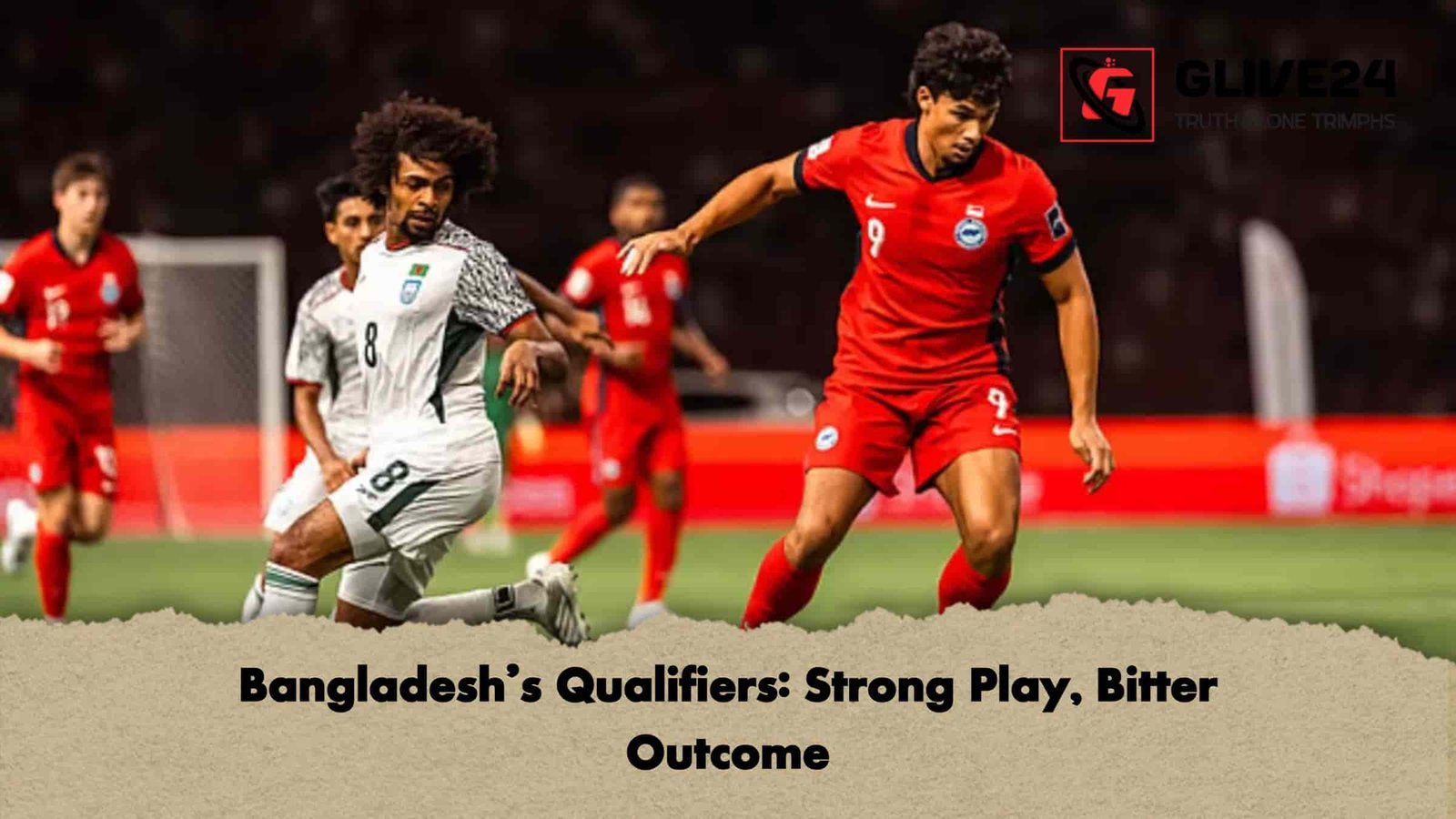
Bangladesh’s journey in the 2027 Asian Cup qualifiers ended in narrow disappointment, highlighting the complex reality of football: playing well does not always guarantee victory. In their final match, Bangladesh fell 1–0 to Singapore on their home turf, a defeat that masked the team’s overall competitive performance.
Despite losing, the team often dominated possession, created scoring opportunities, and controlled the rhythm of matches. The failure to convert chances into goals, however, ultimately prevented Bangladesh from reaching the tournament proper. This campaign, while frustrating, also showcased a national side on the rise.
Campaign Summary
With standout players such as Hamza Chowdhury, Shomit Som, Fahamidul Islam, and Zayan Ahmed, many analysts labelled this Bangladesh squad as potentially the strongest in the country’s history. Across six qualifying matches, the team accumulated five points, finishing third behind India, a performance marked by both promise and missed opportunities.
| Matchday | Opponent | Venue | Result | Points Earned |
|---|---|---|---|---|
| 1 | India | Away | 1–1 | 1 |
| 2 | Hong Kong | Home | 3–3 | 1 |
| 3 | Singapore | Away | 0–1 | 0 |
| 4 | India | Home | 0–0 | 1 |
| 5 | Hong Kong | Away | 0–0 | 1 |
| 6 | Singapore | Home | 1–2 | 1 |
The campaign featured notable highs and lows. Against Hong Kong in Dhaka, Bangladesh staged a remarkable comeback from 1–3 down to draw 3–3, only to concede a late fourth goal due to over-exuberance. In Singapore, the team dominated play but failed to score, leaving frustration as the defining emotion.
Insights from Experts
Former national coach Shafiqul Islam Manik observed that while the team’s quality matched mid-tier opponents like Singapore and Hong Kong, converting control into results remained an issue. “If results are the final measure, the coach has not delivered. Cabrera’s team often played well but lacked finishing,” he noted.
Alfaz Ahmed, coach of Mohammedan Sporting Club, cited inconsistent selection and the absence of a decisive striker as key shortcomings. “Cabrera could not establish a stable squad; players rotated too frequently, leaving no alternatives,” he explained.
Former striker Zahid Hasan Emily emphasised that the campaign reflected progress in competitiveness and team strength but was insufficient in translating into results. “Bangladesh should have finished at least second. While the team has improved, outcomes lag behind capability. A coaching change is necessary for future success,” he stated.
Conclusion
Bangladesh’s qualifiers left a dual legacy: pride in the team’s development and frustration at squandered opportunities. The campaign highlighted the need for tactical refinement, consistent player selection, and a clinical striker. Moving forward, balancing potential with results will be essential if Bangladesh hopes to return to the Asian Cup stage after decades of absence.