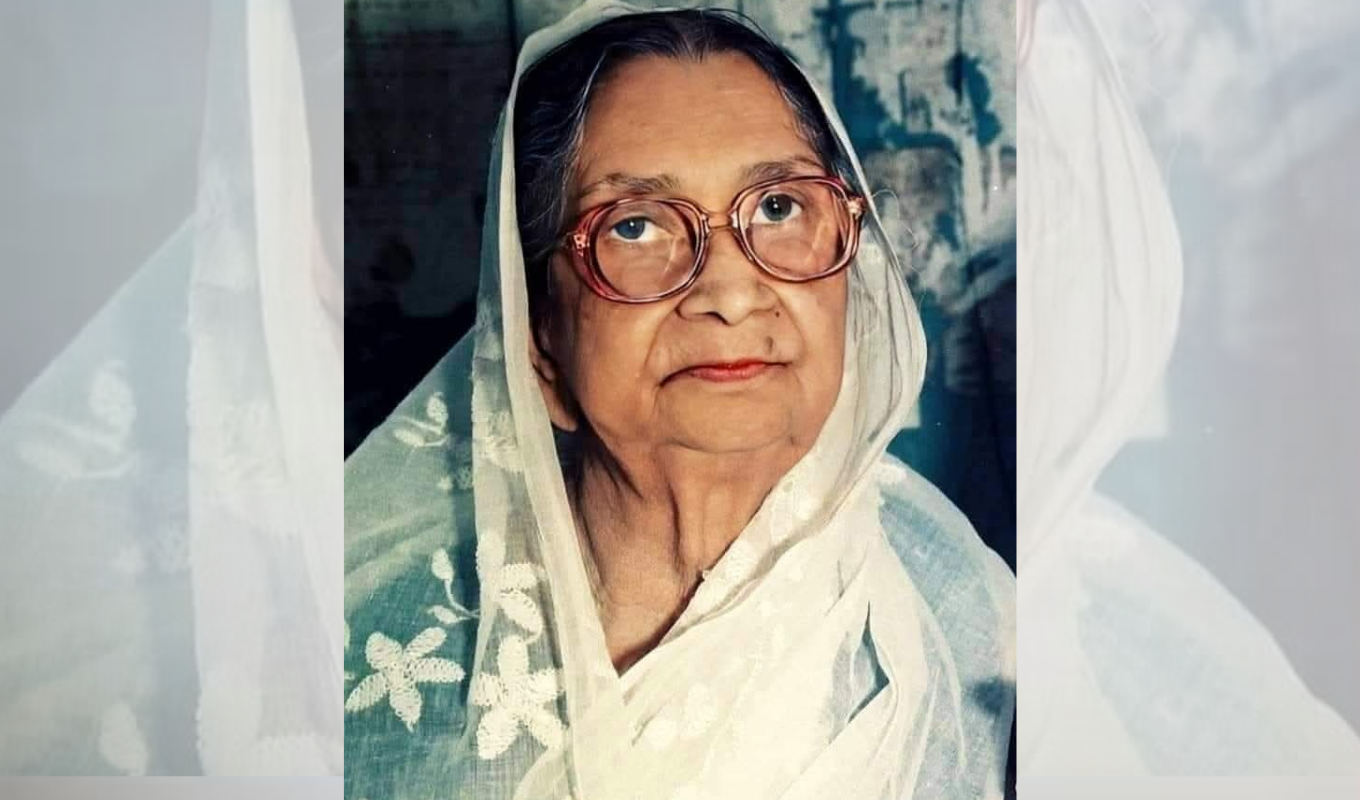
In the history of Bengali literature, the Liberation War, women’s awakening, and humanity, Begum Sufia Kamal stands as a revered name. Her personality embodied both the tenderness of a poet and the determination of a courageous leader. Compassion, emotions, love, and humanity shaped her life; she emerged as a guiding light who taught Bengali women self-respect and confidence.
Birth and Early Life:
Begum Sufia Kamal was born on 20 June 1911 into a respected family in Shayestabad of greater Barishal. At a time when education for Bengali Muslim women was a distant dream, she grew up as a self-taught, strong and visionary woman. She learned her first lessons in Bengali from her mother, Sabera Begum. At the age of 13, she married her cousin Syed Nehal Hossain, who encouraged her literary pursuits.
Journey into Literature:
Her first poem, Basanti, was published in 1926 in the magazine Saogat, marking the emergence of a new poetic voice. Later, as the founding editor of Begum magazine, she played a pioneering role in promoting women’s rights, education, social awareness, and literature.
A Vanguard of Social and National Movements:
After the partition of India in 1947, she moved from Kolkata to Dhaka with her family.
She actively participated in the Language Movement and inspired women to join the protests—an act that was revolutionary at that time.
In independent Bangladesh, she was a brave champion of women’s rights, equality, human dignity, and secular values.
Humanity, freedom, and democracy were the cornerstones of her philosophy.
Literary Contributions:
Her writings reflect her life’s philosophy and humanitarian ideals. Notable works include:
Sanjher Maya
Maya Kajol
Mon O Jibon
Shanti O Prarthona
Story Collection: Kear Kata
Travelogue: Soviet Dinguli
Memoir: Ekattorer Diary—an invaluable record of the Liberation War.
Honours and Recognition:
For her extraordinary contributions to literature, culture, and women’s empowerment, she received:
Ekushey Padak
Bangla Academy Literary Award
Begum Rokeya Padak
National Poetry Award
Independence Day Award
These honours highlight the greatness of her work and legacy.
Demise and Eternal Reverence:
Begum Sufia Kamal passed away on 20 November 1999. Even after her death, she remains a symbol of poetic brilliance, a flame of resistance, and a voice of humanity—guiding countless hearts.
Tribute:
Begum Sufia Kamal—who inspired women to dream, infused literature with humanity, and became a torchbearer in national struggles—will forever be remembered with reverence, love, and gratitude.
SS