
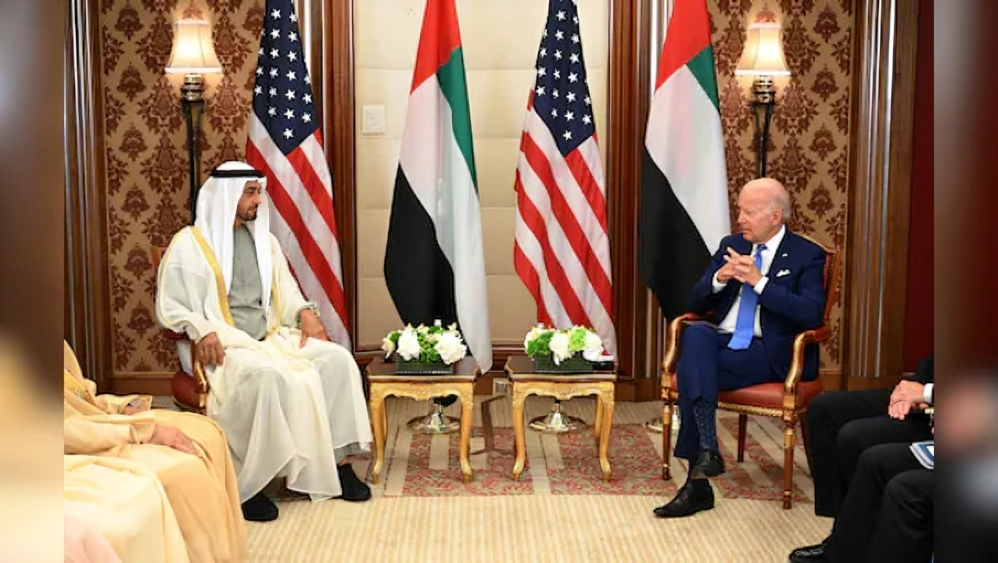
The administration of Joe Biden has formally notified the United States Congress of its intention to move forward with a major arms sale to the United Arab Emirates (UAE) valued at approximately $23 billion. The package includes advanced fifth-generation fighter aircraft, armed unmanned aerial systems, and a wide range of precision-guided munitions.
The deal was initially negotiated under former US President Donald Trump and was temporarily paused earlier this year as the Biden administration undertook a comprehensive policy review of arms transfers, particularly to the Middle East.
Table of Contents
Details of the Proposed Arms Sale
| Equipment | Manufacturer | Quantity |
|---|---|---|
| F-35 Lightning II fighter aircraft | Lockheed Martin | 50 |
| MQ-9B Unmanned Aerial Systems | General Atomics | Up to 18 |
| Air-to-air and air-to-ground munitions | Raytheon Technologies | Various |
A spokesperson for the US State Department confirmed that while the administration has decided to proceed, it will continue close consultations with Emirati authorities to ensure that the weapons are used responsibly and in line with international norms.
Diplomatic and Strategic Background
The arms agreement is closely linked to the Abraham Accords, the US-brokered normalisation agreements signed in 2020 between Israel and several Arab states, including the UAE. The Trump administration formally notified Congress of its approval in November 2020 and finalised the deal on 20 January 2021—just one hour before President Biden was sworn into office.
Israel, which traditionally maintains a qualitative military edge in the region, has stated publicly that it does not oppose the sale, following reassurances from Washington regarding its long-standing security commitments.
Humanitarian and Political Concerns
Despite support from many Republican lawmakers, the deal has drawn criticism from several members of Congress and human rights organisations. Concerns centre on the UAE’s involvement in the conflict in Yemen, widely regarded as one of the world’s gravest humanitarian crises. Critics argue that supplying advanced offensive weaponry could exacerbate regional instability and potentially undermine US human rights commitments.
The Biden administration has simultaneously been reassessing arms sales to other regional partners, notably Saudi Arabia, signalling a shift towards restricting transfers to defensive systems only in certain cases.
Timeline and Conditions
Delivery of the aircraft and systems is not expected before 2025, giving Washington additional time to monitor regional developments and ensure compliance with agreed conditions. US officials have emphasised that the equipment must be securely stored, properly maintained, and used strictly in accordance with international humanitarian law and the laws of armed conflict.
As geopolitical dynamics in the Middle East continue to evolve, the $23 billion UAE arms deal is set to remain a focal point of US foreign and defence policy—balancing strategic partnerships, regional security, and humanitarian considerations.