
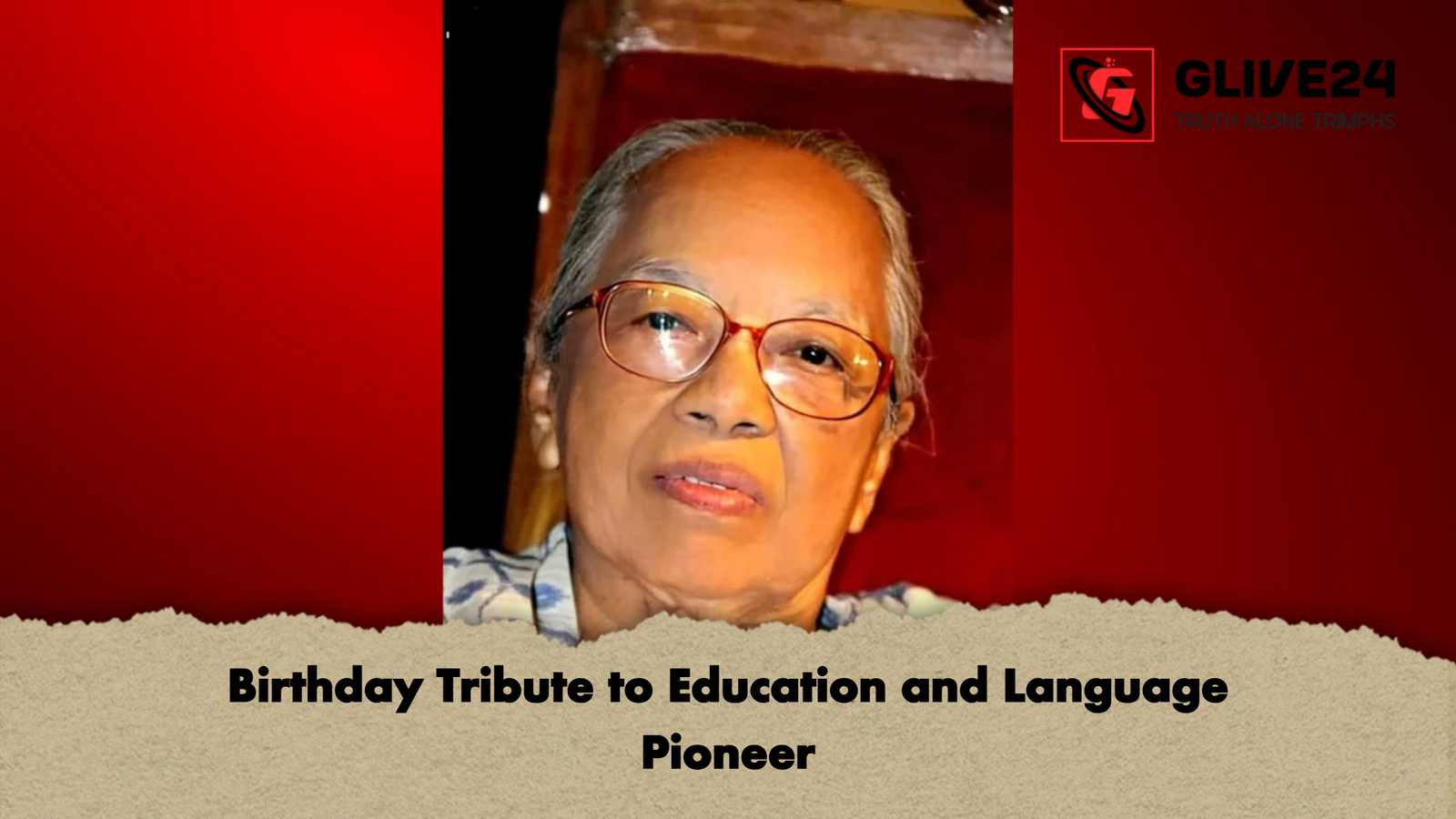
Some people illuminate the world not by seeking attention, but by quietly radiating light, inspiring others through their own brilliance. Professor and language activist Pratibha Mutsuddy is precisely such a luminary—a woman whose life has been dedicated to the cause of education, humanitarian values, and the protection of linguistic heritage. A pioneer of women’s education, a devoted teacher, and a courageous participant in the language movement, her contributions continue to inspire generation after generation.
Pratibha Mutsuddy was born on 16 December 1935, in the village of Mahamuni Pahartali, in Rawnzan, Chattogram. Her father, Kiran Bikash Mutsuddy, was a renowned lawyer, while her mother, Shailabala Mutsuddy, was a gentle, principled homemaker. Raised in a nurturing environment, she imbibed values of humanity, justice, and social awareness from an early age.
Although her formal education began in a small village school, her intelligence and determination quickly propelled her forward. She completed her matriculation from the esteemed Dr. Khastagir Government Girls’ School in Chattogram in 1951, followed by her intermediate studies at Chattogram College in 1953. She then pursued economics at the University of Dhaka, earning a Bachelor’s (Honours) in 1956 and a Master’s degree in 1959. To further her pedagogical skills, she obtained a B.Ed. from Mymensingh Women’s Teachers’ Training College in 1960.
Her formative years coincided with turbulent times—anti-British movements, the Second World War, the Partition, and the struggle for linguistic rights. Even as a teenager, she was socially conscious and active in protest movements. While a student at Chattogram College, she participated actively in the historic language movement. In 1955, as a University of Dhaka student, she was arrested during a self-determination march and spent two weeks in prison, a testament to her indomitable spirit.
Her leadership in student politics was remarkable. In 1955–56, she served as editor of the Women’s Assembly at Dhaka University Student Union, and in 1956–57, she became the first elected Vice President of Rokeya Hall, making history. Yet, after her student years, she chose a path of service to society rather than pursuing political power.
In 1963, she joined Bharateshwari Homes as an economics lecturer, and in 1965, assumed the role of principal, ushering in a new era of women’s education. Under her leadership, Bharateshwari Homes achieved national recognition, becoming a top school in 1987 and a leading college by 1995. Over thirty-three years, countless students blossomed under her guidance, growing into self-reliant, capable individuals.
Currently, she serves as a director of Kumudini Welfare Trust of Bengal Limited and as administrator of the Mirzapur Kumudini Complex. Recognised for her lifelong contributions, she has received the Language Fighter Award, the Ekushey Padak in 2002, and the Bangla Academy Fellowship in 2017. Though unmarried, her family has been the institutions she nurtured.
On her birthday, we pay heartfelt tribute to this extraordinary woman—a beacon of light whose legacy of education, courage, and service continues to shine brightly.