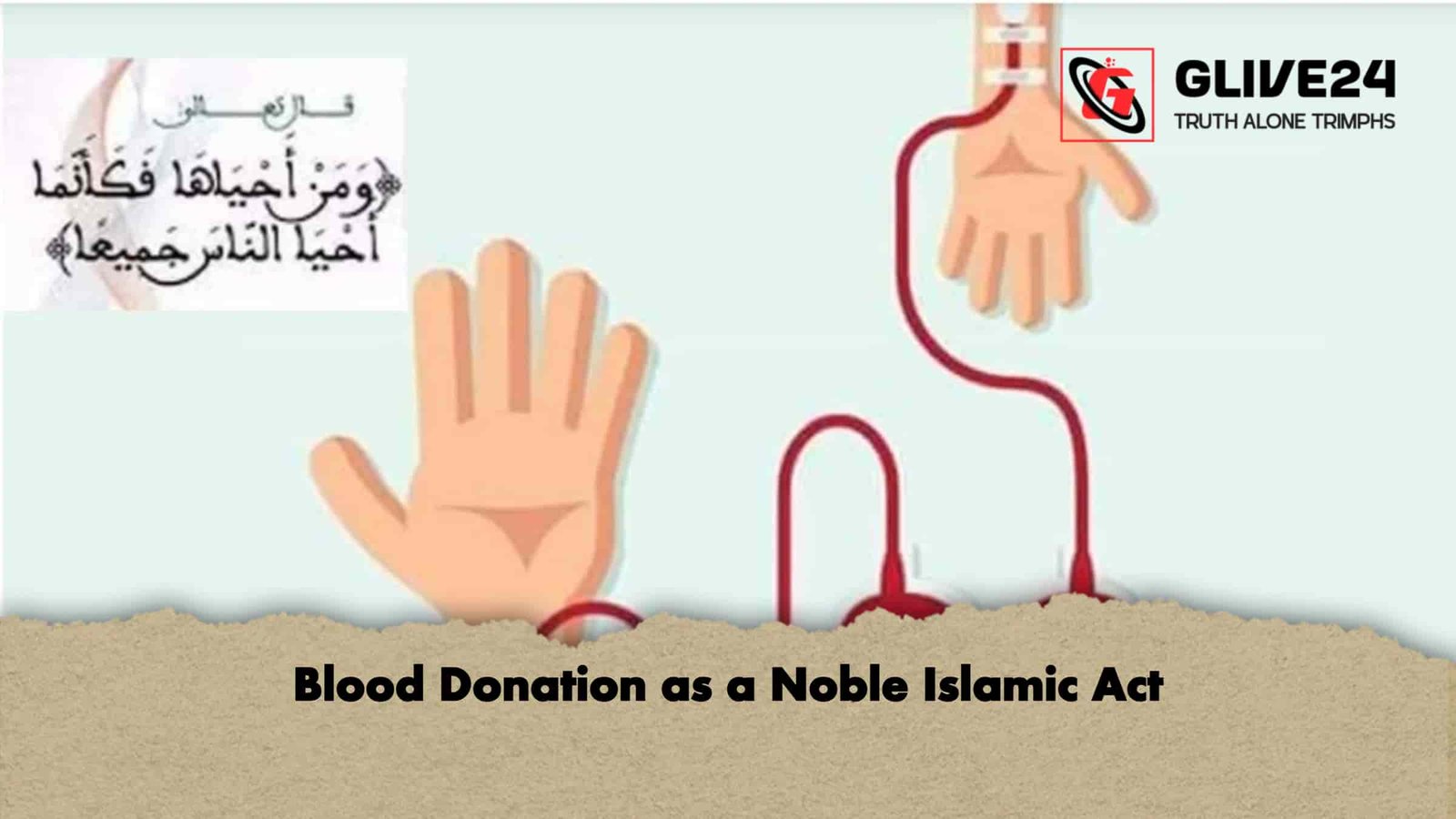
Few deeds are as exalted as the preservation of human life. Across hospitals and emergency units every day, countless patients stand at the fragile boundary between life and death due to the unavailability of blood. Victims of road accidents, patients undergoing major surgery, women facing complications during childbirth, and those suffering from chronic or infectious illnesses such as thalassaemia, cancer, or dengue often rely on safe blood as their final lifeline. In such critical moments, voluntary blood donation transcends the realm of medical assistance alone; it becomes a moral responsibility, a manifestation of social solidarity, and, from an Islamic perspective, a noble act of worship.
Islam accords the highest sanctity to human life. The Holy Qur’an unequivocally declares that saving a single life is akin to saving the entirety of humankind. This profound ethical injunction teaches that any action contributing directly to the preservation of life holds immense value in the sight of Allah. Blood donation represents a practical and tangible application of this principle. A healthy individual, by enduring minimal discomfort, creates an opportunity for another human being to live—an act that epitomises selflessness and compassion.
The sayings of the Prophet Muhammad (peace be upon him) further reinforce the centrality of serving others. He taught that the best among people are those who are most beneficial to humanity, and that whoever alleviates the hardship of a believer in this world will have their hardship alleviated by Allah on the Day of Judgement. When a donor provides blood at a moment of urgency and saves a patient’s life, these teachings cease to be abstract ideals and instead find vivid expression in real life.
From the standpoint of Islamic jurisprudence, blood donation is both permissible and commendable, provided it does not pose serious harm to the donor. Contemporary scholars broadly agree that donating blood within a safe medical framework, and without expectation of worldly gain, falls under the category of sadaqah (charitable giving). If the intention is to seek Allah’s pleasure and ease the suffering of others, the spiritual reward is believed to multiply manifold.
Practical awareness is also essential in blood donation. Not all blood types are universally compatible, and understanding blood groups can significantly enhance the effectiveness of emergency response. The following table outlines common blood groups and their clinical importance:
| Blood Group | Can Donate To | Emergency Significance |
|---|---|---|
| O Positive | Most positive blood groups | Highest demand overall |
| O Negative | All blood groups | Critical in emergencies |
| A Positive | A and AB positive | Widely used in surgical procedures |
| B Positive | B and AB positive | Vital for chronic disease patients |
| AB Positive | AB positive only | Rare yet indispensable |
The benefits of blood donation extend well beyond the immediate moment. A life saved today may continue to support a family, contribute productively to society, and even go on to save other lives in the future. In this way, a single act of donation can initiate a chain of goodness comparable to sadaqah jariyah—a form of ongoing charity whose rewards endure.
The responsibility, therefore, is clear. Those who are healthy and eligible should come forward regularly to donate blood, promote awareness within their communities, and offer help without expectation of recognition or praise. The sole objective should be the preservation of life for the sake of Allah’s pleasure.
In conclusion, voluntary blood donation is a living embodiment of the Qur’anic and Prophetic call to serve humanity. A single drop of blood can open the door to renewed hope and life. May Allah grant us all the ability and sincerity to participate in this noble act of worship.