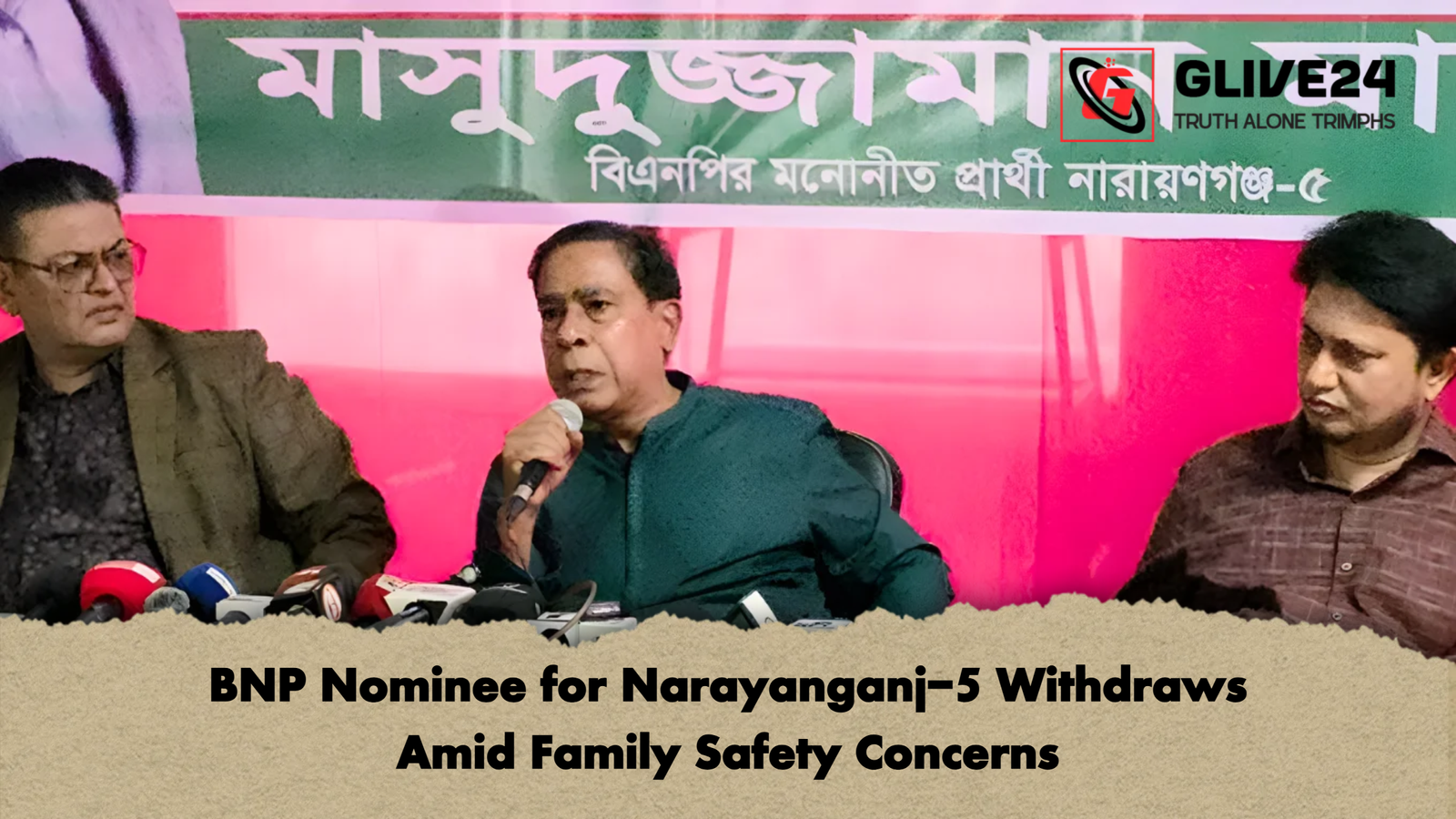
Masuduzzaman Masud, the BNP’s official candidate for Narayanganj-5 (Sadar-Bandar), has formally announced his decision to withdraw from the upcoming parliamentary elections. At a press conference held on 16 December at the Narayanganj Press Club, Masud made it clear that he would neither file his nomination papers nor participate in the electoral process.
Addressing the media, Masud explained, “I have received widespread encouragement during my campaign over the past five to six months. However, due to personal matters and surrounding circumstances, I have had to take this difficult decision. My family is concerned about security issues and has asked me not to contest the election. I apologise to everyone affected by my decision.”
The press conference was attended by key members of the local press and political figures, including the Narayanganj Press Club President Abu Saud Masud, General Secretary Afzal Hossain Ponty, Vice President Billal Hossain Robin, former General Secretary Rafiqul Islam Jibon, and journalist Arif Alam Dipu, among others. Their attendance underscored the significance of Masud’s decision and reflected the heightened media attention surrounding electoral developments in the region.
The announcement comes in the wake of BNP’s Standing Committee meeting on 3 November, which declared candidates for 237 constituencies nationwide. Narayanganj saw nominations for four of its five constituencies, with Masud initially nominated for Narayanganj-5. The remaining constituencies were assigned to Mostafizur Rahman Dipu Bhuiyan (Narayanganj-1), Nazrul Islam Azad (Narayanganj-2), and Azharul Islam Mannan (Narayanganj-3).
Political analysts suggest that Masud’s withdrawal may have a substantial impact on the electoral dynamics in Narayanganj-5. With the sudden absence of the initially selected candidate, the BNP will be required to adjust campaign strategies, mobilise supporters behind a replacement nominee, and navigate potential uncertainties among voters. This development also highlights the sensitive interplay between personal considerations and political commitments, illustrating how security concerns and familial advice can directly influence high-stakes electoral decisions.
The decision may also have implications beyond Narayanganj, as parties across Bangladesh observe how individual candidate withdrawals can alter local party cohesion, voter confidence, and election outcomes. The BNP’s response in reallocating resources and consolidating support behind the new candidate will likely be closely monitored in the coming weeks.