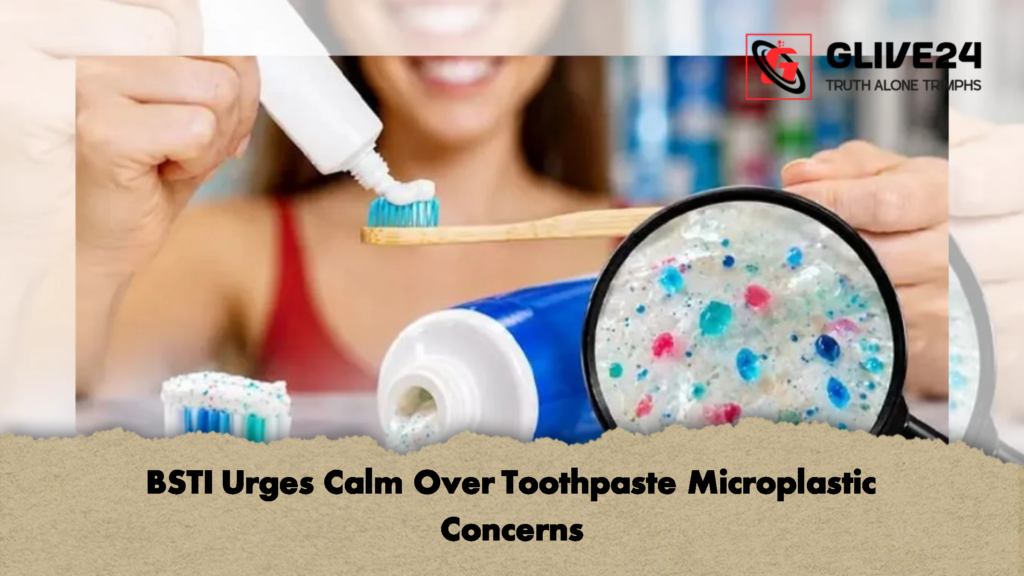
The Bangladesh Standards and Testing Institution (BSTI) has urged the public not to panic amid growing consumer anxiety regarding the alleged presence of microplastics in various domestic toothpaste brands. The national standards body clarified that deeming any consumer brand unsafe or sub-standard without comprehensive scientific and legal verification is premature and inappropriate.
In a press release issued on Tuesday, 28 July, BSTI announced plans to collect fresh samples from both retail markets and manufacturing facilities for re-testing at accredited domestic and international laboratories. The regulator reaffirmed that if any product fails to comply with established Bangladesh Standards (BDS) or is found to contain unauthorised substances, strict legal action will be taken against the offending companies.
The public debate was triggered by a recent study conducted by the Environment and Social Development Organisation (ESDO), a non-governmental research group. ESDO reported finding microplastics in 26 out of 34 toothpaste samples tested. Acknowledging the sensitive nature of the findings, BSTI emphasised that it is treating the matter with utmost gravity given its direct implications for public health and environmental safety.
Microplastics are defined as plastic particles measuring five millimetres or less, rendering them virtually invisible to the naked eye. According to the World Health Organisation (WHO), whilst microplastics represent an emerging environmental concern, global research into their precise health risks remains ongoing, and further scientific data is required to establish definitive health thresholds.
The primary aspects of the regulatory context and the study’s scope are detailed below:
| Parameter / Metric | Description / Statutory Detail |
| National Regulatory Authority | Bangladesh Standards and Testing Institution (BSTI) |
| Research Organisation | Environment and Social Development Organisation (ESDO) |
| Total Brands/Samples Tested in Study | 34 samples |
| Samples Alleged to Contain Microplastics | 26 samples |
| Definition of Microplastics | Plastic particles measuring 5 mm or smaller |
| Permissible Ingredients under BDS | 81 specified raw materials for toothpaste formulation |
| Inclusion of Microplastics in BDS List | Excluded (Not permitted as intentional ingredients) |
| United States Regulatory Cut-off | Banned intentionally added microbeads in rinse-off cosmetics in 2015 |
| European Union Compliance Deadline | Set a phase-out transition period ending October 2027 |
| Regional Standard Frameworks (India, Pakistan, Sri Lanka) | No uniform test method or limit for unintentional microplastics |
BSTI explained that Bangladesh’s national quality standard for toothpaste explicitly lists 81 approved raw materials, none of which include microplastics. Consequently, licensed manufacturers are not permitted to intentionally incorporate microplastic beads into their production lines.
The regulator noted that detecting trace synthetic particles in a laboratory test does not automatically prove that a manufacturer added them deliberately or that the product poses an immediate health hazard. Establishing safety impacts requires detailed analysis of particle types, origins, concentration levels, and toxicological risks.
BSTI has formally requested the full research data and testing methodology from ESDO. Simultaneously, the institution is gathering comprehensive information from local manufacturers and importers regarding raw material sourcing, chemical composition, and any use of synthetic polymers.
A multi-stakeholder technical committee—comprising subject-matter experts, research institutions, the Department of Environment, the Directorate General of Drug Administration (DGDA), dental professionals, industry representatives, and consumer advocacy groups—has been convened to review existing national toothpaste standards. Should scientific evidence warrant it, BSTI pledged to update current regulations by enforcing a strict ban on intentionally added plastic microbeads, mandating full ingredient disclosures, and introducing standardised testing procedures.