
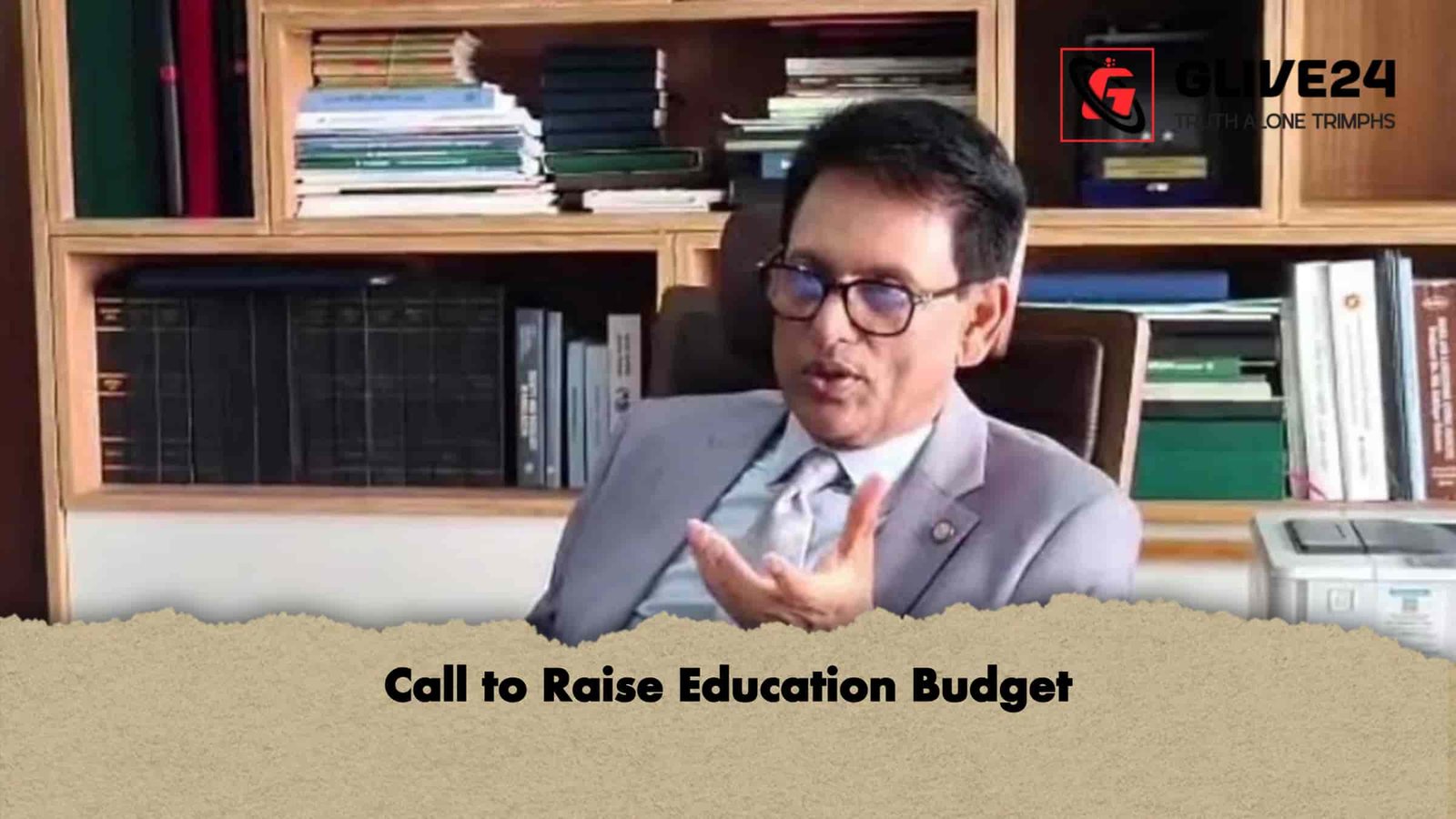
The newly appointed Education Minister of Bangladesh, A N M Ehsanul Haque Milon, has urged a significant increase in national spending on education, describing the sector as the cornerstone of sustainable development and long-term economic resilience.
Addressing journalists at the Secretariat on Wednesday (18 February) after assuming office, the minister stated that although the country has progressed steadily since independence, education has yet to secure the primacy it warrants in national fiscal planning. In the formative decades of state-building, he acknowledged, priority was understandably given to food security, poverty alleviation, and infrastructure development. However, in an era defined by digital transformation, automation and global competition, he argued that the transition to a knowledge-driven economy necessitates a fundamental recalibration of budgetary priorities.
At present, Bangladesh allocates roughly 2 per cent of its gross domestic product (GDP) to education. This figure, the minister observed, falls well short of the internationally endorsed benchmark of between 4 and 6 per cent. For a country aspiring to strengthen its demographic dividend and enhance labour productivity, he suggested that raising the allocation to at least 5 per cent of GDP would be both prudent and strategic.
He emphasised, however, that expanding fiscal space must be accompanied by structural reform. “Quantitative increases without qualitative transformation will not generate sustainable returns,” he remarked. Strategic planning, transparent governance, performance-based budgeting and effective monitoring mechanisms, he added, are indispensable to ensure that additional funds translate into measurable improvements.
Regional Comparison of Education Spending
A comparative overview of selected South Asian economies illustrates Bangladesh’s relative position:
| Country | Education Spending (% of GDP) | Strategic Orientation |
|---|---|---|
| Bangladesh | ~2% | Emphasis on primary education and infrastructure |
| Nepal | ~4% | Focus on inclusive and basic education expansion |
| Sri Lanka | ~3–4% | Investment in higher education and human capital |
The minister noted that neighbouring countries are progressively aligning educational expenditure with innovation policy, skills development and research capacity-building. Such alignment, he argued, is essential if Bangladesh is to remain competitive in regional and global markets.
On the subject of curriculum reform, he characterised change as an iterative process requiring evidence-based policymaking. Revisions must reflect labour market dynamics, technological advancement and international academic standards. He pledged broad consultation with academics, teachers and policy experts before implementing substantive reforms.
Responding to public concerns about examination malpractice and institutional discipline, he affirmed that strengthening accountability frameworks would be an immediate priority. Establishing credible assessment systems and promoting a culture of academic integrity, he said, are prerequisites for restoring public confidence.
The minister concluded by stating that education is receiving renewed attention at the highest policymaking levels. Through integrated planning, improved resource allocation and governance reform, he expressed optimism that tangible progress can be achieved in the short to medium term. Ultimately, he argued, transforming the education sector into a research-oriented, skills-driven and globally recognised system is indispensable to Bangladesh’s aspiration for sustained and inclusive growth.