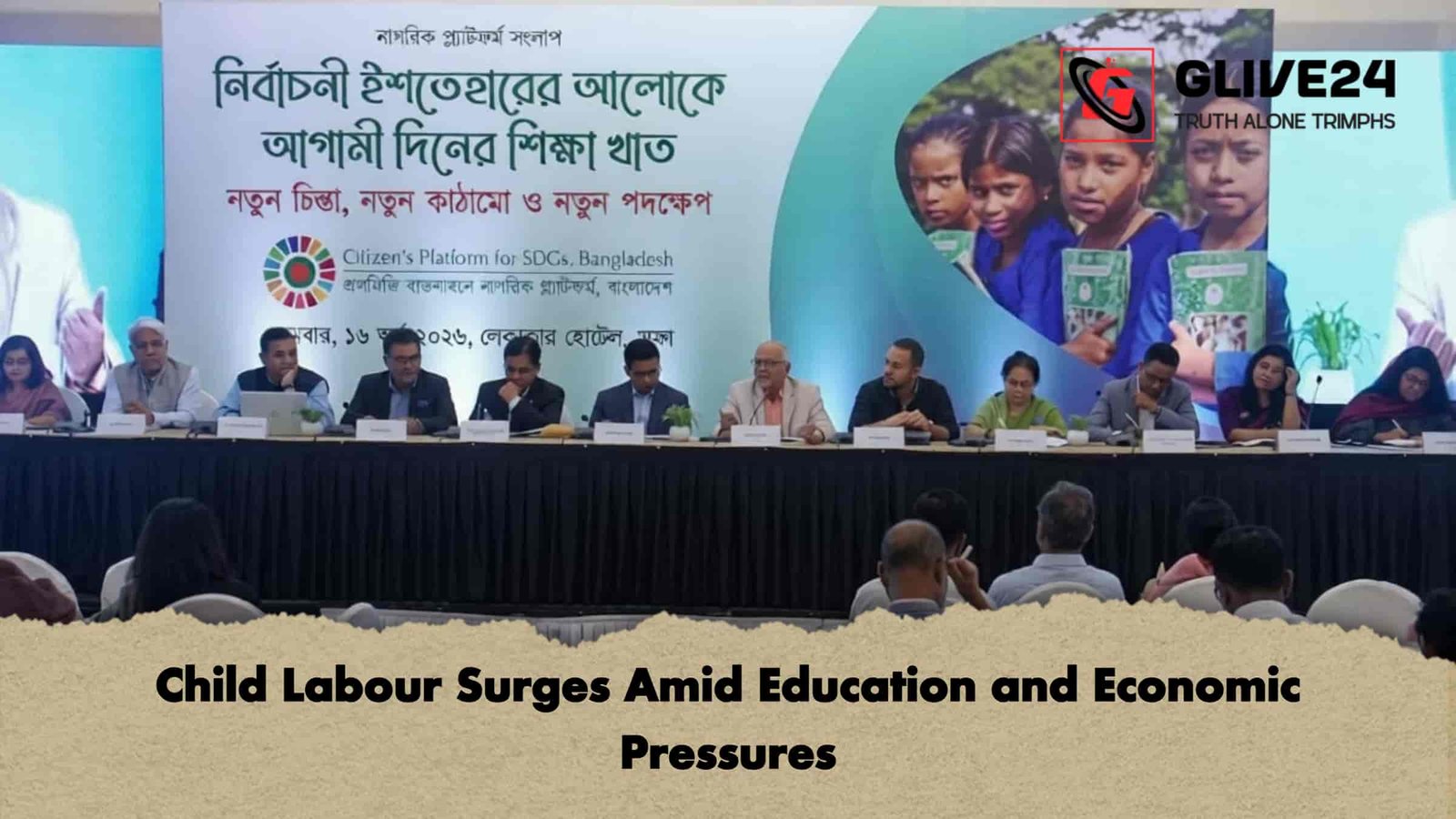
The rate of child labour in the country is rising, driven by economic hardship and social realities that force children to leave school and join the workforce. Although primary school enrolment has reached near-universal levels, a significant proportion of students drop out before completing their education. Recent data indicate that the child labour rate has increased by approximately 2.4 percentage points over the past six years.
These insights were presented on Monday at a dialogue titled “Shaping the Future of Education in Light of Election Manifestos: New Ideas, Structures, and Initiatives”, organised by the Citizen Platform at a hotel in the capital. The session featured a keynote paper by Dr. Toufiqul Islam Khan, Additional Research Director at the Centre for Policy Dialogue (CPD), and was chaired by Dr. Debapriya Bhattacharya, Convener of the Citizen Platform and Honourable Fellow of CPD. Distinguished attendees included State Minister for Primary and Mass Education Babi Hajjaj and the Prime Minister’s Education Adviser Mahdi Amin, alongside CPD Fellows Professor Mostafizur Rahman and educationist Rasheda K. Chowdhury.
Dr. Khan’s presentation highlighted that, despite near-universal enrolment in primary education, retaining students remains a critical challenge. Male enrolment, which once reached nearly 98%, declined to around 91% in 2024. Transition from primary to secondary education is also insufficient, as many children either fail to enroll or drop out midway. Vulnerable populations, including children from poor families, rural communities, and socially disadvantaged groups, are disproportionately affected, often joining the labour market at a young age. Child labour, which was about 6.8% in 2019, has climbed to nearly 9.2% by 2025, representing a rise of 2.4 percentage points.
Education and Child Labour Trends
| Indicator | 2019 | 2024 | 2025 |
|---|---|---|---|
| Male primary enrolment (%) | 97.8 | 91.0 | – |
| Child labour rate (%) | 6.8 | – | 9.2 |
| Transition to secondary education (%) | 85 | 78 | – |
CPD research also identifies stark inequalities in education costs and opportunities. Over half of educational expenses are paid directly by families, making schooling costly for low-income households. While textbooks are provided free, families frequently spend on guides, coaching, and additional learning materials. Limited access to technology and inadequate infrastructure for children with disabilities further impede learning. In addition, insufficient sanitary facilities for girls and a lack of safe learning environments restrict continuous education.
The dialogue also addressed youth unemployment. Among highly educated young people, unemployment has reached nearly 13.5%, revealing a gap between academic qualifications and labour market needs. Graduates often lack the practical and cognitive skills necessary for modern employment, limiting their competitiveness. Experts warn that unless the education system shifts from degree-based instruction to skill-based learning, the dual challenges of educated unemployment and the need for a skilled workforce will persist, threatening long-term economic growth.