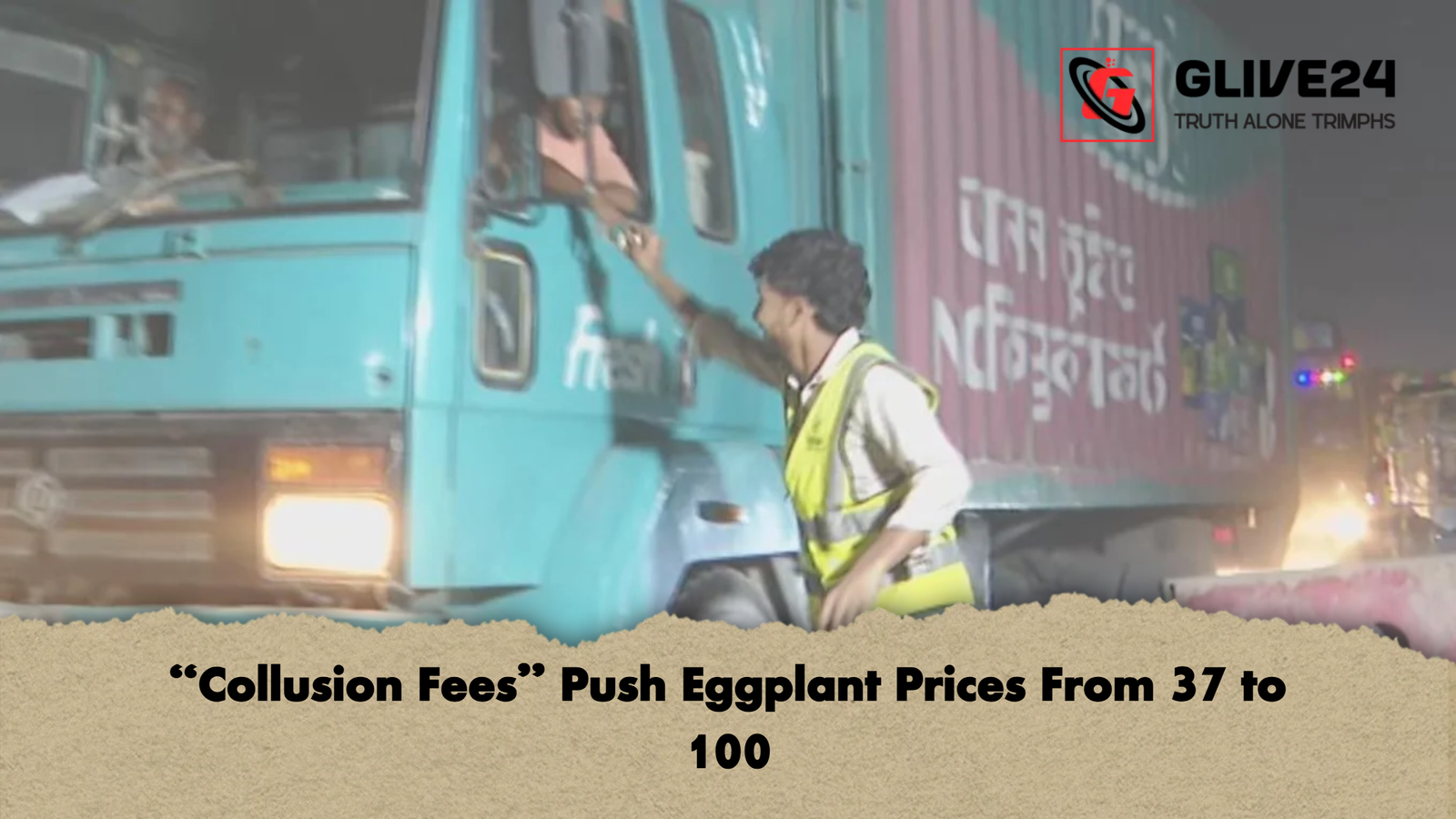
Rampant extortion along supply routes is increasingly dictating vegetable prices in Bangladesh. Eggplants that cost only 37 taka per kilogram at the wholesale level in production areas are reaching Dhaka markets at over 100 taka per kilogram. Analysts say this price surge is largely driven by “collusion fees” collected at multiple points along the supply chain.
Bogura’s Mahasthan Haat, one of the largest and oldest vegetable markets in northern Bangladesh with a 300-year history, serves as a key hub where farmers bring their fresh vegetables and produce. Here, wholesale prices are set: one mound (approx. 37.3 kg) of eggplants sells for 1,400–1,500 taka, translating to roughly 35–37 taka per kilogram. Cucumbers fetch a similar rate of 35–36 taka per kilogram.
However, farmers are forced to pay an additional 20 taka per mound as a “fee” at the market. Some try to bypass these charges by loading their produce directly onto trucks, but extortionists are reportedly waiting even there.
A local trader said, “The cost of clearing goods at the market is 500 taka, but the extortion or collusion fee is 1,000 taka. It’s becoming impossible for traders to manage.”
Truck driver Kashem added, “On the way, trucks are stopped, and a slip is handed over demanding money. Without paying, no vehicle can proceed.” Allegedly, the extortion slips are issued in the name of Taherul Islam, Joint General Secretary of Shibganj Upazila BNP. He, however, denied the allegations, claiming his name may have been misused.
The same situation exists in Sirajganj, where both traders and drivers report being forced to pay fees via slips, even as local authorities deny the existence of such “collusion.” District Commissioner Aminul Islam stated, “There is no collusion here. Anyone collecting money on the roads is engaging in extortion.”
The cumulative effect of these fees is a sharp increase in consumer prices. When vegetables reach Dhaka’s wholesale markets, traders set retail prices, which are inflated due to the multiple layers of collusion fees along the route.
The following table illustrates the escalation in eggplant prices and the impact of collusion fees along the supply chain:
| Stage | Price per kg (Taka) | Additional Fees / Costs | Notes |
|---|---|---|---|
| Production / Wholesale | 35–37 | – | Farmer sale price |
| Market “Collusion Fee” | +20 per mound | Slip-based collection | Extra charge per mound |
| Transport / Route | +20–50 | Collected at multiple spots | Fees imposed on trucks |
| Dhaka Wholesale | +25–30 | Market costs & profit margin | Retail pricing by traders |
| Retail Market | 95–100 | Total cumulative effect | Final consumer price |
Experts note that this systematic extortion along the supply chain effectively doubles or even triples vegetable prices. Though sometimes disguised as “collusion” or “market fees,” the practice remains opaque and burdensome for consumers.
The central question remains: how effectively are authorities tackling this extortion from farm to highway, and to what extent does it continue to impact final consumer prices in Dhaka?