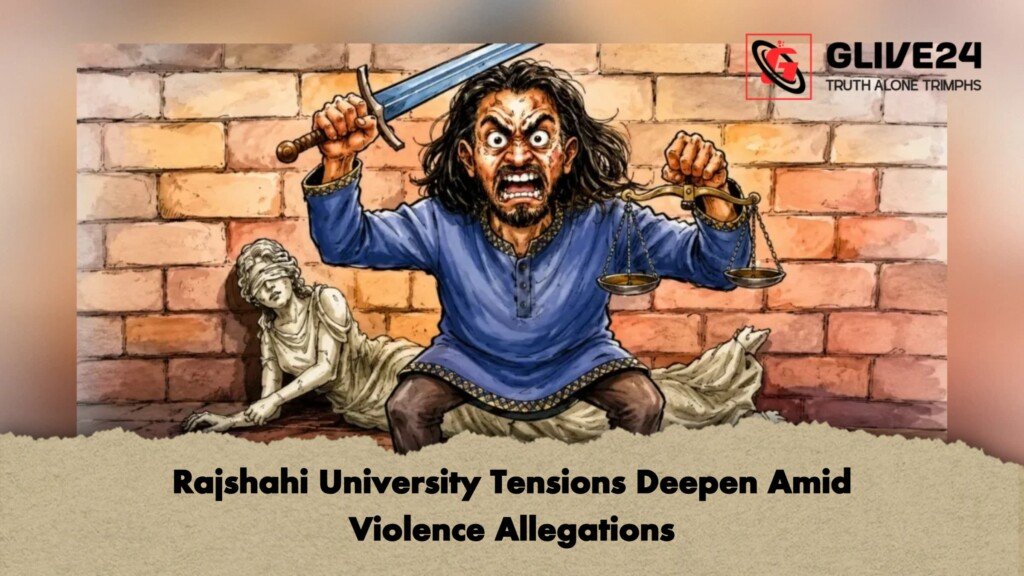
Rajshahi University (RU) has been gripped by heightened tensions following allegations of repeated assaults on students inside the Proctor’s office and the Central Library, claims that victims were labelled as supporters of the Bangladesh Chhatra League (BCL) before being handed over to police, and accusations of intimidation directed at journalists covering the incidents. The controversy has sparked widespread debate across the campus, with student organisations and many students expressing concern over what they describe as an increasingly volatile academic environment.
At the centre of the dispute is Salahuddin Ammar, General Secretary of the Rajshahi University Central Students’ Union (RAKSU) and one of the coordinators of the July 2024 mass uprising, along with several leaders associated with Islami Chhatra Shibir. Critics allege that their actions mirror the atmosphere of intimidation that many students associate with previous periods of campus political violence. They argue that repeated confrontations carried out in the name of protecting students’ rights have instead contributed to growing instability within the university.
Allegations have also emerged that Ammar has played a leading role in organising protest activities that frequently escalate into confrontations. Some students claim that members of Chhatra Shibir have been visibly present during many of these programmes. Both Ammar and Chhatra Shibir, however, have denied any organisational affiliation between him and the student organisation.
Allegations of Political Labelling
According to students, the violence that unfolded on 27 July resembled tactics previously witnessed during earlier periods of campus unrest. Witnesses alleged that three unarmed students—Md Anas, Mahmudul Hasan and Hasan—were assaulted after a verbal altercation. It has been alleged that shovels used for carrying sand and bamboo sticks were used during the incident.
The controversy intensified after police detained Anas and Mahmudul Hasan following the incident. Anas was reportedly identified by some as a member of the Bangladesh Chhatra League, an allegation he has firmly denied. Student leaders from the university unit of Jatiyatabadi Chhatra Dal and the Left Student Alliance condemned the alleged assault, arguing that violence inside the university’s Central Library represented an unacceptable breach of campus safety.
Legal Proceedings Begin
The father of injured student Mahmudul Hasan, MS Asad Uz Zaman, has filed a case before the cognisance court through Motihar Police Station. The case names Salahuddin Ammar as the principal accused alongside eight others.
Those also named include RAKSU Assistant General Secretary Salman Sabbir, Nazmus Sakib, Mehedi Sajeeb, Fahim Reza, Ariful Islam, Ahsan Ullah Farhan, Sifat Abu Saleh and Nurul Islam Shahid.
Counterclaims Over the Incident
Rejecting the allegations against him, Ammar claimed that he and his associates had been attacked first by what he described as “BCL terrorists” inside the RAKSU building and that they acted only in self-defence.
A different account was presented by Sultan Ahmed Rahi, President of the Rajshahi University unit of Chhatra Dal. He alleged that a personal dispute had been given a political dimension and claimed that ordinary students had been branded as BCL activists before being assaulted. He called for those responsible to lose both their positions in the student union and their university enrolment.
Journalists Protest Alleged Threats
The controversy expanded beyond the original incident after a RAKSU press conference attended by Vice-President and former Rajshahi University Chhatra Shibir President Mostakur Rahman Jahid, General Secretary Salahuddin Ammar and Assistant General Secretary SM Salman Sabbir.
During the briefing, Jahid criticised sections of the media, alleging that reports published on the incident were biased and inaccurate. He accused journalists of showing sympathy towards the Bangladesh Chhatra League and criticised the language used in news reports. He also warned that action could be taken against journalists over their reporting while maintaining that no students’ academic activities inside the library had been disrupted because of their presence.
His remarks prompted strong reactions from journalist organisations working at Rajshahi University. Several organisations condemned the statements as unprofessional and intimidating before announcing a boycott of all RAKSU-related news coverage.
University Administration Orders Investigation
University authorities have stated that efforts are underway to restore stability across the campus.
Proctor Professor Dr Mahbubur Rahman said the administration was working to maintain order and had already formed an investigation committee to examine the incidents thoroughly. A five-member inquiry committee has been tasked with submitting a comprehensive report within ten working days.
Previous Controversies Resurface
The latest allegations have also renewed discussion of earlier controversies involving Ammar. Critics point to previous incidents, including allegations that he confronted the university’s Pro-Vice-Chancellor during the ward quota movement in December 2024 and was involved in disputes with acting registrars and university teachers.
Another allegation, raised by Abdul Majid Ontor, convener of the RAKSU Movement Platform, links Ammar to the killing of former Bangladesh Chhatra League leader Abdullah Al Masud, who had previously lost a leg in an attack allegedly carried out by Chhatra Shibir more than a decade earlier. The allegation has intensified debate on campus, although no judicial finding establishing responsibility is cited in the report.
Five-Point Charter of Demands
The Democratic Student Alliance has described the alleged assault inside the Central Library as an instance of “mob violence” and submitted a five-point memorandum to the university’s Pro-Vice-Chancellor.
Its demands include bringing the accused RAKSU and Chhatra Shibir leaders under the law, investigating alleged attacks at the RAKSU building and on a Left Alliance torch procession, ensuring speedy justice for unresolved post-July incidents, and establishing accountability for what it described as failures by the university’s proctorial body.
Alliance leaders argued that the alleged use of physical force by elected student representatives was unprecedented and potentially criminal. They also claimed that a longstanding culture of impunity had encouraged repeated acts of violence on campus, undermining the university’s democratic environment.
Students Launch Signature Campaign
Meanwhile, students have begun a signature campaign demanding legal action against those accused of assaulting fellow students. Organised under the banner of “Students of Rajshahi University”, the campaign began in front of the Central Library on Thursday afternoon and is scheduled to continue until Monday.
The latest developments have placed Rajshahi University under intense public scrutiny. With criminal proceedings underway, an administrative inquiry in progress, and competing narratives emerging from different student groups, many within the university community are now looking to the investigation to establish the facts and help restore confidence in campus governance and security.