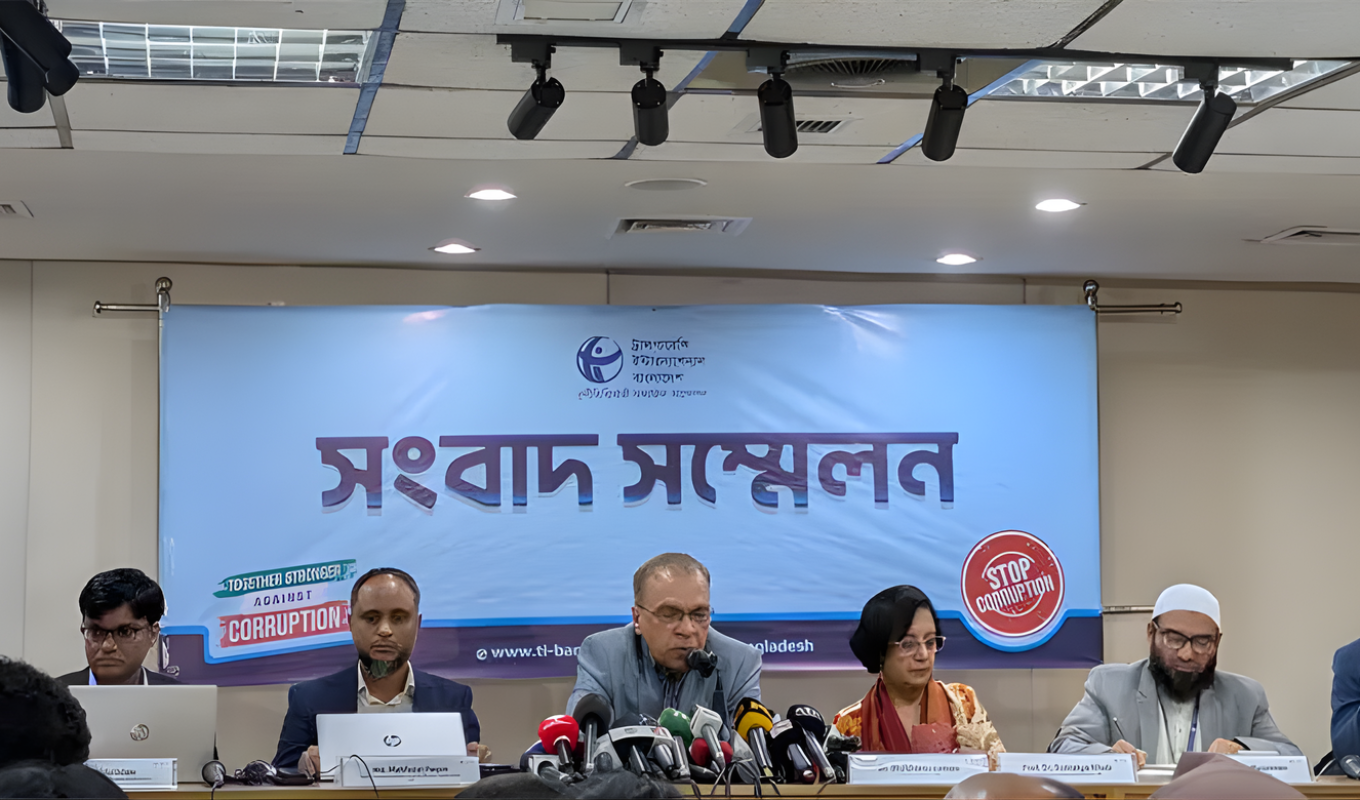
Transparency International Bangladesh Executive Director Iftekharuzzaman has said there is no clear comparative information to determine whether corruption has increased or decreased, but corruption remains widespread in the country.
Answering a question on the trend of corruption, he said TIB is currently working on the issue, but emphasised that corruption is continuing. He said various groups are misusing political and government authority to engage in partisan activities, land grabbing and extortion, and added that instances of corruption have also occurred within the government, which he described as worrying.
Referring to his role as head of a former Anti-Corruption Commission reform commission formed by the interim government, Iftekharuzzaman said there had been scope for a much stronger stance against corruption during this government’s tenure. However, he said it cannot be denied that the government failed to seize that opportunity. He added that TIB is preparing an analysis of the entire tenure of the current government.
He made the comments on Sunday afternoon at a press conference at TIB’s Dhanmondi office, titled “Commitment to a Well-Governed, Equitable and Corruption-Free Bangladesh: TIB’s Recommendations for Political Party Manifestos in the Thirteenth National Parliamentary Election”.
Replying to journalists, he said Bangladesh cannot easily remove the accumulated problems of 54 years, particularly those of the last 15 years, to establish a democratic, well-governed, inclusive and corruption-free society and state. He said this will require a long process, although an opportunity has now arisen. He added that how political parties respond to this opportunity is crucial, and that the outcome will depend on the influence of money, muscle power and religion on their conduct before and after the election.
On reforming the business sector, Iftekharuzzaman said meaningful change must come from within the sector itself, similar to political party reform. He said open competition, transparency and accountability would benefit businesspeople overall. If reforms are not undertaken, a select group benefits while others suffer, as witnessed over the past 15 years, leading to the capture of state structures. He said parts of the business sector had served as a pillar of authoritarianism and stressed that this situation should not be repeated.
In response to a question about Bangladesh’s current strained relations with India, he said the present situation is India’s most embarrassing diplomatic and political defeat, which he said India has so far failed to acknowledge. He added that while India is unlikely to admit this easily, it does not mean relations cannot improve. He said there are areas for high-level partnership and cooperation, depending on both countries, and added that matters would have been easier for Bangladesh had India adopted a more objective stance and moved away from supporting authoritarianism.
At the press conference, TIB outlined 52 proposals it believes should be included in the manifestos of political parties contesting the upcoming election. Iftekharuzzaman presented the first seven proposals, including commitments to implement the July National Charter and recommendations of reform commissions, to continue enforcing ordinances and measures taken under these frameworks, and to ensure proper investigations and trials of killings, crimes and human rights violations during the July mass uprising and the authoritarian government period.
The remaining proposals were presented by TIB senior research officer Md Julkarnain and Director of Research and Policy Mohammad Badiuzzaman. These include pledges related to preventing corruption and irregularities, practising democracy and good governance within parties, ensuring equality and justice, and reforms across sectors including social security, education, health, agriculture, banking and finance, power and energy, environment and climate, as well as promoting good governance in the private sector.
TIB Adviser for Executive Management Professor Sumaiya Khayer and Outreach and Communication Director Mohammad Towhidul Islam also attended the press conference.
Glive24/SS