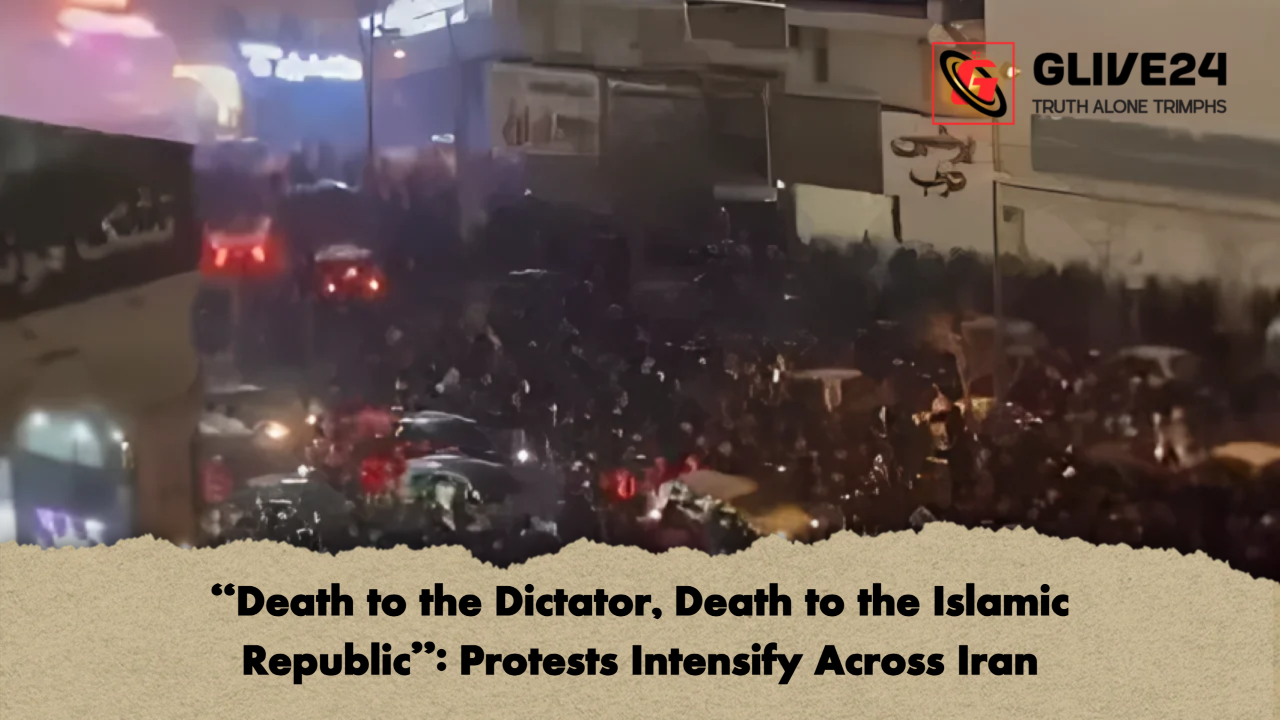
Protests against Iran’s Islamic Republic have intensified in Tehran and across the country, with demonstrators chanting slogans such as “Death to the dictator” and “Death to the Islamic Republic”. The unrest follows calls for nationwide demonstrations by exiled Crown Prince Reza Pahlavi, who urged Iranians to take to the streets at 8 p.m. local time on Thursday and Friday.
As the clock struck eight, neighbourhoods across Tehran erupted in coordinated chants, according to witnesses. Thousands were reportedly visible on the streets before communication with the country was abruptly cut.
The demonstrations are directed primarily against Supreme Leader Ayatollah Ali Khamenei and Iran’s ruling theocratic system. Protesters, angered by a collapsing economy, soaring living costs, and harsh security crackdowns, have increasingly voiced open opposition to the regime.
Table of Contents
Internet Blackout and Threats of Crackdown
As the night-time protests intensified, Iran’s government under reformist President Masoud Pezeshkian shut down the internet and international telephone lines. Both Cloudflare, a global internet firm, and the monitoring group NetBlocks confirmed the outage, attributing it to deliberate government interference.
The head of Iran’s judiciary and senior security officials warned of a “harsh response”, even as crowds continued chanting calls for “freedom”.
Attempts to reach landlines or mobile phones in Iran from abroad, including from Dubai, failed. Similar communication blackouts in the past have often preceded severe security crackdowns.
Pahlavi’s Role and Symbolism
Some demonstrators appeared to be responding directly to Reza Pahlavi’s call. Pahlavi is the son of Iran’s last shah, who fled the country shortly before the 1979 Islamic Revolution. Support for the monarchy was once punishable by death, but chants praising the shah have now resurfaced, underscoring the depth of public anger.
Among the slogans heard were:
- “This is the last battle! Pahlavi will return!”
- Praises for the pre-revolutionary era
However, it remains unclear whether such chants reflect direct support for Pahlavi himself or a broader rejection of the post-1979 political order.
“Iranians demanded their freedom tonight,” Pahlavi said.
“In response, the regime has cut all lines of communication. It has shut down the internet, cut landlines, and may even attempt to jam satellite signals.”
He called on European leaders to join US President Donald Trump in pledging to hold Iran’s leadership accountable, urging them to use technical, financial, and diplomatic tools to restore communications so that Iranians’ voices could be heard.
Pahlavi said he would announce further plans depending on how the protests unfold. His past expressions of support for Israel have drawn criticism, particularly following Israel’s 12-day war with Iran in June.
Protests Spread Nationwide
The unrest is no longer confined to Tehran. Demonstrations have continued across cities and rural towns throughout Iran. Markets and bazaars have increasingly shut down in solidarity with protesters.
According to the US-based Human Rights Activists News Agency, at least 42 people have been killed and more than 2,270 detained since the protests began.
The growing movement has intensified pressure on both Iran’s civilian government and Supreme Leader Ali Khamenei.
Despite the scale of the demonstrations, they remain largely leaderless. Analysts say this has historically limited the success of Iranian protest movements.
“The lack of a viable alternative has undermined past protests in Iran,” wrote Nate Swanson of the Atlantic Council.
“While many potential leaders exist, Iran’s security apparatus has systematically arrested, persecuted, or forced into exile those capable of leading transformative change.”
Why Iranians Are Protesting
The current wave of unrest—the largest in three years—began last month in Tehran’s Grand Bazaar, where shopkeepers protested against the collapse of the national currency.
Economic hardship has since driven nationwide dissent. Inflation reached 52 per cent year-on-year in December, according to Iran’s Statistical Centre. The rial has plummeted, with $1 now costing around 1.4 million rials.
Protesters have also expressed anger over political repression, social restrictions, and years of economic mismanagement compounded by Western sanctions.
Iranian authorities acknowledge the economic crisis but claim the protests are being fuelled by foreign-linked networks.
President Pezeshkian has attempted to calm tensions, describing protesters’ demands as “legitimate” and calling for improvements to living conditions. However, he has admitted his ability to act is limited by the scale of Iran’s economic collapse.
“From an Islamic perspective,” Pezeshkian previously said,
“if we do not resolve the issue of people’s livelihoods, we will end up in Hell.”
Security Response and Rising Violence
Iranian officials appear to be taking the protests seriously. The hard-line Kayhan newspaper published footage claiming security forces would deploy drones to identify demonstrators.
Although authorities have not officially acknowledged the protests’ full scale, reports of violence involving security forces have emerged.
- A police colonel was fatally stabbed outside Tehran, according to judiciary outlet Mizan.
- Fars News Agency reported that two security personnel were killed and 30 wounded in a shooting in Lordegan, Chaharmahal and Bakhtiari province.
- In Chenaran, five people were killed in an attack on a police station, according to a provincial deputy governor.
- The Revolutionary Guard later confirmed that two of its members were killed in Kermanshah.
Despite these incidents, it remains unclear why authorities have not yet launched a more extensive nationwide crackdown.
Trump Issues Warning
US President Donald Trump warned last week that Washington would intervene if Iran “violently kills peaceful protesters”.
Speaking to radio host Hugh Hewitt, Trump said Iran had been warned “very strongly” that such actions would carry severe consequences.
When asked whether he would meet Reza Pahlavi, Trump declined.
“I’m not sure that it would be appropriate at this point,” he said.
“I think we should let events unfold and see who emerges.”
Iran has faced repeated waves of protest in recent years, but the combination of economic collapse, currency freefall, and widespread anger suggests this movement may be more sustained. Whether it can overcome the absence of organised leadership—and how forcefully the state responds—will shape Iran’s political future in the weeks ahead.