
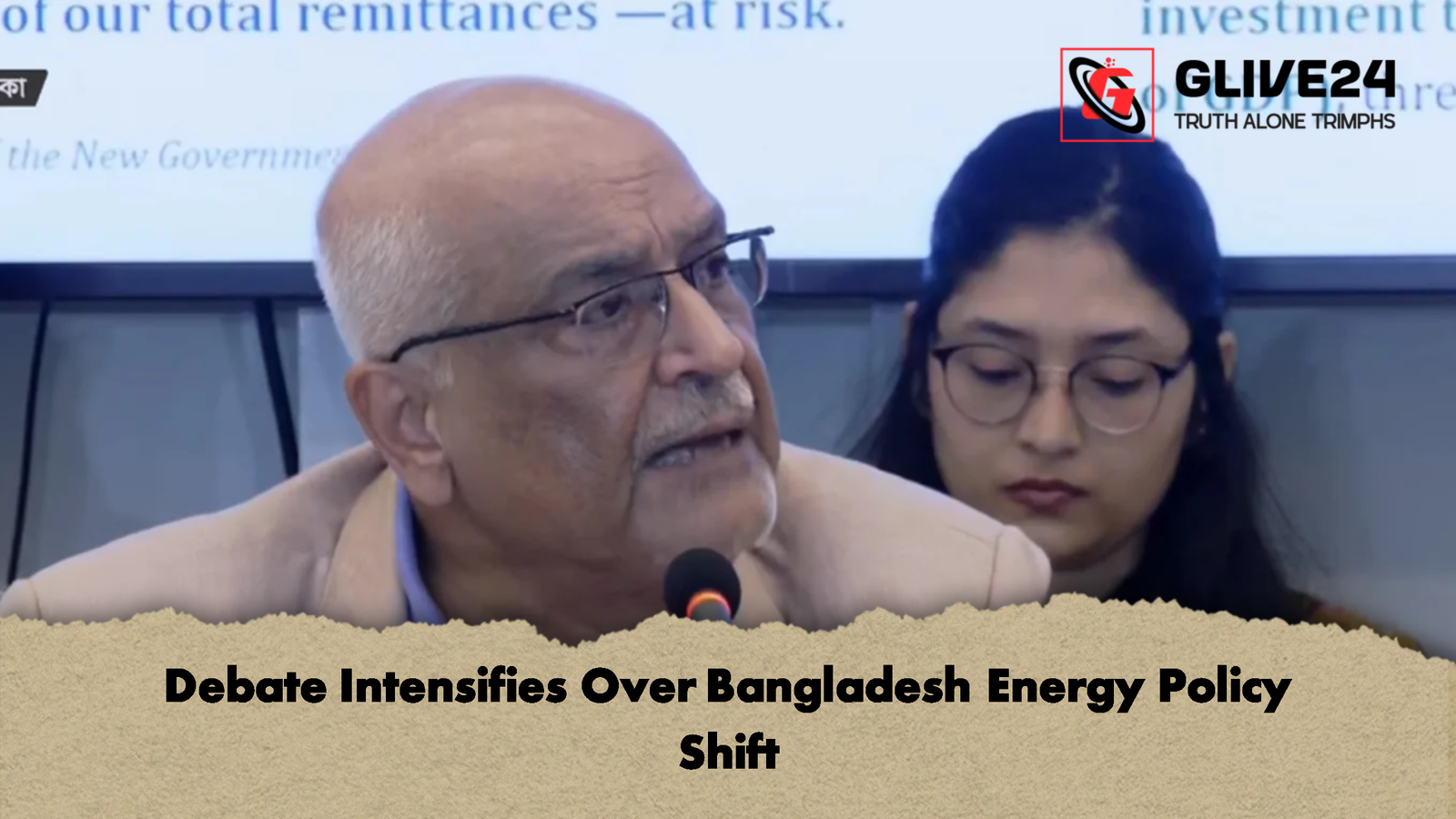
Prominent Bangladeshi economist Debapriya Bhattacharya has cautioned that the country’s ability to import lower-cost fuel is becoming increasingly constrained, amid what he described as a growing overlap between economic decision-making and foreign policy considerations under the interim administration.
Speaking at a policy briefing in Dhaka, he suggested that recent trade and strategic arrangements with the United States could indirectly affect Bangladesh’s flexibility in sourcing cheaper energy supplies from countries such as Russia. In his view, global energy procurement has become increasingly shaped by geopolitical alignment rather than purely commercial considerations.
“The economy can no longer be viewed in isolation from foreign policy,” he remarked, adding that certain import decisions may now require additional layers of approval or diplomatic clearance, thereby reducing the scope for cost-driven energy procurement.
The comments were made on Tuesday (31 March) at a media briefing titled “Reflections on the First Budget of the New Government”, held at the Centre for Policy Dialogue (CPD) conference facility in Dhanmondi. The event was jointly organised by the CPD and the SDG Implementation Citizen’s Platform, Bangladesh.
Table of Contents
Mounting macroeconomic pressures
Bhattacharya outlined a broad set of structural economic challenges facing Bangladesh. He noted that external debt has risen significantly, while the balance of payments remains under sustained pressure. At the same time, investment levels and employment generation continue to remain subdued.
Inflation, particularly in essential food items, remains persistently high, he said, adding that global instability has further exposed underlying weaknesses in the domestic economy.
He also warned that ongoing geopolitical tensions in the Middle East have created three interconnected risks for Bangladesh:
| Risk category | Potential impact |
|---|---|
| Liquid fuel supply | Disruption in global oil supply chains and price volatility |
| Gas availability | Reduced reliability of imported gas shipments |
| Electricity generation | Increased strain on domestic power production capacity |
He stressed that these risks require immediate policy attention, arguing that government responses should not be deferred until the upcoming budget cycle.
Calls for fuel, subsidy and fiscal reforms
The economist recommended that authorities consider increasing fuel imports to stabilise domestic supply, alongside potential reductions in duties and taxes to ease price pressures.
He further urged a comprehensive review of the subsidy regime, arguing that inefficient or inequitable subsidies should be identified and rationalised. Particular emphasis, he said, should be placed on assessing whether public support schemes primarily benefit low-income households or disproportionately advantage higher-income groups.
Bhattacharya also proposed a gradual, multi-stage reduction of cash incentive programmes as part of broader fiscal consolidation efforts.
Reform of development spending and state enterprises
Calling for urgent restructuring of the Annual Development Programme (ADP), he suggested the formation of a dedicated task force to review ongoing projects within one to one-and-a-half months. Without such scrutiny, he warned, continued approval of low-quality or poorly designed projects would fail to deliver meaningful development outcomes.
He also advocated significant reform of state-owned enterprises, arguing that many continue to operate at a loss and place an unsustainable burden on public finances. According to him, underperforming public sector entities should either be privatised or restructured, with liabilities addressed through the divestment of assets where appropriate.
He further supported the sale of government-held shares in commercial entities, recalling earlier reform efforts initiated under former Finance Minister Saifur Rahman. He argued that bureaucratic resistance has historically slowed divestment processes, despite their potential to strengthen the capital market and reduce fiscal pressure.
Revenue realism and tax overhaul
A central concern raised during the briefing was the continued setting of overly ambitious revenue targets. Bhattacharya argued that even within the National Board of Revenue there is an understanding that such targets are often unrealistic, leading to repeated shortfalls and fiscal planning distortions.
He called for more credible budget formulation, suggesting that a smaller but achievable fiscal framework would be preferable to inflated revenue expectations that are unlikely to materialise.
He also advocated the elimination of excessive tax exemptions, expansion of the tax base, and strengthened digital compliance systems to improve collection efficiency. In addition, he called for the introduction of wealth taxation and urged the rapid implementation of the proposed institutional restructuring of the National Board of Revenue.
Scale of fiscal foregone revenue
A background presentation at the briefing highlighted the significant cost of tax exemptions and incentives to the national exchequer. In the 2021–22 fiscal year alone, the government reportedly forewent approximately BDT 272,850 crore in revenue due to income tax, VAT and customs exemptions—equivalent to 6.87% of GDP.
Separately, in the 2024–25 fiscal year, around BDT 32,230 crore was allocated in targeted incentives for agriculture, exports, jute products and remittance inflows, amounting to nearly 0.60% of GDP.
Economists at the event warned that unless such fiscal leakages are rationalised, Bangladesh could face increasing constraints in managing debt, inflation, and development expenditure in an already uncertain global economic environment.