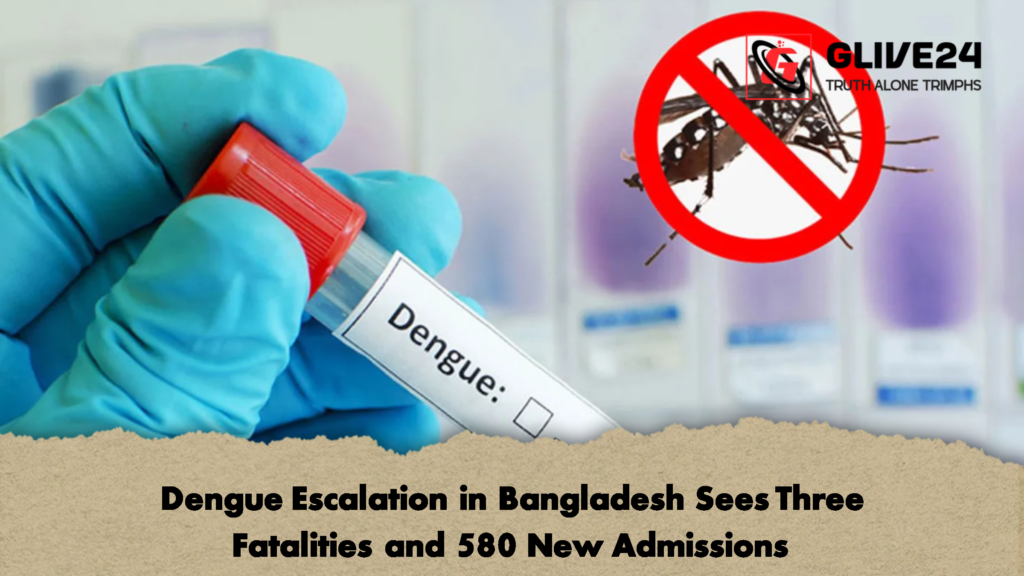
At least three patients have succumbed to dengue fever across Bangladesh in a single 24-hour window, alongside 580 new hospital admissions, according to the official epidemiological statistics published by the Health Emergency Operation Centre and Control Room under the Directorate General of Health Services (DGHS). The daily figures highlight a noticeable uptick in mosquito-borne viral transmission as the country experiences peak monsoon conditions, triggering heightened operational alertness across urban public health authorities.
The geographical distribution of the latest fatalities reflects widespread transmission across both central metropolitan zones and regional divisions. One death was registered within the jurisdiction of the Dhaka South City Corporation, while the Khulna Division and Sylhet Division recorded one casualty each. With these recent loss of lives, the national death toll directly attributed to laboratory-confirmed dengue fever for the current calendar year has climbed to 59.
In terms of regional hospitalisation patterns, health facilities located in the Dhaka Division witnessed a significant influx, absorbing 125 newly admitted patients. Meanwhile, municipal healthcare centers within the Dhaka South City Corporation and Dhaka North City Corporation admitted 78 and 59 individuals respectively. Outside the capital, Southern and Western regions reported substantial patient loads, with the Barishal Division logging 81 new hospitalisations, Chattogram recording 79, and Khulna accounting for 67. Additional admissions were scattered across Mymensingh, Rajshahi, Rangpur, and Sylhet, illustrating that vector activity is no longer confined solely to dense urban centers.
The addition of 580 newly hospitalised patients brings the total nationwide count of confirmed dengue cases since January to 16,684. Public health analysts point out that seasonal rainfall, sporadic downpours, and localized waterlogging during the ongoing rainy season have accelerated the creation of ideal breeding sites for Aedes aegypti and Aedes albopictus mosquitoes. The progressive rise in hospitalisation numbers mirrors expert warnings that infection rates could continue upward throughout August and September unless aggressive vector-control drives are sustained.
Epidemiology experts and entomologists have repeatedly called for integrated and centralized vector management across all municipal corporations. While local government bodies are carrying out routine anti-mosquito activities, including larviciding and thermal fogging in vulnerable neighborhoods, health authorities continue to urge citizens to maintain domestic vigilance. Householders are advised to inspect flowerpots, plastic containers, discarded tyres, and air conditioning trays regularly to ensure stagnant water is emptied within three days, preventing mosquito larvae from reaching maturity.
Healthcare institutions have been instructed to ensure adequate stockpiles of intravenous fluids, diagnostic kits (such as NS1 antigen tests), and dedicated isolation beds to accommodate potential further surges. Medical practitioners strongly advise members of the public to avoid self-medication, particularly over-the-counter non-steroidal anti-inflammatory drugs, and to seek immediate evaluation at medical facilities if high fever is accompanied by persistent abdominal pain, fluid retention, severe fatigue, or mucosal bleeding.