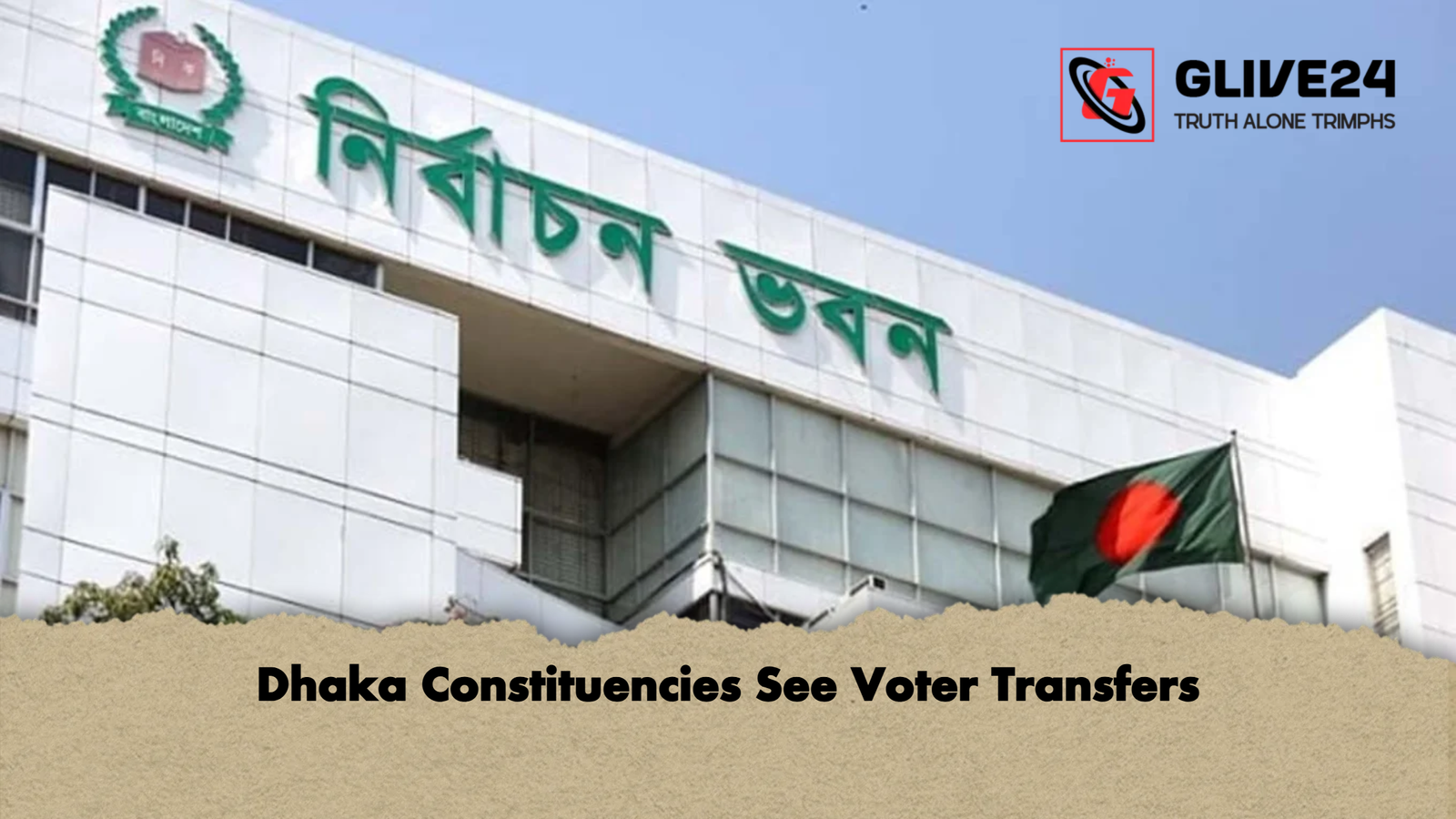
The Election Commission (EC) has released constituency-wise data on voter transfers in Dhaka ahead of Bangladesh’s thirteenth parliamentary election, rejecting opposition claims that the scale of transfers is abnormal or politically motivated. The Bangladesh Nationalist Party (BNP) has repeatedly alleged that unusually high voter movements in several Dhaka constituencies could be used to manipulate election outcomes, and has formally raised these concerns with the Commission. The EC, however, insists that the figures fall well within historical and administrative norms.
According to the Commission, preparations for both a national referendum and the parliamentary election prompted an official call for applications to change voter constituencies in August last year. This process was not confined to a short window; rather, it continued throughout the year to accommodate citizens who had changed residence due to employment, education, family relocation, or other legitimate reasons. Election officials argue that such updates are an essential part of maintaining an accurate and credible electoral roll, particularly in urban centres such as Dhaka where population mobility is high.
By November, voter transfers had taken place across all electoral regions of the country. Dhaka region recorded 86,825 voter constituency changes, reflecting its dense population and frequent residential movement. Other regions also saw substantial numbers: Faridpur registered 39,095 transfers, Khulna 81,725, Mymensingh 78,805, Rangpur 63,897, Sylhet 27,576, Rajshahi 72,815, Barishal 85,720, Cumilla 105,543, and Chattogram 30,085. Within Dhaka district alone, spread across 20 parliamentary constituencies, a total of 49,992 voters changed their registered voting areas.
Public and political attention has been particularly focused on constituencies associated with prominent or so-called heavyweight candidates. In Dhaka-17, linked to BNP chairperson Tarique Rahman, 3,039 voters transferred their registration. Dhaka-15, associated with Jamaat-e-Islami Ameer Dr Shafiqur Rahman, recorded 3,520 transfers. The constituency of Dhaka-11, connected to National Citizen Party (NCP) convener Nahid Islam, saw 3,141 voters change constituencies, while Dhaka-9—where former NCP leader and independent candidate Dr Tasnim Jara is active—recorded 2,634 transfers. In Dhaka-8, contested by BNP’s Mirza Abbas and NCP’s Nasiruddin Patwari, the number stood at 3,633.
Overall, the EC’s data shows significant variation among Dhaka’s constituencies. The highest number of voter transfers was recorded in Dhaka-1, with 4,732 voters changing their registration. At the other end of the spectrum, Dhaka-7 saw the lowest figure, with just 676 transfers.
The Commission maintains that these patterns do not indicate electoral engineering, but rather reflect demographic realities such as urban expansion, housing shifts, and seasonal or employment-driven migration. Officials emphasise that all voter transfers are processed according to established rules, with documentation and verification at multiple stages. While opposition parties remain sceptical, the EC argues that transparency in publishing constituency-wise data is intended precisely to counter misinformation and build public confidence.
Selected Dhaka Constituencies: Voter Transfers
| Constituency | Voter Transfers |
|---|---|
| Dhaka-1 | 4,732 |
| Dhaka-7 | 676 |
| Dhaka-8 | 3,633 |
| Dhaka-9 | 2,634 |
| Dhaka-11 | 3,141 |
| Dhaka-15 | 3,520 |
| Dhaka-17 | 3,039 |
As the election approaches, voter registration dynamics are likely to remain a contentious issue. Whether the Commission’s assurances will be enough to ease political tensions remains to be seen, but the data suggests that voter mobility—particularly in Dhaka—is a structural feature of the electoral landscape rather than an exceptional anomaly.