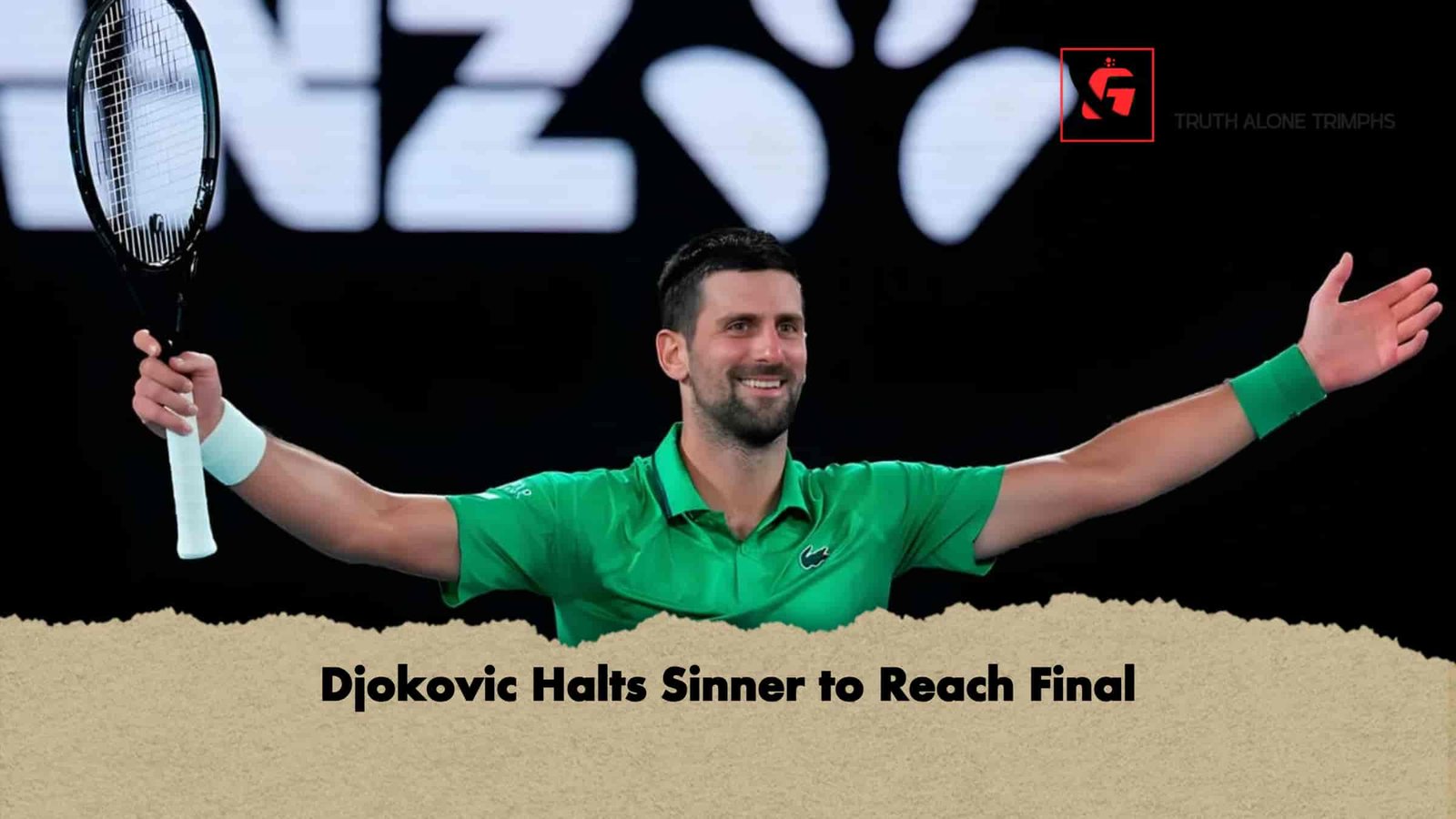
As many elite athletes contemplate retirement with advancing age, Novak Djokovic continues to defy conventional sporting logic. On the eve of turning 38, the Serbian icon once again demonstrated that experience, tactical intelligence and mental resilience can still outweigh youth and raw power. Under the bright lights of Melbourne Park, Djokovic produced a masterclass of perseverance to defeat reigning champion and world number one Jannik Sinner in a gripping Australian Open semi-final lasting more than four hours, thereby booking his place in yet another Grand Slam final.
The five-set encounter ended in Djokovic’s favour by a scoreline of 3–6, 6–3, 4–6, 6–4, 6–4. It was far more than a simple victory; it represented a vivid generational confrontation between an all-time great and one of the brightest stars of modern tennis. Momentum swung relentlessly throughout the match, with Sinner’s fearless aggression repeatedly testing Djokovic’s famed defensive solidity, while the Serbian relied on patience, variation and psychological strength to stay alive.
Sinner set the early tone by dominating the opening set. His powerful serve, coupled with penetrating groundstrokes from both wings, allowed him to dictate rallies and secure a decisive break. Djokovic, however, responded in the second set by reverting to his hallmark strategy—elongating rallies, altering pace and depth, and forcing his opponent into uncomfortable positions. The result was a shift in rhythm that enabled Djokovic to restore parity.
The third set once again belonged to the Italian. Sinner stepped inside the baseline, struck clean winners and appeared poised to end Djokovic’s long-standing authority in Melbourne. At that juncture, many observers sensed the possibility of a symbolic passing of the torch. Yet the fourth set showcased why Djokovic remains one of the sport’s supreme competitors. His defensive-to-offensive transitions improved markedly, his movement sharpened, and his refusal to yield on key points gradually wore down his younger rival.
The deciding fifth set became a stern examination of nerve and endurance. Here, Djokovic’s vast experience proved decisive. He reduced unforced errors, seized critical opportunities and closed out the contest with trademark composure. In doing so, he set a new Open Era record as the oldest player to reach the Australian Open men’s singles final.
This triumph marks Djokovic’s 11th final at Melbourne Park and the 38th Grand Slam final of his illustrious career. More significantly, it keeps alive his pursuit of a historic 25th major title. Awaiting him in Sunday’s final is Spain’s Carlos Alcaraz, a prodigious talent seeking to edge closer to a career Grand Slam. Melbourne, therefore, stands ready for a compelling duel between experience and youth.
Match and Career Snapshot
| Category | Detail |
|---|---|
| Match result | 3–6, 6–3, 4–6, 6–4, 6–4 |
| Djokovic’s age | 38 |
| Australian Open finals | 11th |
| Total Grand Slam finals | 38th |
| Potential Grand Slam titles | 25th |
As the tennis world reflects on this epic semi-final, one question dominates the conversation: will seasoned mastery prevail once more, or will a new era finally assert itself on the sport’s grandest stage?