
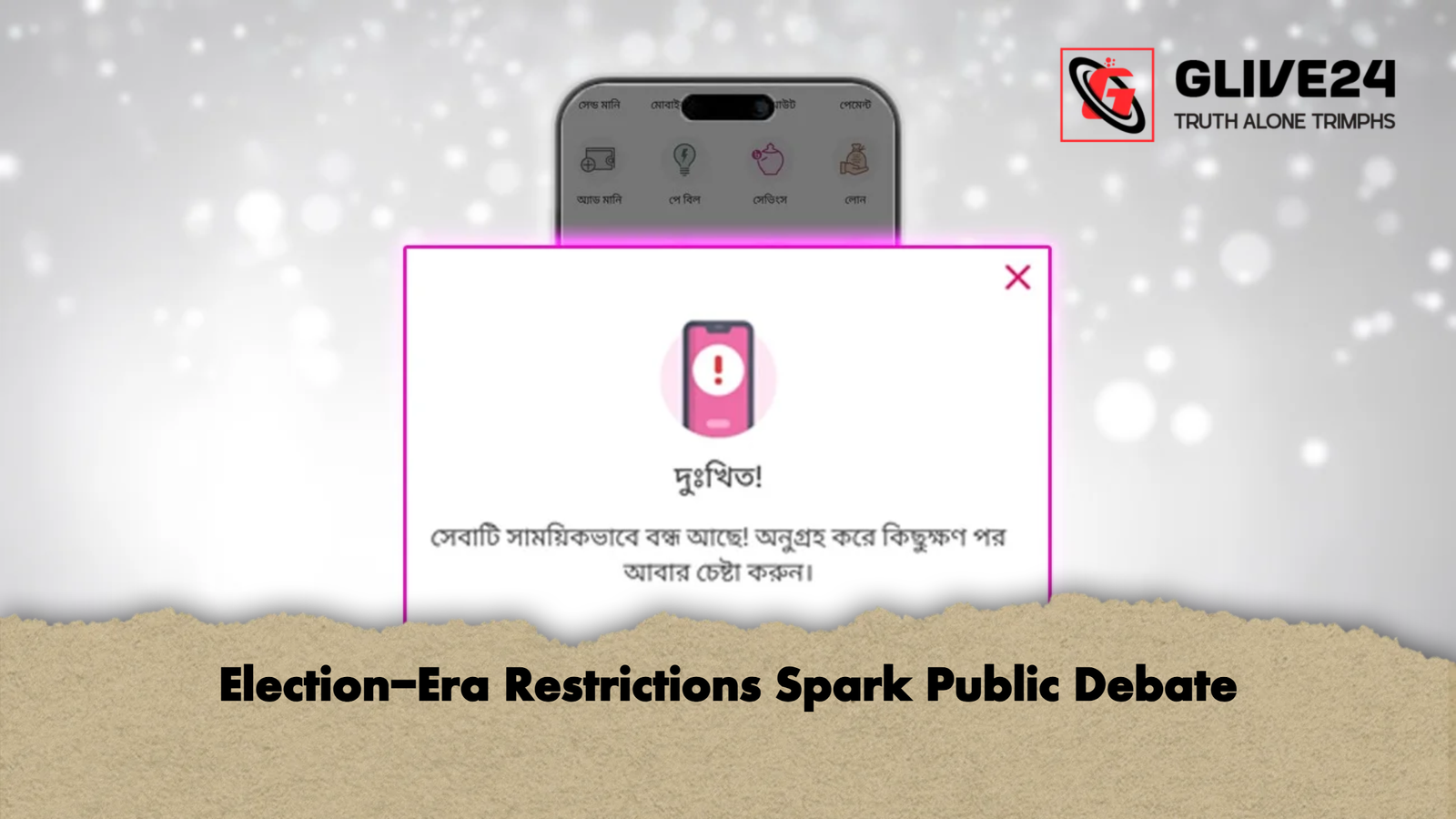
As the country approaches another crucial election, a series of temporary restrictions on financial transactions and transport services has triggered lively debate and criticism across social media and public forums. The measures—introduced in the name of election security—include limits on cash withdrawals through mobile financial services (MFS), tighter controls on certain banking transactions, the suspension of motorcycles and ride-sharing services for specified hours, and restrictions on mobile phone use near polling centres. Critics argue that, taken together, these decisions risk complicating both voters’ mobility and their ability to manage everyday finances during the polling period.
Supporters of the measures point out that similar restrictions are common in many democracies during elections. Election-focused security protocols often aim to prevent the movement of illicit funds, curb vote-buying, and reduce the risk of violence or disorder around polling stations. From this perspective, temporary financial and transport controls are seen as preventative tools designed to safeguard the integrity of the vote and ensure a calm electoral environment.
However, concerns have been raised about the timing and scope of the restrictions. Analysts warn that sudden limits on cash withdrawals or digital transfers may disproportionately affect certain groups of voters. Students, for instance, frequently rely on funds sent by their families through MFS platforms to cover travel costs when returning to their home constituencies to vote. If cash-out services are suspended or capped at short notice, arranging transport and accommodation can become difficult. Similarly, working professionals—particularly those on tight schedules—often depend on ride-sharing services or motorcycles for quick travel across cities. Their suspension may lengthen journeys and discourage timely voter turnout.
Urban residents have voiced additional worries about the ban on mobile phone use within designated distances of polling centres. While the rule is intended to reduce disturbances, misinformation, or unauthorised communications, some voters fear it may hinder emergency contact or coordination, especially for elderly voters or those with special needs.
Election Commission officials typically defend such measures as temporary and necessary. According to them, restrictions are imposed to prevent irregularities, curb the transportation of illegal money, and reinforce security at polling stations. They also emphasise that alternative arrangements—such as increased public transport availability and clear advance notice—are meant to ease public inconvenience. Nevertheless, questions remain about how effective these alternatives will be in practice.
The main restrictions under discussion can be summarised as follows:
| Area | Proposed Restriction | Likely Impact |
|---|---|---|
| Mobile Financial Services (MFS) | Temporary limits on cash withdrawals | Short-term difficulty accessing cash |
| Banking Transactions | Controls on selected transactions | Delays in transferring large sums |
| Transport | Suspension of motorcycles and ride-sharing | Reduced speed and convenience of travel |
| Polling Centre Vicinity | Limits on mobile phone use within a set radius | Improved security but reduced communication |
Observers broadly agree that ensuring election security is essential. Equally, they argue, safeguarding voter convenience and participation is fundamental to a credible democratic process. Many have therefore urged policymakers to strike a more careful balance—combining robust security measures with clear communication, adequate notice, and practical alternatives—so that the right to vote is protected without imposing unnecessary hardship on citizens.