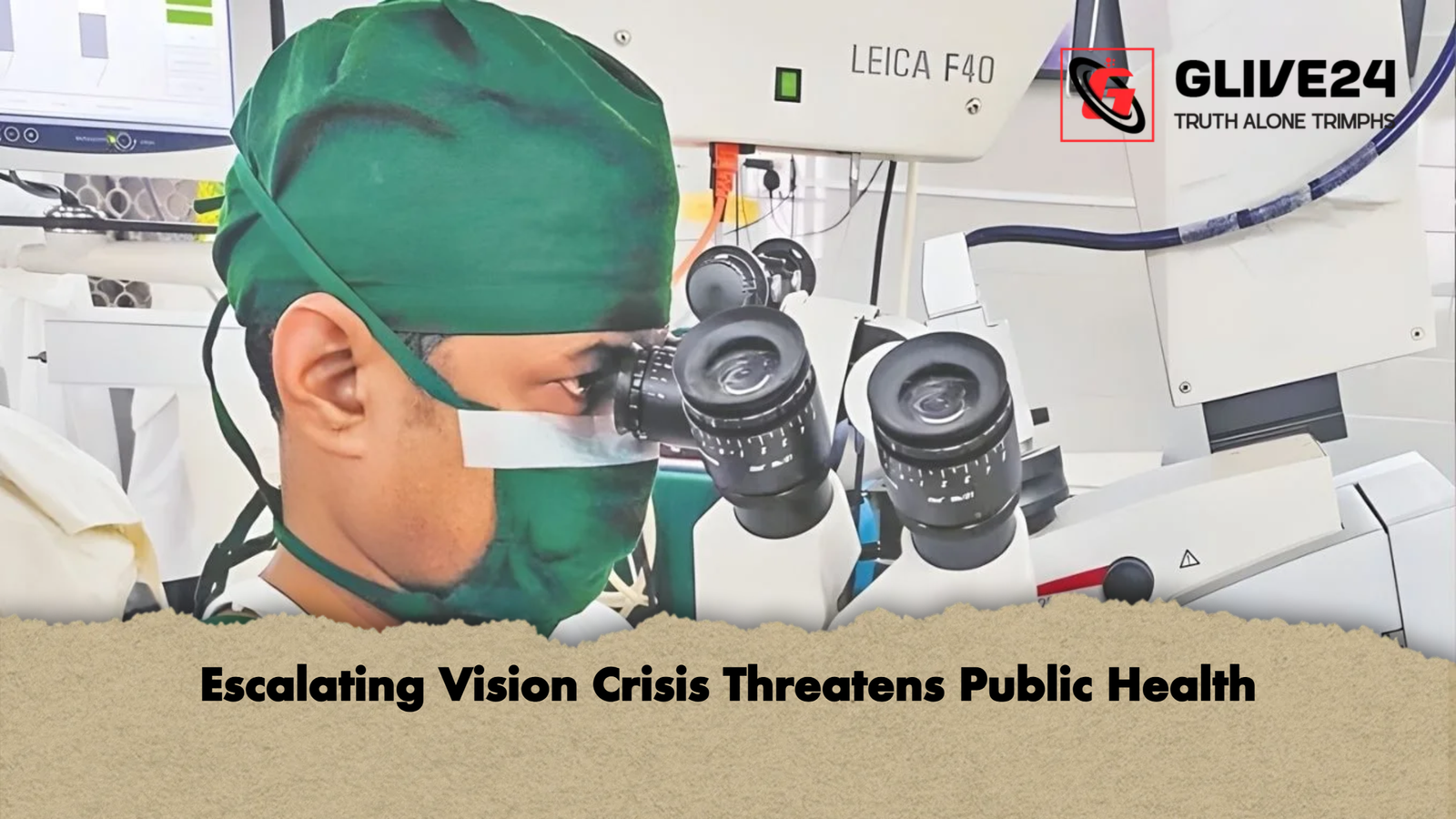
The prevalence of vision-related problems in the country is rising at an alarming rate, emerging as a significant public health challenge. According to the World Health Organization (WHO) and domestic specialists, a substantial portion of these conditions is preventable. Yet, millions of people—particularly in rural and marginalised regions—are deprived of essential eye care due to a severe shortage of ophthalmologists and optometrists. As a result, common refractive errors, cataracts, glaucoma, and diabetic retinopathy often go undetected until advanced stages, significantly increasing the risk of blindness.
Latest data from the Directorate General of Health Services (DGHS) indicates that the nation has roughly one ophthalmologist for every 200,000 people. Ophthalmologists diagnose and treat eye diseases and perform surgical procedures, but the majority operate in the capital or divisional cities, leaving rural areas underserved.
Optometrists, or vision specialists, play a critical role in providing primary eye care, prescribing corrective lenses, conducting school-based vision screening, and identifying complex eye conditions. Presently, Bangladesh has only 200 registered optometrists, far below international standards, which recommend four optometrists per ophthalmologist—equivalent to a national requirement of at least 4,800 professionals.
| Profession | Current Number | Required Number | Shortfall / Distribution |
|---|---|---|---|
| Ophthalmologist | ~600 | Adequate but urban-centric | Mostly based in cities |
| Optometrist | 200 | 4,800 | 4,600 shortage, especially rural areas |
Currently, optometrist training programmes are offered exclusively at the Chittagong Institute of Community Ophthalmology (affiliated with Chittagong Medical University) and the Ittehad College & Syk College of Health Sciences (affiliated with Rajshahi Medical University). This limited capacity is insufficient to meet nationwide demand.
Syed Mohammad Didarul Alam, Chairman of the Optometrist Society of Bangladesh, emphasised: “Deploying more optometrists in peripheral regions could significantly reduce preventable blindness. Ideally, there should be at least one optometrist per 100,000 population.”
The WHO recognises optometrists as essential service providers. Experts advocate for their recruitment at upazila and union levels, establishment of optometry corners in community clinics, and expansion of school-based eye screening programmes. Timely and decisive action from policymakers could dramatically improve ocular health for underserved populations and lower the incidence of avoidable blindness.
Dr. Khair Ahmed Chowdhury, Additional Director General of DGHS and a leading ophthalmologist, stated: “The government’s initiative to introduce new optometrist courses is commendable. However, proper regulation and oversight are crucial. An integrated system, as seen in other countries, would be highly effective in Bangladesh.”