
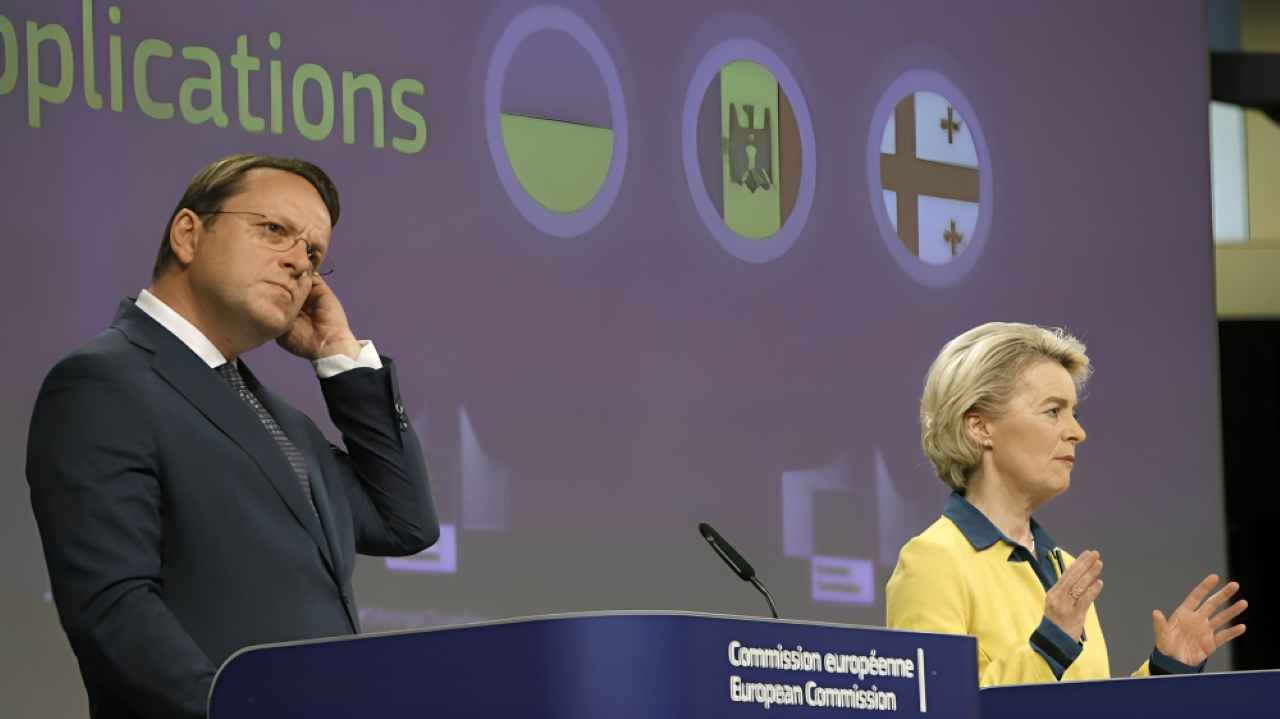
The European Union has delivered a powerful political signal of solidarity with Ukraine by formally backing Kyiv’s bid for EU candidate status, even as Russia intensifies economic pressure on Europe by sharply reducing gas supplies. The move underscores the growing geopolitical divide created by Moscow’s invasion of Ukraine and Europe’s determination to support the country’s long-term European aspirations.
On Friday, the European Commission recommended that Ukraine be granted EU candidate status, clearing the way for a final decision by the bloc’s 27 leaders at their summit in Brussels on 23–24 June. All member states must agree unanimously, but the proposal has already received strong backing from key EU powers, including France, Germany and Italy. Their leaders demonstrated visible support earlier in the week during a joint visit to war-scarred areas near Kyiv.
European Commission President Ursula von der Leyen emphasised the symbolic and practical importance of the decision, stating that Ukrainians had shown extraordinary commitment to European values. “We all know that Ukrainians are ready to die for the European perspective. We want them to live with us for the European dream,” she said.
Ukrainian President Volodymyr Zelensky welcomed the Commission’s recommendation as a historic milestone, describing it as a crucial first step on a path that would strengthen Ukraine politically and morally during the war. He expressed confidence that EU leaders would endorse the decision at the upcoming summit.
Russia’s reaction was notably restrained in tone. President Vladimir Putin said Moscow had “nothing against” Ukraine joining the EU, describing it as a sovereign economic choice, though he repeated his claim that membership could turn Ukraine into a “semi-colony” of the West. Russian officials, however, accused Brussels of manipulating Kyiv with promises of integration.
As political support for Ukraine grew, Russia escalated pressure on Europe by cutting gas flows through key pipelines. Several EU states reported major reductions, pushing energy prices higher and exacerbating inflation across the continent. Germany and Italy, both heavily dependent on Russian gas, rejected Moscow’s explanation that technical issues were to blame, arguing the move was politically motivated.
Meanwhile, fighting continued to rage in eastern Ukraine, particularly around Severodonetsk in the Donbas region. Ukrainian officials reported mounting civilian casualties and severe humanitarian conditions, with hundreds of civilians trapped in industrial facilities under constant shelling.
Once accepted as a candidate country, Ukraine will join several Western Balkan states already in the queue for EU membership. However, full accession is expected to take many years and will require extensive political, legal and economic reforms, alongside the outcome of the war itself.
Key Developments at a Glance
| Issue | Details |
|---|---|
| EU decision | European Commission recommends EU candidate status for Ukraine |
| Final approval | EU leaders’ summit, 23–24 June (unanimous vote required) |
| Russian response | Putin says he has “nothing against” EU membership |
| Energy impact | Russia cuts gas supplies to several EU countries |
| Military situation | Heavy fighting continues in eastern Ukraine |
| Membership outlook | Candidate status granted first; full membership may take years |
The EU’s endorsement marks a defining moment in Europe’s relationship with Ukraine, combining symbolism with long-term strategic intent at a time of escalating conflict and economic uncertainty.