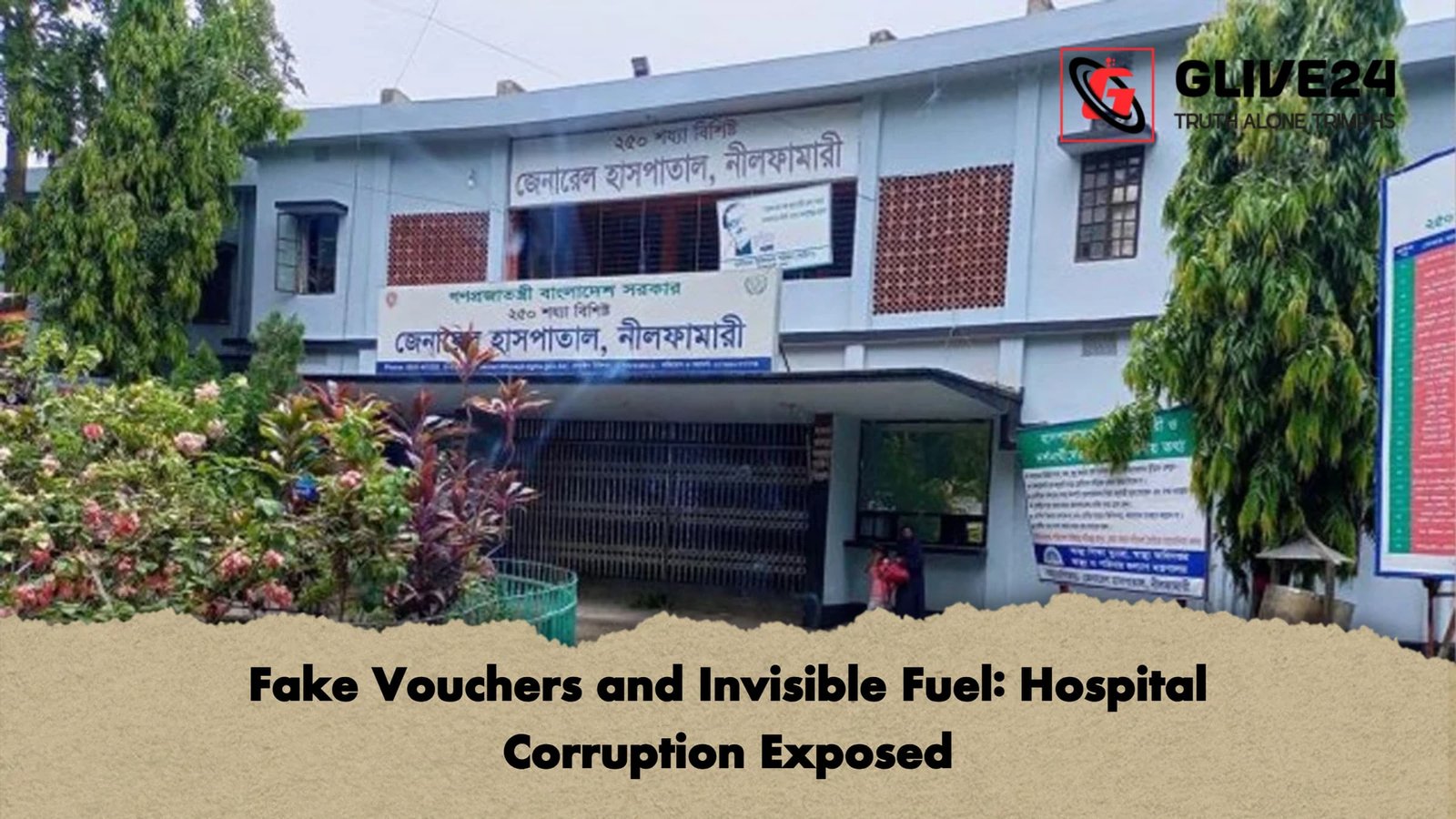
A grave financial crisis has emerged at Nilphamari General Hospital, where allegations of systemic corruption, “invisible” fuel consumption, and predatory kickbacks have reached a projected total of 200 million BDT. The hospital’s Superintendent, Dr Abu Hajjaj, finds himself at the centre of a firestorm, accused by staff and contractors alike of transforming the healthcare facility into a personal fiefdom of embezzlement over the past four years.
Table of Contents
The “Ghost Diesel” Phenomenon
Perhaps the most peculiar allegation involves the hospital’s standby generator. Despite the region experiencing a period of exceptionally stable electricity with almost no load-shedding, the administration reportedly billed the state for 30 lakh BDT worth of diesel fuel. Whistleblowers within the hospital claim the generator was essentially a “silent ornament,” yet its supposed fuel consumption continued to drain the hospital’s budget on paper.
Systematic Extortion of Contractors
The corruption allegedly extended into the very procurement of life-saving medical supplies. Multiple contractors, speaking on the condition of anonymity for fear of professional reprisal, have alleged that a 5% “Audit Commission” was mandatory for all bills processed under the Medical Store Rules (MSR) sector. Without this kickback, payments were reportedly delayed indefinitely.
Summary of Alleged Financial Mismanagement
| Sector of Misconduct | Type of Irregularity | Estimated Impact (BDT) |
| Generator Fuel | Procurement of diesel with no recorded power cuts. | 30 Lakh |
| Transport & Oil | Personal/commercial freight via hospital ambulances. | High Volume |
| MSR Procurement | Mandatory 5% “Audit Fee” for all external bills. | Ongoing |
| Facility Upkeep | Inflated billing for IT, sanitation, and laundry. | Multi-lakh |
| Total Suspected Defalcation | Aggregate losses over a four-year period. | 200 Million (20 Crore) |
Misuse of Emergency Assets
The scandal further deepens with claims regarding the hospital’s fleet. Ambulances—reserved for the transport of critical patients—were reportedly utilised as private couriers to haul commercial goods to and from Rangpur. These unauthorised trips were then allegedly masked by fraudulent logs for “additional oil usage,” further inflating the hospital’s transport expenditure.
A Crisis of Accountability
Staff members have described the administration’s style as “autocratic,” alleging that recruitment for outsourcing roles was riddled with nepotism. Lucrative contracts for hospital linens and beddings (the MSS sector) were reportedly awarded to a small circle of favoured associates rather than through a competitive bidding process.
There is a growing consensus among local advocates and hospital employees that Dr Hajjaj has enjoyed a “shield of protection” from certain influential figures within the Rangpur Health Division, allowing him to remain in his post despite mounting evidence of malpractice.
The local community is now calling for an immediate Special Forensic Audit by the central government. They argue that as long as the accused Superintendent remains in power, any local investigation will be an exercise in futility. Despite several attempts to contact Dr Hajjaj for his response to these multi-million BDT allegations, he has remained unavailable for comment.