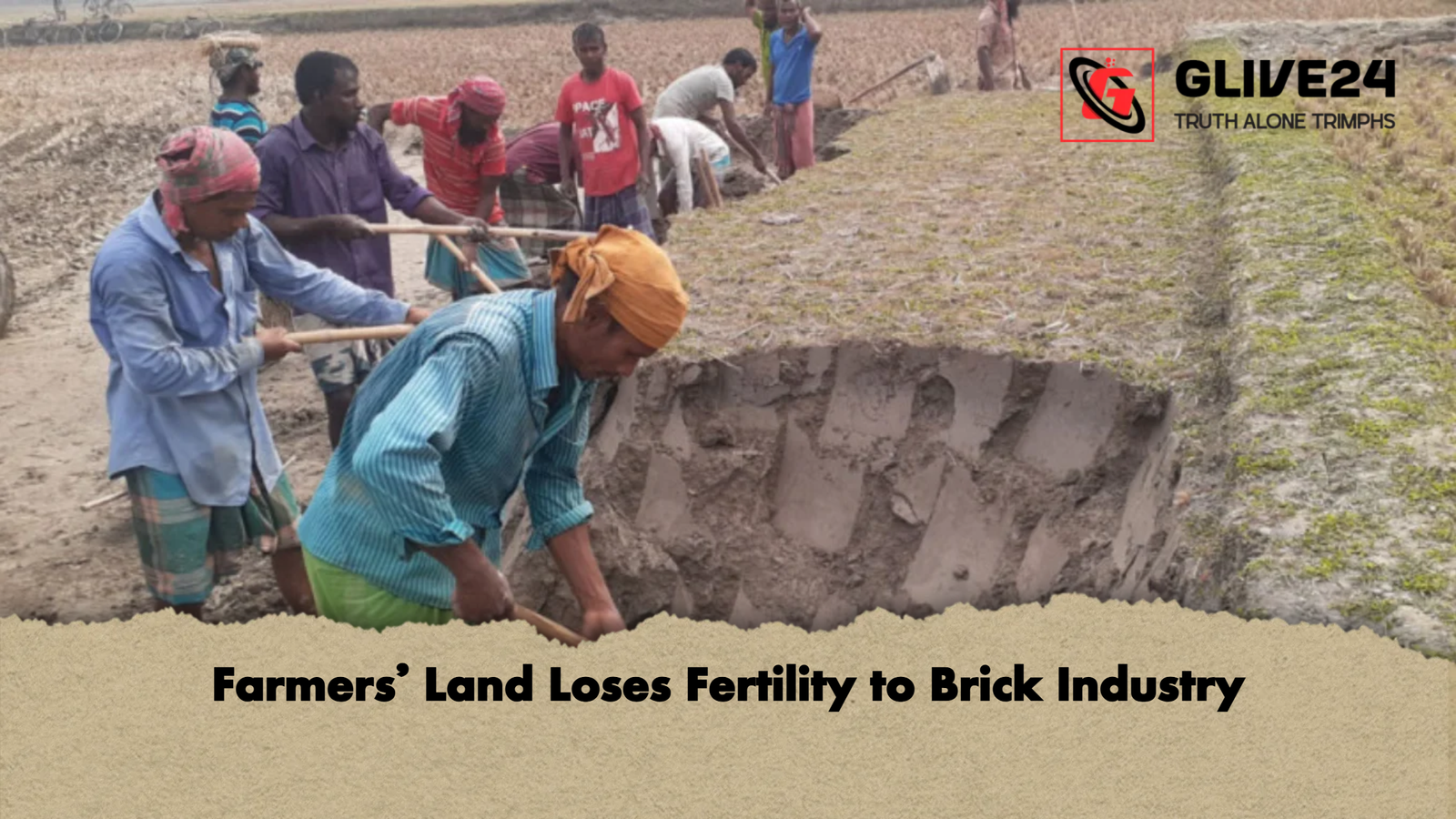
In the northern division of Rangpur, fertile topsoil from agricultural land is being indiscriminately removed and transported to brick kilns, raising serious concerns over future crop productivity. Experts warn that the stripping of this nutrient-rich layer could severely compromise soil fertility and threaten food security in the region.
According to agronomists, the topsoil layer is the most crucial part of agricultural land, containing the highest concentrations of organic matter and beneficial microorganisms. Once removed, it can take over a decade for the soil to naturally regain its fertility.
Data from the Department of Environment indicates that at least 595 brick kilns across four districts—Lalmonirhat, Kurigram, Gaibandha, and Rangpur—are actively using fertile agricultural soil for brick production.
Local authorities have begun enforcement actions: in the past week alone, 12 brick kilns were fined a total of 1.5 million taka for illegally using farmland soil. Operations targeted specific areas including Haatibandha and Patgram in Lalmonirhat, Phulbari, Nageshwari, and Ulipur in Kurigram, Sundarganj in Gaibandha, and Taraganj in Rangpur. Despite repeated crackdowns, officials admit that the supply of topsoil to brick kilns continues unabated.
A technician at a Kurigram brick kiln, Jamal Uddin, explained that producing a single brick requires approximately five kilograms of soil, with topsoil preferred for quality. Each kiln produces an estimated 40–50 million bricks annually, demanding vast quantities of fertile farmland.
Brick kiln owners claim that farmers sell the soil voluntarily. Afzal Hossain, a kiln owner in Haatibandha, stated, “Farmers willingly sell their topsoil at a good price. Without purchasing this soil, our kilns would shut down, halting local development projects.”
However, farmers report coercion rather than choice. A 65-year-old farmer from Durgapur village, Ulipur, Afatab Uddin, said that kiln operators remove topsoil from multiple plots simultaneously, lowering surrounding land and disrupting irrigation and cultivation. Farmers often feel compelled to sell under pressure. Narayan Goswami from Pirgacha noted that one bigha of topsoil sells for 18,000–20,000 taka, but the apparent short-term profit is offset by reduced yields for several years.
Agricultural specialists emphasise the long-term environmental and economic dangers. Dr. Safinur Rahman, senior scientist at the Rangpur Soil Resource Development Institute, said, “Topsoil hosts the densest organic matter and microbes. Once removed, it can take over a decade to restore the land’s fertility.” Sirajul Islam, Additional Director of the Rangpur Agriculture Extension Department, echoed that soil removal is causing widespread negative impacts on crop production.
The Department of Environment has informed local administrations, and enforcement actions with fines continue. Rangpur Divisional Commissioner Shahidul Islam confirmed that district authorities have been instructed to implement strict measures to prevent further topsoil extraction.
Summary of Brick Kilns and Enforcement Actions :
| District | Estimated Brick Kilns | Kilns Fined Recently | Total Fine (Taka) |
|---|---|---|---|
| Lalmonirhat | 150+ | 3 | 3,00,000 |
| Kurigram | 200+ | 4 | 5,00,000 |
| Gaibandha | 120+ | 2 | 2,00,000 |
| Rangpur | 125+ | 3 | 5,00,000 |
| Total | 595+ | 12 | 15,00,000 |